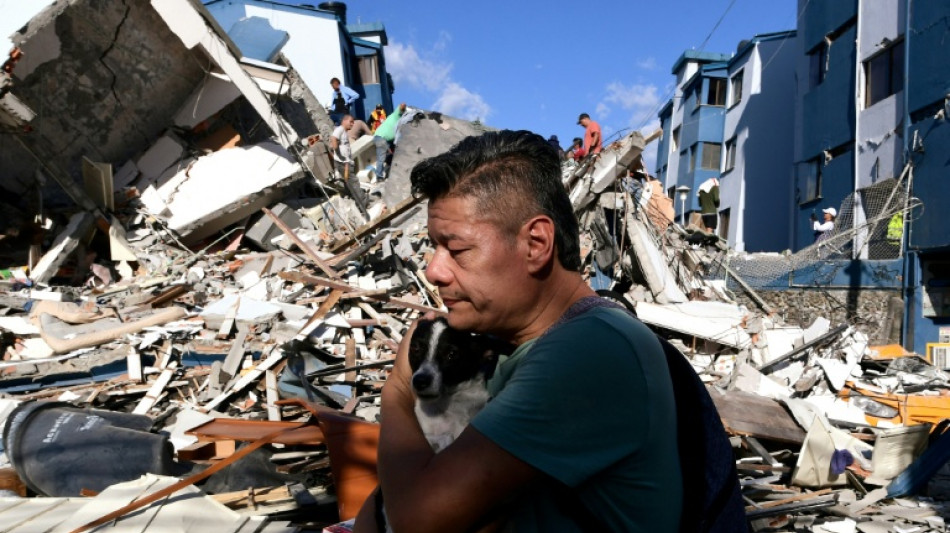
Colombia scrambles to find survivors as quake kills 169 / Photo: Jaime SALDARRIAGA - AFP

 Zach Hickerson Recounts Hayden Panettiere's Final Moments in New Interview

 Luxembourg Housing Petition Passes Threshold for Parliamentary Consideration

 Raheem Sterling Receives Suspended Sentence After Lamborghini Crash

 Audience to Choose the Set List at Luxembourg's First FAMIL Jukebox Night

 Luxembourg Pay Rise Delayed as Regional and World Headlines Develop

 Chennai Urbanist Sashna Develops 'Anniki' Card Game to Gamify Tamil Nadu History

 Transport Minister Defends Land Seizure Powers for Toronto-Quebec City High-Speed Rail

 UAE Weather Forecast: Scattered Showers and Fog Expected as Temperatures Drop
Colombian volunteers and rescuers cleared rubble with their bare hands to search for survivors early Tuesday after the country's strongest earthquake in a decade killed at least 169 people and smashed dozens of buildings.
The 7.4-magnitude quake struck cities across Colombia's western region shortly after 7:30 am (1230 GMT) on Monday, sending panicked residents onto the streets, AFP journalists saw.
The quake killed 169 people and injured more than 600, according to an association of Colombian city mayors. The deaths were concentrated in Cali, Pereira, Manizales, and Quibdo. The mayors also reported that 165 buildings collapsed.
Colombian President Abelardo de la Espriella -- just three days after being sworn into the job -- declared a state of emergency and vowed a concerted rescue effort.
The city of Pereira, which was among those hit hardest, was mostly plunged into darkness amid power outages on Monday night as volunteers probed for signs of life under collapsed buildings.
"We're without power. This seems honestly like a zombie city," resident Juan David Gaitan told AFP.
Tattoo artist Andres Hernandez said he was worried about his family and friends, adding that he would stay awake because structures around him were "on the verge of collapsing."
Hernandez recalled being asleep at home when the quake happened and rushing into the street for safety, as the quake devastated the city in the heart of Colombia's coffee-growing region.
"It was a movie scene, because I saw the poles, the cables, everything moving. I'm worried about my family, my friends," he said.
There were scenes of destruction in several cities, with furniture and fabrics sandwiched between concrete walls, floors tossed into irregular angles, and cabling strewn across roads.
In Manizales, the quake crumpled a tower of the city's beloved neo-Gothic cathedral.
In Quibdo, the capital of Colombia's Choco department, local official Jenny Rivas said public services and communications "have been virtually shut down."
"People ran out naked, people jumped from the second floor of their homes," Quibdo resident and law student Wilmer Cuesta recalled.
Dentist Julian Pena said he "ran outside carrying nothing" after feeling strong tremors and found hundreds doing the same.
"People were praying in the street. It was overwhelming," he told AFP.
"There are many buildings with gaps, with cracks. There are others that have completely collapsed."
- Overnight searches -
The quake was felt across Colombia, including the capital Bogota, where crowds rushed out into the street in their pajamas.
At a depth of 110 kilometers (68 miles), the quake was also felt in neighboring Ecuador and Panama.
Experts at the US Geological Survey said the quake was likely caused by movement along a deep fault within the Nazca tectonic plate.
Hospitals in five Colombian cities were put on red alert Monday and a nighttime curfew was declared in Cali, according to local authorities.
At least six local airports suspended operations, the civil aeronautics agency said.
Colombian pop megastar Shakira led the calls for unity.
"All my strength and love to my homeland. Let's hold each other tight," she said.
In Cali, Colombia's third-largest city, volunteers quickly went to work with picks, basic tools and their hands to try to find survivors.
"Getting here was unbelievable. It felt like the end of the world -- cars and motorcycles driving the wrong way, everyone searching for their loved ones," said volunteer rescue worker Nelson Moreno.
"What we need now are flashlights and goggles" to keep working through the night, he said.
Rescuers formed human chains to remove bricks and masonry, stopping every few minutes to listen for signs of life from those trapped below.
"We are trying to get everyone out alive," said Andres Felipe Mejia, another volunteer.
"A lot of people have come, with supplies, with food, helping the firefighters, helping the people," he said.
- International support -
The devastation comes less than two months after powerful twin quakes rattled neighboring Venezuela, killing over 6,300 people and leaving tens of thousands homeless.
Messages of support came in from countries across the region and the world.
Pope Leo XIV is "deeply saddened" and "raises his prayers to the Lord for the prompt recovery of those affected by this tragedy," the Vatican said Tuesday.
Secretary of State Marco Rubio said Monday the United States was "closely monitoring" the situation and "stands ready to support the people of Colombia."
The US announced $15.5 million in emergency relief.
European Union chief Ursula von der Leyen said the EU had mobilized Copernicus, a satellite service, to help with rescue operations.
Israel, Mexico, Ecuador and France also offered assistance.
S.Jackson--AT


