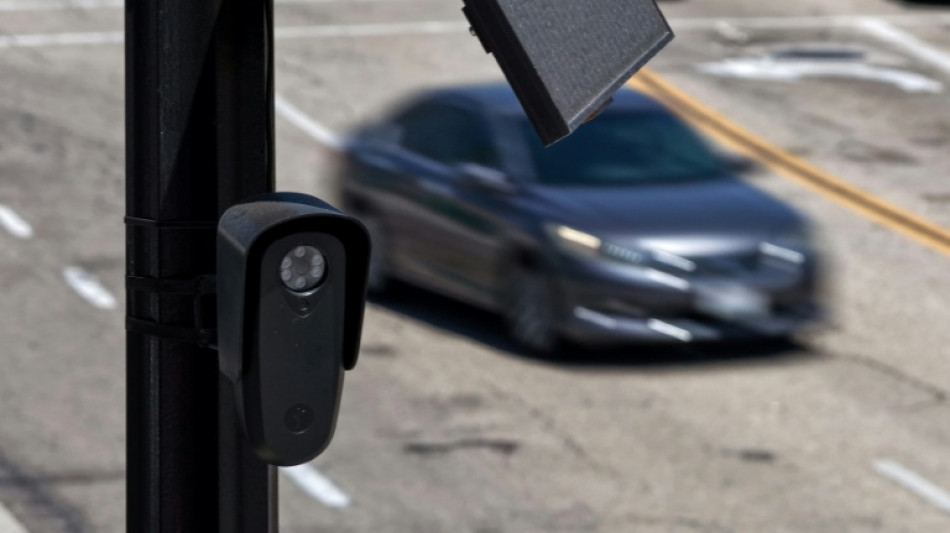
Angers mounts in US over vast network of car license plate cams / Photo: JUSTIN SULLIVAN - GETTY IMAGES NORTH AMERICA/AFP/File

 Messi says Argentina retirement is 'saddest day of my career'
 Oil rises and stocks fall as Hormuz worries flare

 Pacific presses world for help 'surviving' climate change at pre-COP summit

 Verstappen revival to be put to the test in steamy Singapore
 US woman who survived botched execution is conscious, speaking: lawyers

 Climate champion Australia digging more coal
 Emotion, tears as Messi retires from Argentina national team
 Dodgers push Braves to the brink of MLB playoff exit
 Crisis-stricken Haiti postpones elections
 N. Korea's Kim pledges 'invariable support' in Putin birthday letter

 OGRD Alliance Advances PLPC Multi-Asset Platform Following APHELAR Milestone, Expanding Licensing and Strategic Capital Frameworks

 Emotion, tears as Messi prepares for Argentina farewell
 Kane eyes Ronaldo record after matching England cap mark

 Spain fight back to beat Croatia, Kane adds to record for England

 Merino double helps Spain beat Croatia, reach Nations League quarters

 US stocks hit fresh records as oil stabilizes on rising supplies
 As Messi bows out, Argentines say 'thank you'

 Ronaldo opens door for Portugal return, apologises for walkout
 'Nobody seems to care': Russian city shrugs off plague reports
 Hundreds arrested in French school protests as Macron summons ministers

 WADA seeks tough anti-doping stance from Kenya

 German ex-spy chief arrested for suspected espionage, treason

 Furyk vows US will 'do more' to end Ryder Cup losing streak

 Iyer hits ton as India hammer West Indies in T20 opener

 Mandhana named India women's team captain after Kaur quits
In only a few years, the surveillance start-up Flock has installed more than 100,000 license plate reader cameras across the United States.
But a grassroots movement upset over privacy concerns is fighting back -- even going so far as systematically vandalizing the equipment.
The first time he decided to trash one of the cameras, a self-styled vigilante wearing all black and known as Nomark says he was "super nervous."
Now, after disabling about 30 of the devices near his home in the Minneapolis area, he told AFP: "I'm not really as scared anymore."
Flock cameras are installed by police departments, homeowners' associations and businesses, ostensibly to catch criminals in the act. Data is uploaded to Flock's cloud and can be shared with subscribers.
But opponents are outraged at what they say is a dangerous tool that can be used to infringe on American privacy and civil liberties.
At just 20 years old, Nomark offers his 500,000 Instagram followers a how-to guide for rendering the cameras useless, raising awareness about the devices.
His detractors point out -- correctly -- that his actions are illegal, but like-minded individuals have followed suit nationwide over the past few weeks.
Instead of being dismissed as a radical fringe outfit, the anti-Flock movement is taking hold.
Its proponents have been active online for months, creating crowdsourced maps of cameras, sharing ways to block their lenses, and hailing the "heroes" who are arrested for destroying them.
The Facebook group DeFlock America has more than 600,000 members, and is gaining thousands more by the day.
- Massive database -
Flock cameras differ from traditional surveillance cameras in that they do not record video footage.
Instead they take still images of vehicles, capturing the make, model, color, license plate data and other distinguishing features such as bumper stickers.
And unlike classic surveillance cameras, which are not networked, this data is stored for up to a month and shareable, sometimes across state lines.
Opponents say this gives police an overwhelming look into the private lives of law-abiding Americans.
Jon Bridges, a police official in Virginia's state capital Richmond, says that for "practically any crime that has a connection with a vehicle or a vehicle involved, we will at least query the database to see if there's anything there."
His department has used Flock since 2023.
Bridges gave an example of how useful the technology can be: during the investigation of a domestic-related double homicide in May, police quickly identified a suspect who fled the scene in his pick-up truck.
Detectives retrieved his license plate data and entered an alert in Flock's system. When he appeared on another camera, officers in a neighboring county arrested him.
- Potential abuses -
Detractors fear that this allows officers to track vehicles without warrants, opening the door to a host of possible abuses of power.
According to an investigation done by The Washington Post, at least 50 police officers have been accused of misusing the Flock system, most of them to spy on the comings and goings of their romantic partners or exes.
In other cases reported in US media, cops used Flock to track women who had abortions -- illegal in several US states. Some illegally sent data from the system to immigration agents.
Flock CEO Garrett Langley has accused some opponents of being "terrorists," stoking the fire.
"There is really an incredible grassroots movement against Flock," said Chad Marlow, senior policy counsel for the American Civil Liberties Union, calling its growth "stunning."
The movement has support on both the political left and right, notably from libertarians.
Former Fox News host and conservative heavyweight Tucker Carlson has called the vandals "decent, patriotic Americans" who are simply "taking matters into their own hands."
Across the country, local groups are pushing their lawmakers to step back from Flock.
Steven Keener, a professor of criminology at Christopher Newport University in Virginia, said residents can meet with city council members or mayors to convince them to cancel their contracts with the surveillance company.
So far, such grassroots efforts are proving successful.
From Los Angeles to small towns in Virginia, more than 70 municipalities have ended their association with Flock in recent months, according to an ACLU tally.
For Keener, the movement stands out in a country riven by political divisions.
'Because decisions are at the local level, people realize that they can actually make a difference," he told AFP.
E.Hall--AT