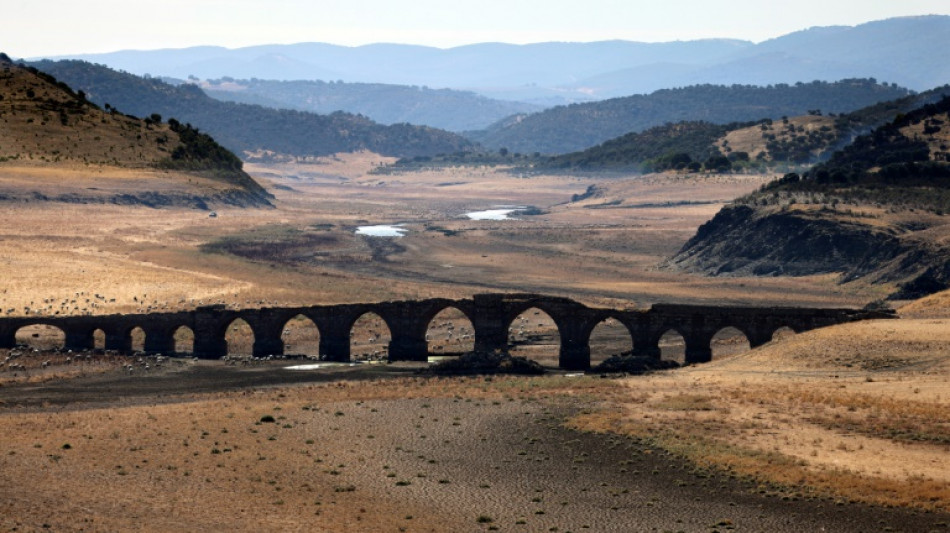
Severe drought in Spain uncovers submerged monuments / Photo: THOMAS COEX - AFP

 Trump envoys arrive in Kyiv for first Ukraine visit

 Indonesia's main airport suspends operations after volcanic eruption

 US aircraft carrier departs Thailand after port call

 Haze emergency grips Malaysian Borneo town

 Messi creates both Miami goals in 2-2 draw with Atlanta

 Rybakina books US Open fourth-round berth, inches closer to No. 1

 Sobering reality: Curbs on alcohol in northeast Syria cause discontent

 Wobbly Osaka 'shocked' to battle past Mertens and reach last 16

 Indian Oscar-nominated filmmaker turns camera on his cancer

 Argentina 'let off hook' by Australia as Kiss's winning run ends

 Argentina threatens to sanction oil projects around Falklands

 Gauff into round four at US Open after straight-set win

 Bordeaux hammer Racing in Top 14 start as Bielle-Biarrey extends deal

 Zheng, Potapova pull off upsets to reach US Open last 16

 Swiatek into US Open fourth round in tight two-setter

 Werro wins in Brussels, as Russell and Dos Santos shine

 Kolbe breaks jaw and shoulder injury sidelines Savea

 US military strikes oil tankers as Iran vows tougher reprisals

 Zheng rallies to stun Keys, Anisimova out in US Open third round

 Bayern held to draw by stubborn Schalke

 Lens lose again ahead of Champions League date

 Olympic champion Zheng storms home to reach US Open last 16

 Big-spending Spurs must make better attacking decisions, says De Zerbi

 South Africa dominate New Zealand in second half to lead series

 Kiefer Sutherland still in action, but ibuprofen lending helping hand

A centuries-old church and a huge megalithic complex are among the underwater monuments that have resurfaced in Spain as a severe drought causes water levels in reservoirs to plunge.
After a prolonged dry spell, Spain's reservoirs -- which supply water for cities and farms -- are at just under 36 percent capacity, according to environment ministry figures for August.
The receding waters have exposed the ruins of an 11th-century church in the usually submerged village of Sant Roma de Sau, which was flooded in the 1960s when a nearby dam was built.
Normally, the church's bell tower is the only visible sign of the village in the northeastern region of Catalonia.
Drawn by pictures on social media and television reports, crowds of tourists fill the restaurants in the nearby village of Vilanova de Sau.
"It has been years since (water levels) are as low as they are now," said 45-year-old Nuria Ferrerons during a recent visit to the site.
"We saw it on social media and we said 'well let's see how it is'," she added.
Two tourists on a canoe paddled through an arch of the church, which is fenced off to prevent people from getting too close due to the risk the ruins could collapse.
"Normally you can only see the bell tower," said Sergi Riera, who came to see "something that has not been visible for years".
In Spain's western Extremadura region, the receding waters of the Valdecanas reservoir have revealed a prehistoric stone circle on an islet that is normally underwater.
Dubbed the "Spanish Stonehenge", the circle of dozens of megalithic stones was discovered by archaeologists in 1926 but the area was flooded in 1963 when the reservoir was built.
The stones are also drawing tourists, who reach the islet on boats operated by several private firms.
Officially known as the Dolmen of Guadalperal, the site is believed to date back to 5000 BC.
"People leave delighted," said Ruben Argenta, who owns a firm offering guided tours of the stones.
Manuel Mantilla, a sixty-year-old from the southern city of Cordoba, was visiting with his wife after hearing about the site through the media.
"We saw that as a unique opportunity," he said.
Climate change has left parts of Spain at their driest in more than 1,000 years, and winter rains are expected to diminish further, a study published in July by the Nature Geoscience journal showed.
A.O.Scott--AT