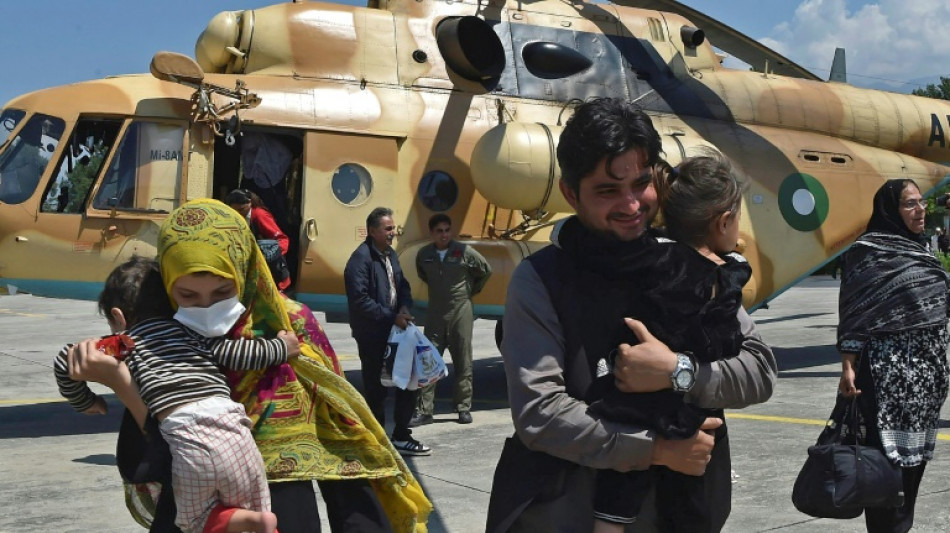
'Second life': helicopters rescue the stranded from Pakistan valleys / Photo: Abdul MAJEED - AFP

 Zach Hickerson Recounts Hayden Panettiere's Final Moments in New Interview

 Luxembourg Housing Petition Passes Threshold for Parliamentary Consideration

 Raheem Sterling Receives Suspended Sentence After Lamborghini Crash

 Audience to Choose the Set List at Luxembourg's First FAMIL Jukebox Night

 Luxembourg Pay Rise Delayed as Regional and World Headlines Develop

 Chennai Urbanist Sashna Develops 'Anniki' Card Game to Gamify Tamil Nadu History

 Transport Minister Defends Land Seizure Powers for Toronto-Quebec City High-Speed Rail

 UAE Weather Forecast: Scattered Showers and Fog Expected as Temperatures Drop
Up to 200,000 people are stranded in remote Pakistan valleys after the unrelenting floods of the past week -- with helicopters the only way of reaching them.
Unprecedented rain in the Swat Valley turned rivers into raging torrents that washed away roads and bridges, cutting off tourists and residents from nearby towns, even as the water receded.
Army and government helicopter missions have rescued hundreds of panicked tourists and locals -- some urgently needing medical help.
"It feels like I have got a second life," said tourist Yasmin Akram, a diabetic who was airlifted to Saidu Sharif's airfield from the Kalam valley with her 12-year-old daughter and husband.
The traffic police officer watched in despair as the hotel they fled in the middle of the night was swallowed by the Swat river, taking with it a young boy.
"I witnessed this all with my own eyes," she said. "Since then I haven't slept."
Her husband, dazed from exhaustion, said he ran out of medication for his kidney condition after Kalam was cut off.
"When I arrived here it was like being given a new life," said Muhammad Akram, an official with the Punjab government.
Their two adult sons were left behind, with priority given to the sick, women and children.
The stunning Swat Valley, known locally as the "Pakistani Switzerland", is a popular tourist spot because of its majestic mountains, lakes and rivers.
The deeply conservative area came to notoriety in the mid-2000s, when it saw the rise of a powerful local chapter of the Pakistani Taliban.
In 2012, following a military operation to displace the Taliban, then-schoolgirl Malala Yousafzai -- now a Nobel peace laureate -- was shot and left for dead by militants in Swat's main town, Mingora.
- 'Challenges are immense' -
Junaid Khan, the deputy commissioner for Swat, told AFP that stricken tourists have made up the majority of evacuations.
Government officials and doctors have been airlifted into the valleys to identify those most in need of rescue.
Locals are willing to stay behind if food and medical supplies are guaranteed, said Khan.
Thousands of food aid packages have already been delivered –- some dropped from the back of a helicopter when crowds of people reaching for the aircraft made it impossible to land.
"We've reached areas that no other organisations and aid groups have been able to," Khan said at Saidu Sharif's airfield, where some of the rescue missions are being coordinated.
Locals are hurrying to create makeshift landing pads for the helicopters –- with the first established on grounds surrounding a mosque in Mankyel.
It could be days before roads leading to the mountains and valleys are repaired.
"The challenges are immense but the hope is very high in this region which has seen the worst of terrorism, militancy, earthquakes and floods," said Khan.
A helicopter supplied by the provincial government's chief minister –- not built for rescue missions -- has helped to pull more than 350 people from villages, carrying up to double the recommended number of passengers.
Army helicopters have collected hundreds more.
N.Mitchell--AT


