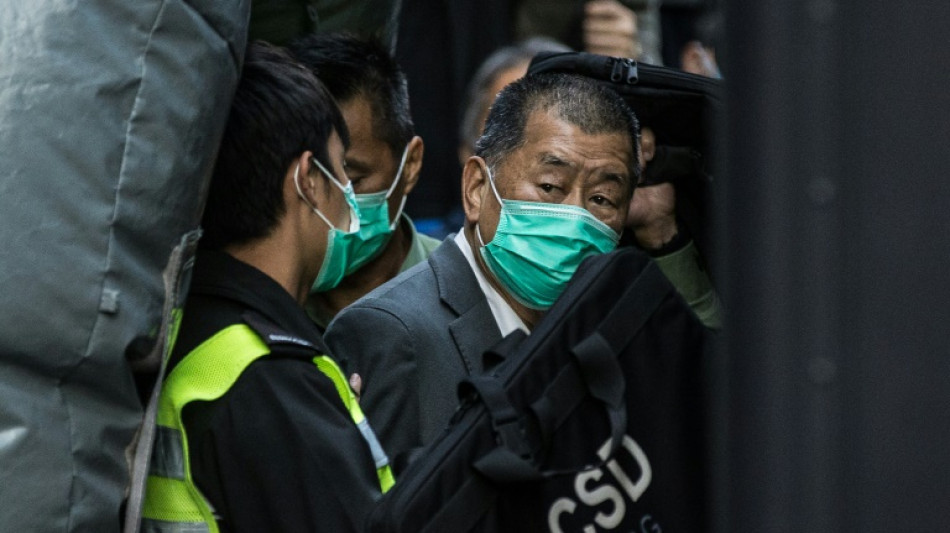
Hong Kong court orders search of media tycoon Jimmy Lai's phones / Photo: STR - AFP

 Zach Hickerson Recounts Hayden Panettiere's Final Moments in New Interview

 Luxembourg Housing Petition Passes Threshold for Parliamentary Consideration

 Raheem Sterling Receives Suspended Sentence After Lamborghini Crash

 Audience to Choose the Set List at Luxembourg's First FAMIL Jukebox Night

 Luxembourg Pay Rise Delayed as Regional and World Headlines Develop

 Chennai Urbanist Sashna Develops 'Anniki' Card Game to Gamify Tamil Nadu History

 Transport Minister Defends Land Seizure Powers for Toronto-Quebec City High-Speed Rail

 UAE Weather Forecast: Scattered Showers and Fog Expected as Temperatures Drop
Two phones owned by jailed pro-democracy media tycoon Jimmy Lai can be searched on national security grounds and are not protected by journalistic privilege, a senior judge ruled Tuesday in Hong Kong.
Lai, owner of the now-shuttered Apple Daily tabloid, will soon go on trial for "collusion with foreign forces", an offence that carries up to life in prison under the sweeping national security law Beijing imposed on Hong Kong two years ago.
Two smartphones were seized when hundreds of police officers arrested Lai and raided the newsroom of Apple Daily, which eventually collapsed after its assets were frozen under the security law
Lai's legal team claimed the content of the phones was covered by journalistic privilege, which is recognised by case law in Hong Kong, as well as legal privilege that protects conversations between lawyers and their clients.
Last month, police applied for a warrant to search the phones under the national security law.
Wilson Chan, one of the High Court judges handpicked by the government to try security cases, on Tuesday ruled that police could search Lai's phones, including journalistic materials. He excluded content covered by legal privilege.
"Press freedom simply does not equate (to) any blanket prohibition against the seizure, production or disclosure of journalistic materials," Chan wrote in his judgement.
Chan ruled the warrant covers all types of materials so long as they contain or are likely to contain evidence of a national security offence, including journalistic materials.
In a day-long judicial review hearing last week, Lai's lead lawyer Philip Dykes warned that the lack of safeguards for journalistic materials would cause a chilling effect.
"Confidential journalistic materials are an essential feature and a cornerstone of a healthy and functioning free press," Dykes told the court.
Dykes, a former chairman of the Hong Kong Bar Association, argued that the national security warrant "abrogated the protection of journalistic materials" under Hong Kong law.
Jenkin Suen, representing the Department of Justice, countered that "journalistic materials cannot by definition form the subject of any order or direction of the court authorising search or requiring disclosure or production."
Hong Kong has tumbled down press freedom rankings since the imposition of the security law, which has begun transforming Hong Kong's legal landscape, including toughening bail requirements and eliminating juries in some cases.
L.Adams--AT


