Deadly Philippines quake turns seabed into shore / Photo: Ferdinandh Cabrera - AFP

 'Aura' battles leap from social media to Latin America streets

 US, Canada fail to reach trade pact to avert Trump tariffs

 Sudan farms lie barren as El Nino leaves Nile banks dry
 Arctic shipping a daunting prospect in hotly contested region
 In US, rare earths extracted from coal mine wastewater

 Nakashima pounds Fritz, Bejlek beats Keys in Cincinnati upsets

 Canadian negotiator says 'more work to do' on US trade deal

 'Solid' Clark takes solo lead at BMW Championship
 Arteta hails Arsenal's desire after perfect start to title defence

 Betis down Real Sociedad in La Liga opener

 Mexican governor resumes job despite US drug charges

 Arsenal rout Coventry to open Premier League season in style

 Giant-killer Bejlek overhauls Keys to reach Cincinnati semi-finals

 Man Utd agree deal for Brighton midfielder Baleba: reports

 Werro wins Lausanne 800m, well off world record pace

 China mulls bid to host 2028 UN climate talks: sources
 Jones becomes third Englishman to join Inter this summer

 Mexican governor wanted on US drug charges returns to job

 Bolivia's Paz forced to fire economy minister in mid-crisis

 A-Rod ups T-Wolves stake in $4.5bn ownership change
 UK court orders Prince Harry, others to pay Daily Mail initial £9.5mn

 'Grateful' ex-world champion Alaphilippe retires from cycling

 US, Canada work to wrap up trade deal ahead of looming deadline

 Malaysia's JDT claim unbeaten run world record

 At least 2 teens seriously wounded in sword attack at Swedish school

Arsenio Butil Jr. fell to his knees and began to pray when last week's deadly 7.8-magnitude earthquake began shaking his home on the coast of the southern Philippines.
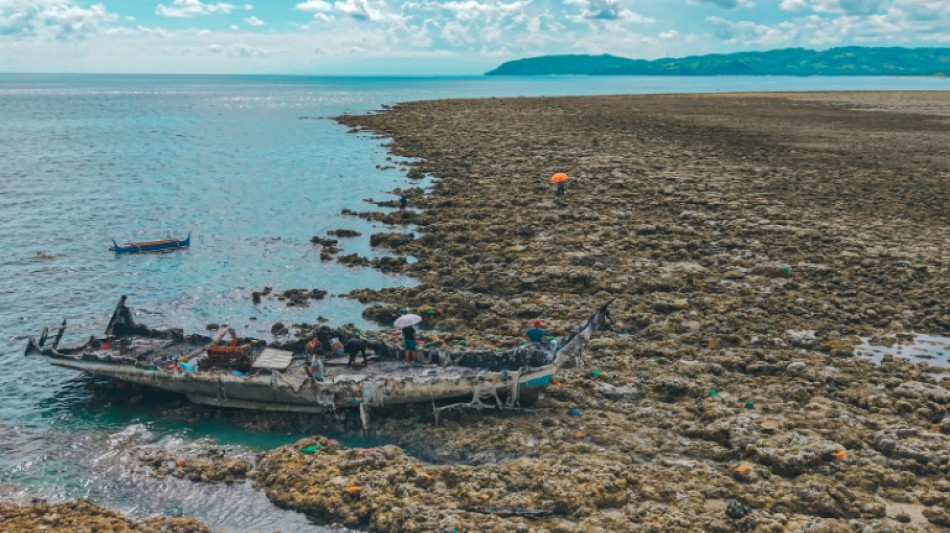
When he opened his eyes, he saw a once-familiar shoreline changing in real time, with swathes of previously submerged coral suddenly pushing above the waterline.
The June 8 quake, driven by a shifting of the nearby Cotabato Trench, toppled buildings, triggered landslides and killed at least 76 people on the southern island of Mindanao.
The tectonic forces at work also thrust chunks of the island's coastline upward in a phenomenon known as "coastal uplift", leaving stretches of shore unrecognisable to families who have spent their whole lives there.
During a visit to the area, AFP saw fishing boats that had once been at the water's edge on the wrong side of a wall of jagged, now-dead coral stretching for kilometres in both directions.
Butil Jr, a fisherman and pastor living in Sarangani province's Glan, told AFP the June 8 quake was the largest that he had ever felt.
"The people were extremely panicked," he said.
"What I saw at the shoreline was that the water receded. After a while, I saw it... slowly returning. And then it receded again. Maybe three or four times," Butil said.
"The fish were dying and floating."
The Cotabato Trench, which lies as close as 50 kilometres off Mindanao, is the site of frequent seismic activity, including a "swarm" of thousands of mostly small tremors recorded in January.
A UN disaster risk reduction report released in mid-May hinted they could be a precursor to a large earthquake.
"What they see now is their new coastline," Nane Danlag of the Philippines' seismology centre told AFP from her office in General Santos City on Friday, adding the change was permanent.
"The (seabed) went up two meters," Danlag said, extending the shore by 200 metres (650 feet) in some areas according to initial assessments.
Pointing at a map, she said the affected area stretched between two towns nearly 100 kilometres (62 miles) apart.
As shocking as the changes to the coastline appeared, the shifting of the earth's crust that created it was a "natural movement", she said.
"This has been going on for thousands of years."
- 'What everyone fears' -
In the hills above a neighbouring village, about 100 men, women and children who fled to higher ground when the earthquake struck were still living in an encampment visited by AFP.
Datu Atom Malimpnig, a Maguindanaon chieftain, said the newly formed coastline had left the group of fishermen and their families hesitant to return to their now-destroyed homes.
Many remain convinced a tsunami could yet strike, he said, as government aid workers ladled rice porridge into bowls for the evacuees.
"(The seabed) rose... It's not the same as it was before," Malimpnig said.
"What if the sea surges forward? That is what everyone fears," he said, adding their new home atop the hill felt far safer.
Ten kilometres away, Edzel Baylon, a staffer at the Isla Jardin del Mar resort, bemoaned a newly changed landscape that spelled trouble for a destination that touted a white sand beach holiday experience.
"It has a huge effect on the resort, because the main draw for customers is the sea," she said, pointing at an idyllic beachfront now separated from the water by exposed coral.
"Sadly, today, our sea has become shallow. It's no longer suitable for swimming."
Since the June 8 quake, more than 8,500 aftershocks have shaken the region, according to the seismology agency.
In Glan, residents were thinking about next steps, but not yet ready to attempt to rebuild their destroyed homes, said Butil Jr, the pastor.
"The ground there is cracked, and the cracks are long. That is why this area would be very dangerous if another earthquake as strong follows," he said.
Minutes later, a 5.4 tremor shook the ground underneath his feet.
W.Morales--AT