Vast areas of coral reef could resist climate change: study / Photo: Tony KARUMBA - AFP

 Pope visits San Marino, before addressing Italian political gathering

 Trump tariffs heap up as Canada tries to curb US reliance

 Australia lose three wickets after skittling Bangladesh for 64

 Bangladesh all out for 64 in 2nd Test after Starc masterclass

 Odyssey effect: stars sell Greece to a new wave of US tourists

 South Korea to send first container ship through Arctic route

 Starc takes 5-11 to leave Bangladesh reeling in 2nd Test

 Injured Rune withdraws from US Open

 Nakashima knocks out Fritz to reach Cincinnati semi-finals

 Ukraine says 'cynical' Russian strike on shopping centre killed 16

 TikTok to pay $400 mn settlement in US children's privacy case

 MLS fines Messi for striking an opponent

 Gouiri double fires Marseille past Strasbourg in Ligue 1 opener

 Mavericks buy out Thompson, now reportedly bound for Heat

 England v Pakistan first Test: Three talking points

 US, Canada push to seal trade deal as deadline nears

 One dead, three wounded after sword attack at Swedish high school

 Ukraine says 'cynical' Russian strike on shopping centre killed 15

 US Supreme Court allows White House ballroom construction for now

 Root hails emerging fast bowlers as England thrash Pakistan

 Brazil's Lula urges tariffs resolution in call with Trump

 Ukraine says 'cynical' Russian strike on shopping centre killed 14

 Heatwave-hit Europe logs over 30,000 excess summer deaths: first figures

 Give LIV Golf 'one more shot,' says DeChambeau

 Duplantis hits the high notes for athletics anthem

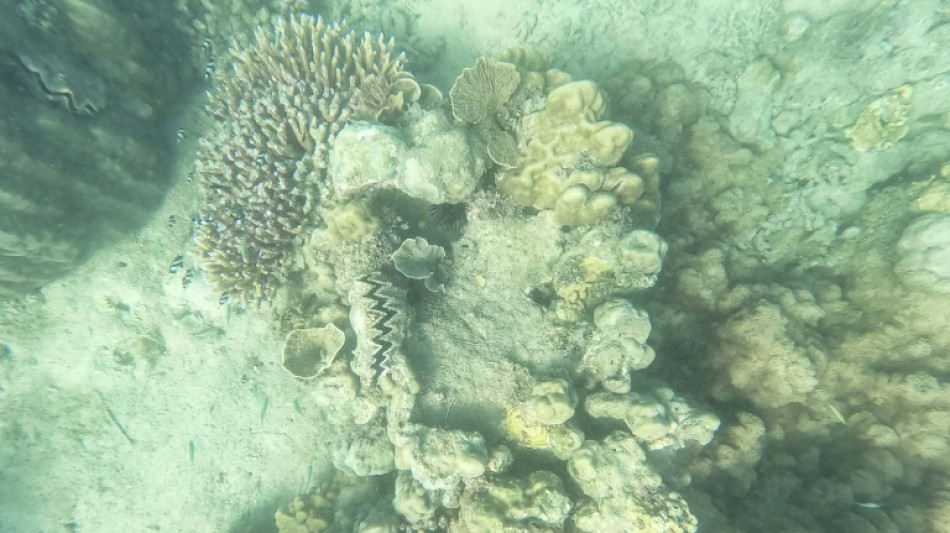
In the crystalline waters off Kenya's coast, coral reefs are thriving -- evidence of a rare good news story in the battle to protect oceans from the ravages of climate change.
A new study presented at the Our Ocean Conference in Mombasa on Tuesday finds that 166,000 square kilometres of the world's coral reefs -- around a third of the total -- are particularly "climate-resilient", meaning they have the potential to survive through major ocean warming events.
The study by the Wildlife Conservation Society (WCS) and Macquarie University in Australia challenges the findings of the IPCC, the global authority on climate change, which has stated 70 to 90 percent of coral reefs could die with global warming of 1.5 degrees above pre-industrial levels, and 99 percent at 2 C.
"Our models are showing a much more hopeful future for corals reefs. We predict that there are many climate resilient reefs around the world that will persist over time," Stacy Jupiter, executive director for marine conservation at WCS, told AFP.
Action is still needed since only 28 percent of those resilient reefs are being actively protected.
Down the coast from Mombasa, on Kenya's paradisical Wasini-Mkwiro island, villagers are showing the way.
As local fishermen bring in their catch from the beach, it is weighed, measured and logged by local data collectors in the village.
Other members of the "beach management unit" patrol the waters to make sure no one is over-fishing or using destructive equipment. Others plant seaweed and mangroves, and scoop out rubbish.
"We want to keep this ecosystem as pristine as possible because we know the benefits," said Edward Karanja, Kenya Wildlife Service warden for the nearby Kisite marine park, citing the importance of tourism and fishing to locals.
Thanks to their efforts, the park became the first in Kenya to earn a Gold-Level Blue Park Award from the US-based Marine Conservation Institute in 2021.
- 'Living seed-banks' -
Coral "bleaching" occurs when water temperatures rise by a degree or two, stressing the coral's animal tissues and making them expel algae, turning them white.
But the new study finds many reefs are resilient, either because they exist in cool spots, or because they have evolved to withstand heat, or recover more quickly than most.
"The way we see coral responding to heat events is more nuanced than we previously thought," said Jupiter.
Kenya is fortunate to have a significant stretch of naturally resilient coral.
Divers off traditional wooden dhows at Wasini-Mkwiro find coral species like the boulder-like Porites and staghorn-shaped Acropora supporting a dazzling ecosystem that includes moray eels, angelfish, crabs, turtles, dolphins, and much more.
The last major bleaching event in 2024 led to coral cover in the zone falling from 44 to 27 percent, according to WCS data. But within a year it had recovered to 40 percent.
The new research, funded by Bloomberg Ocean Initiative and currently under peer review, builds on a pioneering study from 2018 that identified 50 resilient reefs around the world.
New technology makes its map 10,000 times more detailed than any previous version, enabling the discovery of three times more resilient coral than previously known.
More than half are concentrated in Australia, the Bahamas, Cuba, Indonesia and the Philippines.
"These reefs could act as living seed banks for wider ecosystem recovery," said lead author Kyle Zawada, of Macquarie University.
Mass bleaching events are becoming almost annual occurrences. The arrival of a potentially powerful "El Nino" weather system this year could be particularly devastating.
Local communities have little scope to control global warming, said Jesse Kosgei, a WCS marine researcher in Mombasa, but "there are urgent and immediate things that we can control directly", such as preventing destructive fishing or water pollution.
"We have good news about coral reefs, and it's for us now... to make sure that we start conserving these places that are resilient," he added.
Clint Oakley, a coral scientist at Victoria University in Wellington, said the study was "heartening".
But he emphasised it still sees climate change-induced warming as the "greatest threat" and "reducing carbon emissions is still the most important thing if we want to have coral reefs a century from now."
H.Thompson--AT