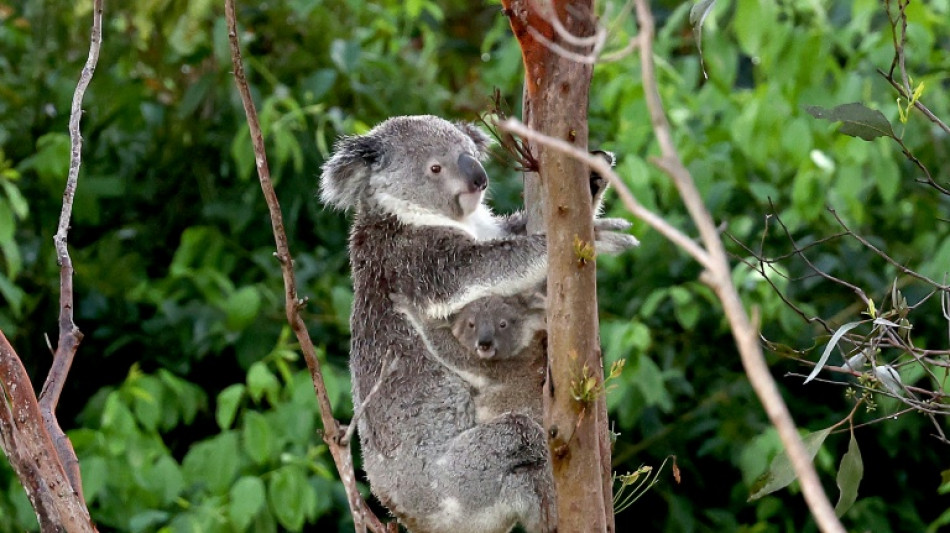
Even moderately hot days raise risk of koala deaths: study / Photo: DAVID GRAY - AFP/File

 Canada's Carney stands up to Trump, despite risks

 Lens hammer Auxerre thanks to Thauvin penalty double

 No singles for Serena, but she joins Alcaraz for US Open

 Joao Pedro extends Chelsea stay with new long-term deal

 Yamaguchi to face An in hunt for fourth badminton world crown

 Norris clinches pole for Dutch GP

 Norris clinches pole for Dutch Grand Prix

 Pope Leo calls for courage in Rimini visit after stop in tiny San Marino

 Man Utd must learn from 'frustrating' defeat at Hull: Carrick

 Yamaguchi on course for fourth badminton world crown

 Man Utd humiliated by Hull in dismal start to Premier League season

 Anthropic market debut could break SpaceX IPO record: media

 Pope's 'couturier of the sacred' fueled by faith
 Duplantis locked in on 'grinding' for big bars

 Stokes says decision to leave Headingley off Ashes roster 'shambolic'

 New arrival Rodri to miss Elche opener: Barca's Flick

 Atletico's Alvarez to return against Villarreal: Simeone

 Dozens of civilians killed, kidnapped as jihadists clash in Nigeria

 Former envoys urge joint French, UK action on Palestinian territories

 Australia lead by 101 in 2nd Bangladesh Test as 18 wickets fall on day one

 'Aura' battles leap from social media to Latin America streets

 US, Canada fail to reach trade pact to avert Trump tariffs

 Sudan farms lie barren as El Nino leaves Nile banks dry
 Arctic shipping a daunting prospect in hotly contested region
 In US, rare earths extracted from coal mine wastewater

Koalas can endure tough conditions in the Australian bush but prolonged exposure to even moderately hot weather can increase their risk of heat-related death, researchers said on Wednesday.
The findings, based on more than 20 years of data of koala rescues, underscore the threat facing not just humans but wildlife as climate change makes heatwaves more frequent and intense.
Researchers found the odds of adult koalas being admitted into care or dying in the Australian state of New South Wales rose when average maximum temperatures over a seven-day period reached 27C.
At 30C or above, those risks "were between 1.5 and 3.5 times higher compared to conditions around 25C", said Valentina Mella, lead author of the study published in Biology Letters.
"Our findings suggest that even what might seem like moderate heat can become physiologically stressful when it is sustained over time," Mella, from the University of Sydney, told AFP.
On hotter days, koalas regulate body temperature by hugging trees to dissipate heat or seeking out denser foliage and lower trees away from direct sunlight.
The herbivorous marsupial can also reabsorb water from the colon and produce more concentrated urine to preserve hydration, or allow its body temperature to fluctuate with the environment in a process known as heterothermy.
But while they can survive conditions above 40C for a limited time, even prolonged exposure at much lower temperatures "appears to significantly compromise their health and survival", Mella said.
- Sedentary and vulnerable -
Researchers adapted a technique widely used to study heat and human health to establish the first "statistically validated association between ambient temperature and koala mortality", the study said.
They analysed nearly 12,000 records of koala admissions and mortality available from rescue organisations and koala hospitals in NSW between 2000 and 2022.
The findings support the evidence that rising temperatures and climate-driven heatwaves are a key threat to wildlife health and survival.
Temperatures once rare are becoming more common, particularly during summer, Mella said, meaning koalas "are likely to experience heat stress conditions more regularly and over longer periods each year".
Koalas remain particularly vulnerable to climate change, even while some other wildlife adapt by switching diets or shifting habitats.
A largely sedentary and inflexible creature, dependent on eucalyptus leaves for much of their water, koalas quickly develop dehydration when hotter conditions persist.
But habitat fragmentation can also prevent them from reaching cooler areas in hotter times, said Mella.
Those with chlamydiosis -- a major disease affecting koalas -- were at greater risk, suggesting heat stress may compound the effects of this condition.
The increasing frequency and intensity of hot days in Australia pose a "significant threat" to endangered inland northwest koala populations at greatest risk of heat exposure, the study said.
Mella said that protecting large, shade-producing trees or providing access to water during heatwaves could help reduce dehydration risk among koalas.
"Without proactive intervention, the continued rise in extreme heat events could push already vulnerable koala populations closer to extinction," the study said.
J.Gomez--AT