
Black Book HIMSS26 Europe Pulse: Hospital Buyers Say Digital Care Continuity, Not AI Hype, Is the Underreported Investment Priority

 Shein grapples with EU backlash, but clients keep coming

 Key facts about Chinese-founded fast-fashion giant Shein

 Shein to make market debut in Hong Kong in September

 Fils tops Tiafoe to claim first ATP Masters title in Cincinnati

 Gauff powers past Pegula to win Cincinnati WTA 1000 crown

 Ukraine backers gather as war escalates, air defence runs low

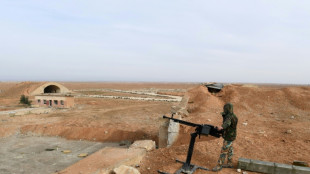 Syria says Israel talks addressed de-escalation, staying out of Israel-Turkey tensions

 Tourism boom pushes limits of Athens air traffic control

 Liga holders Barcelona crush Elche, Atletico salvage Villarreal draw

 Spain's World Cup hero Torres saves PSG's blushes at Rennes

 Swiss forward Embolo joins Atlanta United

 Former cricket captains appeal to Pakistan over Khan health care

 Latest 'Spider-Man' tops American box office for 4th weekend

 Szoboszlai's last-gasp leveller rescues Liverpool in Newcastle draw

 Landfill collapse kills 30 in Guinea

 'Unbelievable' Cherki proves his point to Man City boss Maresca

 10-man Atletico snatch Villarreal draw as Alvarez returns

 Seville, Jefferson-Wooden roar to 100m wins at Silesia Diamond League

 VW chief warns carmaker's situation 'more than critical'

 England cricketer Carse under investigation after 'nightclub incident'

 McLaren's Norris wins Dutch GP after Verstappen crash

 Giroud scores as Lille give Davide Ancelotti winning start

 Kejelcha smashes half-marathon world record in Buenos Aires

 Trump admin predicts US trade war 'devastating' for Canada

 Trump set for starring role at Washington's debut IndyCar race

New survey of HIMSS26 Europe attendees finds patient-flow visibility, cyber recoverability, workflow reliability, interoperability and operational command capability are now viewed as board-level patient-care risks
COPENHAGEN, DK / ACCESS Newswire / May 21, 2026 / Black Book Research today released findings from a new HIMSS26 Europe attendee pulse survey, revealing a sharp shift in how European hospital buyers, digital health executives and healthcare investors are evaluating health technology in 2026.
The new Black Book survey of 122 HIMSS26 Europe attendees, conducted this week in Copenhagen, was designed as a separate event-based market pulse and is not connected to Black Book's EHR/EPR vendor rankings, data valorisation research, or prior provider-user benchmarking studies.
The survey found that European healthcare leaders are increasingly focused on a less publicised but more urgent issue: whether hospitals have the digital infrastructure to maintain safe, timely and coordinated patient care under mounting pressure from workforce shortages, waiting lists, cyber threats, operational bottlenecks and fragmented technology estates.
HIMSS26 Europe is taking place in Copenhagen from 19-21 May 2026, with the official programme centred on digital maturity, AI, cybersecurity, interoperability and healthcare transformation.
"The dominant conversation at HIMSS26 Europe is not simply whether hospitals will adopt AI," said Kat Johnson, Black Book spokesperson. "The more important question is whether hospitals can keep care moving safely when capacity is tight, systems are fragmented, staff are stretched and digital downtime or workflow failure can immediately affect patients."
Key findings from Black Book's HIMSS26 Europe attendee pulse
Among the 122 HIMSS26 Europe attendees surveyed by Black Book this week:
Finding | Respondents agreeing |
|---|---|
Said digital care continuity is now a board-level patient-safety and operational-risk issue | 88% |
Said patient-flow, bed-capacity, discharge and diagnostic-turnaround visibility are still not reliable enough for real-time operational control | 76% |
Said cyber resilience should be evaluated as a care-continuity capability, not only an IT security or compliance function | 74% |
Said hospitals are underestimating the patient-care impact of disconnected systems, duplicate documentation and manual workarounds | 71% |
Said AI investment should be delayed or limited where workflow integration, data governance and clinical accountability are immature | 68% |
Said interoperability failures continue to create measurable delays in referrals, handoffs, diagnostics, discharge or follow-up | 65% |
Said their 2026-2027 technology buying priorities are shifting toward workflow reliability, command-centre intelligence, cyber recoverability and operational visibility | 63% |
Among investor, advisory and vendor-strategy respondents, said they would discount healthtech companies that cannot prove measurable deployment inside hospital workflows | 72% |
Black Book concludes that the underreported HIMSS26 Europe signal is clear: the highest-value digital health category is shifting from standalone innovation to infrastructure that protects care delivery.
The issue hospital boards cannot ignore: digital failure is now clinical failure
The HIMSS26 Europe attendee pulse found that hospital executives are increasingly treating digital infrastructure as a frontline clinical dependency.
Respondents identified five areas where digital weakness now directly affects patient care:
1. Patient-flow opacity
Hospitals cannot reliably manage emergency pressure, elective backlogs, bed capacity, diagnostics, transfers or discharge if operational data arrives too late, lives in disconnected systems or requires manual reconciliation.
2. Workflow fragility
Respondents said too many digital tools still add clicks, duplicate documentation, disconnected tasking or parallel processes. In overstretched clinical environments, workflow friction is not an inconvenience; it is a capacity drain.
3. Interoperability failure at the point of care
The survey found that buyers are no longer satisfied with generic claims of integration. They want proof that information moves reliably across referrals, diagnostics, imaging, laboratories, pharmacies, community care, emergency care and discharge pathways.
4. Cybersecurity as care continuity
Attendees said cyber planning must move beyond prevention and compliance. Hospitals need tested downtime procedures, recoverability, access continuity and operational resilience so that clinical services can continue during disruption.
5. AI without operational readiness
Respondents were broadly interested in AI, but sceptical of AI deployments that are not grounded in reliable workflows, governed data, clinician trust, auditability and measurable operational value.
"European buyers are becoming more disciplined," said Doug Brown, Black Book's founder. "They are not rejecting AI. They are rejecting AI layered on top of brittle systems, poor workflow design and unproven operational readiness."
Why this matters to hospital buyers across Europe
Black Book's HIMSS26 Europe pulse found that hospital buyers are changing procurement questions.
Based on the attendee responses, Black Book expects European hospital buyers to prioritise technologies that can demonstrate:
real-time or near-real-time patient-flow visibility;
bed, discharge, diagnostic and referral command capability;
workflow automation that reduces clinician burden;
interoperability that works in production, not just in sales demonstrations;
cyber recoverability and downtime-safe clinical operations;
identity, access, audit and governance controls;
clinically accountable AI deployment;
measurable impact on waiting lists, length of stay, handoffs, missed follow-ups and staff productivity.
Black Book says hospital boards should treat these capabilities as care-delivery infrastructure, not optional digital transformation projects.
Why this matters to investors
For general business investors, the HIMSS26 Europe pulse points to a more durable digital health investment thesis.
The strongest European healthtech opportunities may not be the most visible AI demonstrations, largest in installations, or loudest marketing departments. They may be the companies solving operational infrastructure problems that hospitals cannot defer:
patient-flow orchestration;
operational command centres;
cyber resilience and clinical recoverability;
interoperability middleware;
workflow automation;
clinical communications and tasking;
diagnostic and referral coordination;
downtime-safe care operations;
identity, consent, access and governance infrastructure;
AI tools embedded into real clinical operations.
"Investors should pay attention to the companies that make hospitals work better under pressure," said Brown. "The highest-value healthcare technology will reduce fragility. It will help hospitals move patients, protect services, coordinate staff, recover from disruption and convert digital systems into dependable care infrastructure."
The underreported market signal from HIMSS26 Europe
Black Book says HIMSS26 Europe attendees are signalling a pragmatic market correction. The last digital health cycle rewarded promise: AI pilots, dashboards, apps, portals and platform claims.
The next cycle will reward proof:
proof that clinicians use the system;
proof that operational leaders trust the data;
proof that care teams can coordinate in real time;
proof that systems recover when attacked or unavailable;
proof that interoperability reduces delays;
proof that AI improves decisions without adding risk;
proof that technology improves patient access, throughput and safety.
This shift matters because European hospitals are operating under constrained capacity. Digital tools that do not improve care delivery, reduce burden or strengthen resilience will face higher scrutiny from buyers, boards and investors.
"The underreported opportunity in European digital health is operational dependability," said Brown. "Hospitals need technology that helps them deliver care under pressure. That is where buyers are moving, and that is where investors should look."
Black Book's HIMSS26 Europe Attendee Pulse was conducted among 122 HIMSS26 Europe attendees during the Copenhagen conference week in May 2026. Respondents included hospital and health-system executives, digital transformation leaders, healthcare IT buyers, clinical informatics stakeholders, data and analytics professionals, cybersecurity leaders, consultants, vendor strategy executives, investors and healthcare advisory professionals.
This was a new, separate, event-based pulse survey designed to capture current attendee sentiment at HIMSS26 Europe. It is not part of, derived from, or connected to Black Book's EHR/EPR vendor rankings, data valorisation studies or provider-user vendor performance surveys.
The findings should be interpreted as a directional event-attendee market read, not a statistically weighted pan-European hospital census.
HIMSS is a trademark of the Healthcare Information and Management Systems Society. This release is independent and does not imply endorsement by HIMSS or any affiliation with Black Book.
About Black Book Research
Black Book Research is an independent healthcare IT market research and public opinion research firm known for healthcare technology surveys, buyer sentiment research, market intelligence and vendor performance measurement across global healthcare sectors. Several new 2026 Black Book global healthcare IT reports are available to industry stakeholders at no cost at https://www.blackbookmarketresearch.com
Media Contact
[email protected]
1.800.8637590
SOURCE: Black Book Research
View the original press release on ACCESS Newswire
M.O.Allen--AT