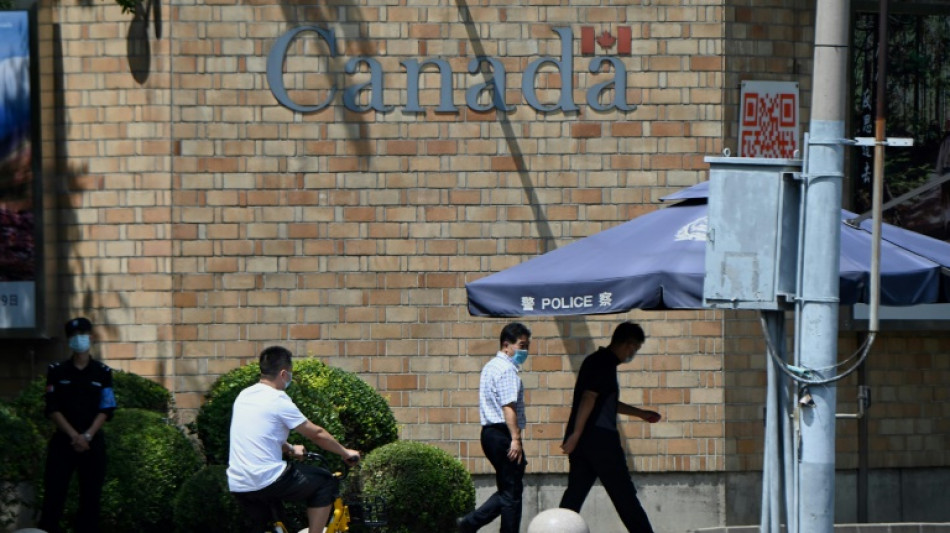
Disappeared Chinese-Canadian tycoon jailed for 13 years / Photo: Noel Celis - AFP

 Zach Hickerson Recounts Hayden Panettiere's Final Moments in New Interview

 Luxembourg Housing Petition Passes Threshold for Parliamentary Consideration

 Raheem Sterling Receives Suspended Sentence After Lamborghini Crash

 Audience to Choose the Set List at Luxembourg's First FAMIL Jukebox Night

 Luxembourg Pay Rise Delayed as Regional and World Headlines Develop

 Chennai Urbanist Sashna Develops 'Anniki' Card Game to Gamify Tamil Nadu History

 Transport Minister Defends Land Seizure Powers for Toronto-Quebec City High-Speed Rail

 UAE Weather Forecast: Scattered Showers and Fog Expected as Temperatures Drop
A Chinese-Canadian tycoon who disappeared from a Hong Kong hotel five years ago has been sentenced to 13 years in prison and his company fined $8 billion for embezzlement and bribery, a Shanghai court said Friday.
Xiao Jianhua, one of China's richest people when he was allegedly abducted in 2017, reportedly had close connections to the upper echelons of the ruling Communist Party.
There had been no official word about Xiao -- who is a Canadian citizen -- until Ottawa confirmed in July that he was facing trial.
Xiao and his firm, Tomorrow Group, were found guilty of "illegally absorbing public deposits, breaching trust in the use of entrusted property... (and) illegal use of funds," the Shanghai No. 1 Intermediate People's Court said in a statement.
It added that Tomorrow Group had committed the "crime of bribery".
The firm's actions "have seriously disrupted the financial management order, seriously endangered the country's financial security", the court said.
It also fined Tomorrow Group 55.03 billion yuan ($8 billion) and Xiao 6.5 million yuan ($950,000).
Xiao and his company pleaded guilty and cooperated with the authorities in recovering what they had illegally acquired, the statement said.
The Canadian embassy had said in July that its diplomats were denied access to the trial.
On Friday, China's foreign ministry insisted that because Beijing does not recognise dual citizenship, Xiao "does not enjoy the right to consular protection from other countries".
"Xiao has Chinese citizenship. China holds trials for criminal activity by its citizens in accordance with the law," foreign ministry spokesman Wang Wenbin told a briefing.
- Diverse business empire -
After attending university in the late 1980s, Xiao began selling computers and in the decades that followed built an empire with diverse interests including banking and insurance.
According to the Hurun Report, which ranks China's wealthiest people, Xiao was worth almost $6 billion in 2017.
Local media in Hong Kong had reported at the time of Xiao's disappearance that he was snatched by mainland Chinese agents -- fuelling concern over China's tightening influence in the financial hub.
Those fears were at the heart of massive pro-democracy protests that shook Hong Kong in 2019, prompted by a government bill that would have allowed extraditions to mainland China's opaque, party-controlled judicial system.
Xiao had reportedly denied allegations that he fled to Hong Kong in 2014 to escape a corruption crackdown in China.
He is said to have acted as a broker for the Chinese leadership, including for President Xi Jinping's family.
"After five years of quietly waiting, our family is still, based on my brother's strict instructions, putting faith in the Chinese government and Chinese law," Xiao's elder brother Xinhua told The Wall Street Journal in June this year.
The years after Xiao's disappearance have been marked by plummeting relations between China and Canada, sparked by the arrest in Vancouver of Meng Wanzhou -- the chief financial officer of telecoms giant Huawei -- at the request of the United States.
Following Meng's arrest, Beijing detained two Canadians in China and targeted Canadian agricultural exports.
All three were released in September 2021 after Meng reached a deal with US prosecutors on fraud charges, ending her fight against extradition to the United States.
Since then there have been hopes of a thaw in diplomatic relations, with Beijing lifting a ban on Canadian canola imports earlier this year.
J.Gomez--AT


