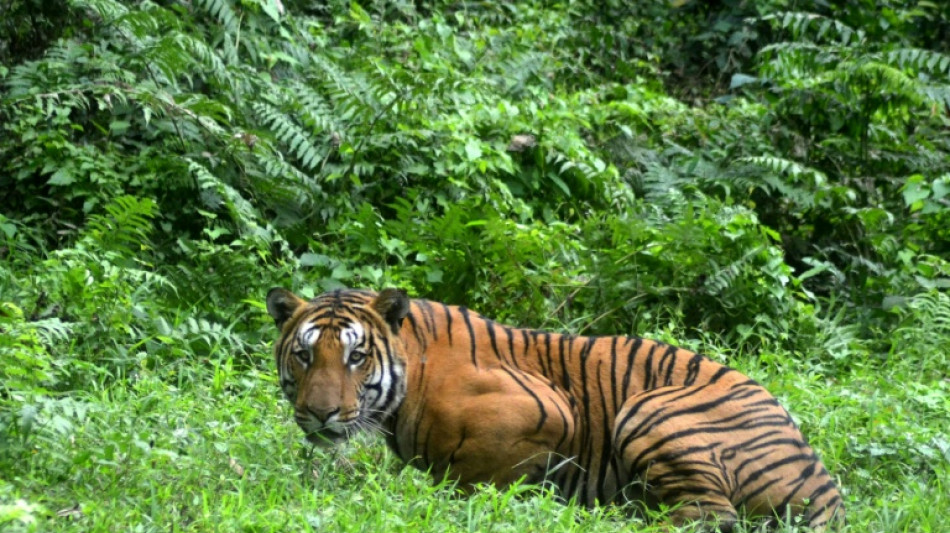
Earning its stripes: tech bid to crack tiger trade / Photo: STR - AFP/File

 French court to hear Depardieu's appeal against rape trial order: sources

 The German state premier hoping to halt far-right surge
 Lebanon wants Israel security deal as prelude to peace: president to AFP

 England's Brook keen to learn from 'hero' Pietersen after stunning ton

 Saudi says Houthis target Mecca, warns of 'red line'
 Phillippines ex-leader Duterte makes first appearance at ICC

 Lebanon wants Israel security deal, Hezbollah disarmament without confrontation: president to AFP

 BASIS.pro Expands On-Chain Infrastructure with XDC Network Partnership and Zypher DAO as Auto Earn Goes Live
 Samson relishing battle with teen star Sooryavanshi for India spot

 Pickle-flavoured tart? AI inspires Japan's convenience stores

 Macau holds first closed-door national security trial

 Bank of Japan set to raise rates under pressure from inflation, US
 Zverev, Shelton back on court for Davis Cup qualifiers

 Peace is a 'dangerous' word in Russian city heading to polls

 Meta chief pushes back on AI slowdown calls

 'Resident Evil' film brings video game's ethos to the big screen

 Court orders N. Korea pay Seoul $32.5 mn for blowing up office

 US military buildup in Palau stirs war fears
 US Fed to deliver rate decision with markets betting on hike
 Saudi, Egypt demand open Red Sea as Riyadh vows response to Houthi attacks

 Physical Gold IRA Investing Guide Released by Experts (2026 Update)

 Tocvan Expands Near-Surface Gold at El Mezquite: 47.7 m of 0.8 g/t Au Including 2.8 m of 8.4 g/t Au and 54 g/t Ag

 FireFox Gold Announces Discovery of the Lammas Zone, Intersecting 21.0m at 4.13 g/t Gold More Than 650m From Previous Drilling at the Mustajärvi Project in Lapland, Finland

 Smith & Nephew Plc Announces Result of Cash Tender Offer for 2030 Bonds
 Brazil's Supreme Court clashes over handling of probe involving judge

In a town in northeastern Scotland, Debbie Banks looks for clues to track down criminals as she clicks through a database of tiger skins.
There are thousands of photographs, including of rugs, carcasses and taxidermy specimens.
Banks, the crime campaign leader for the Environmental Investigation Agency (EIA), a London-based charity, tries to identify individual big cats from their stripes.
Once a tiger is identified, an investigator can pinpoint where it comes from.
"A tiger's stripes are as unique as human fingerprints," Banks told AFP.
"We can use the images to cross-reference against images of captive tigers that might have been farmed."
Currently this is slow painstaking work.
But a new artificial intelligence tool, being developed by The Alan Turing Institute, a centre in the UK for data science and artificial intelligence, should make life much easier for Banks and law enforcement officials.
The project aims to develop and test AI technology that can analyse the tigers' stripes in order to identify them.
"We have a database of images of tigers that have been offered for sale or have been seized," Banks said.
"When our investigators get new images, we need to scan those against the database.
"At the moment we are doing that manually, looking at the individual stripe patterns of each new image that we get and cross-referencing it against the ones we have in our database."
It is hoped that the new technology will help law enforcement agencies determine where tiger skins come from and allow them to investigate the transnational networks involved in trafficking tigers.
Once the officials know the origins of confiscated tiger skins and products, they will be able to tell whether the animal was farmed or poached from a protected area.
Poaching, fuelled by consumer demand, remains a major threat to the survival of the species, according to the EIA.
Tiger skins and body parts are sought after, partly due to their use in traditional Chinese medicine.
An estimated 4,500 tigers remain in the wild across Asia.
"Tigers faced a massive population decline in the last 120 years, so we want to do everything we can to help end the trade in their parts and products, including tiger skins," Banks said.
Anyone with photographs of tigers is invited to submit them to the EIA to help bolster the AI database.
"We are inviting individuals -- whether they are photographers or researchers and academics -- who may have images of tigers where their stripe patterns are clear," Banks said.
"They could be live tigers, dead tigers or tiger parts.
"If they can share those with us, the data scientists can then develop, train and test the algorithm," she said.
"We need thousands of images just to do that phase of the project."
A.Williams--AT