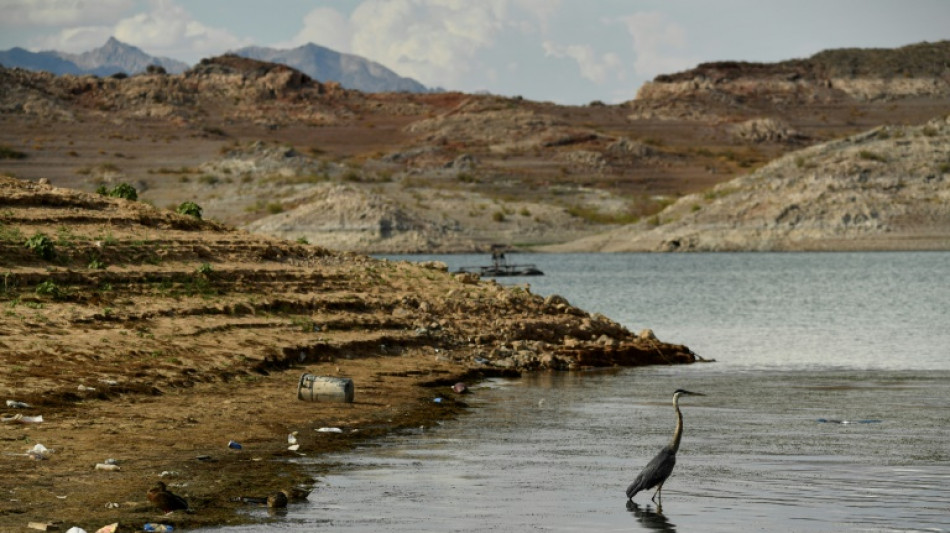
US cuts water allowance for some states, Mexico as drought bites / Photo: Patrick T. FALLON - AFP/File

 Zach Hickerson Recounts Hayden Panettiere's Final Moments in New Interview

 Luxembourg Housing Petition Passes Threshold for Parliamentary Consideration

 Raheem Sterling Receives Suspended Sentence After Lamborghini Crash

 Audience to Choose the Set List at Luxembourg's First FAMIL Jukebox Night

 Luxembourg Pay Rise Delayed as Regional and World Headlines Develop

 Chennai Urbanist Sashna Develops 'Anniki' Card Game to Gamify Tamil Nadu History

 Transport Minister Defends Land Seizure Powers for Toronto-Quebec City High-Speed Rail

 UAE Weather Forecast: Scattered Showers and Fog Expected as Temperatures Drop
Some US states and Mexico must cut their water usage to avoid "catastrophic collapse" of the Colorado River, Washington officials said Tuesday, as a historic drought bites.
More than two decades of well below average rainfall have left the river -- the lifeblood of the western United States -- at critical levels, as human-caused climate change worsens the natural drought cycle.
Despite years of warnings, states that depend on the river have not managed to reduce their demands enough, and on Tuesday, the federal government said it was imposing cuts.
"In order to avoid a catastrophic collapse of the Colorado River System and a future of uncertainty and conflict, water use in the Basin must be reduced," said Tanya Trujillo, Assistant Secretary for Water and Science at the Interior Department.
Arizona's allocation from the river will fall by 21 percent in 2023, while Nevada will get eight percent less. Mexico's allotment will drop by seven percent.
California, the biggest user of the river's water and the most populous of the western states, will not be affected next year.
The Colorado River rises in the Rocky Mountains and snakes its way through Colorado, Utah, Arizona, Nevada, California and northern Mexico, where it empties into the Gulf of California.
It is fed chiefly by snowpack at high altitudes, which melts slowly throughout the warmer months.
But reduced precipitation and the higher temperatures caused by humanity's unchecked burning of fossil fuels means less snow is falling, and what snow exists, is melting faster.
As a consequence, there is not as much water in the river that supplies tens of millions of people and countless acres of farmland.
Deputy Secretary of the Interior, Tommy Beaudreau, said the department -- the part of government with responsibility for water resources -- was "using every resource available to conserve water and ensure that irrigators, Tribes and adjoining communities receive adequate assistance."
"The worsening drought crisis impacting the Colorado River Basin is driven by the effects of climate change, including extreme heat and low precipitation," he said.
"In turn, severe drought conditions exacerbate wildfire risk and ecosystems disruption, increasing the stress on communities and our landscapes."
The western United States is suffering under a drought that is now in its 23rd year, the worst episode in more than 1,000 years.
That drought has left swathes of the country dry and vulnerable to hotter, faster and more destructive wildfires.
Communities served by the Colorado River, including Los Angeles, have been ordered to save water, with unpopular restrictions in place on outdoor watering.
B.Torres--AT


