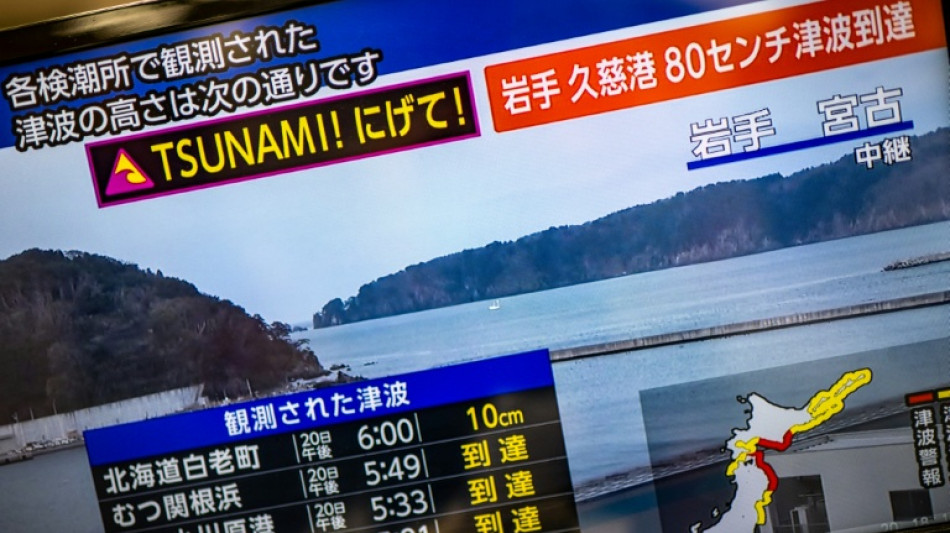
Tsunami warning as major quake hits northern Japan, shakes Tokyo / Photo: Philip FONG - AFP

 High quality, low risk: record number of Japanese in Premier League

 Stocks edge higher as oil drops on fresh Mideast hopes

 Pakistan's girls fight for their place in the boxing ring
 Five things to know about Anthropic ahead of Wall Street debut

 Social media use on the rise among Australian under-16s after ban: data

 Instagram chief admits touting teen safety tool while omitting it was barely used

 'Final Fantasy', 'The Witcher' in spotlight at Europe gaming bash
 Syrian Kurdish leader dissolves force that spearheaded jihadist fight

 Trump raises prospect of demolishing iconic Kennedy Center

 PGA Tour to end in two-week matchplay showdown from 2028: CEO

 United States of Dolly: how a country queen bridged America's divide

 PGA chief says 'no current plans' for LIV stars to return

 Golf giant Callaway apologizes after ad sparks outcry

 Ioane stars as New Zealand recover to beat Johannesburg Lions

 Ukrainians seeking beauty in a bomb-scarred city

 Dolly Parton: Country music's dolled up but deserving queen

 US robotaxi firm Waymo plans to launch in Germany

 'Here to win': Xavi vows to restore pride in Dutch football

 Cameroon's Baleba joins as Man United boost midfield options

 'Shocking' book about Putin's private life wins French literary prize

 Pogacar storms to Vuelta a Espana stage four solo triumph

 Canada unveils counter-tariffs of 15-50% on US goods

 Volkswagen boss braces German workers for more job cuts
 Olympic champion Brignone to undergo new knee operation

 The summer climate change became scorching reality for Europe

A 7.5-magnitude earthquake struck northern Japan Monday, shaking large buildings in Tokyo hundreds of kilometres away and prompting a warning for tsunami waves of up to three metres (10 feet).
The quake hit at 4:53 pm (0753 GMT) in Pacific waters off northern Iwate prefecture, Japan's Meteorological Agency (JMA) said.
Around 40 minutes later, an 80-centimetre (31-inch) tsunami wave hit a port in Kuji in Iwate, according to the JMA, which initially estimated the quake's strength at 7.4 but later revised it upwards.
"Evacuate immediately from coastal regions and riverside areas to a safer place such as high ground or an evacuation building," it said, warning that damage due to tsunami waves was expected.
"Tsunami waves are expected to hit repeatedly. Do not leave safe ground until the warning is lifted," it said.
Footage from national broadcaster NHK did not show any immediate visible damage around several ports in Iwate.
A JMA official warned in a televised press briefing that more quakes could strike the area within the next week, particularly within the next two to three days, potentially "causing even stronger shaking".
The prime minister's office said it had set up a crisis management team.
"For those of you who live in areas for which the warnings have been issued, please evacuate to higher, safer places such as higher ground," Prime Minister Sanae Takaichi told reporters, adding that the government was trying to confirm whether there were any casualties or property damage.
Japan is one of the world's most seismically active countries, sitting on top of four major tectonic plates along the western edge of the Pacific "Ring of Fire".
The archipelago, home to around 125 million people, typically experiences around 1,500 jolts every year and accounts for about 18 percent of the world's earthquakes.
The vast majority are mild, although the damage they cause varies according to their location and the depth below the Earth's surface at which they strike.
Japan is haunted by the memory of a massive 9.0-magnitude undersea quake in 2011, which triggered a tsunami that killed or left missing around 18,500 people and caused a devastating meltdown at the Fukushima nuclear plant.
In 2024, the JMA issued its first special advisory of a possible "megaquake" along the Nankai Trough.
This 800-kilometre undersea trench is where the Philippine Sea oceanic tectonic plate is "subducting" -- or slowly slipping -- underneath the continental plate that Japan sits atop.
The government has said a quake in the Nankai Trough and subsequent tsunami could kill as many as 298,000 people and cause up to $2 trillion in damage.
The JMA lifted the 2024 advisory after a week but it led to panic-buying of staples like rice and prompted holidaymakers to cancel hotel reservations.
It issued a week-long second "megaquake" advisory in December 2025 after a magnitude-7.5 tremor struck off the northern coast.
The December 8 quake triggered tsunami waves of up to 70 centimetres (28 inches) and injured more than 40 people, but no major damage was reported.
Ch.P.Lewis--AT