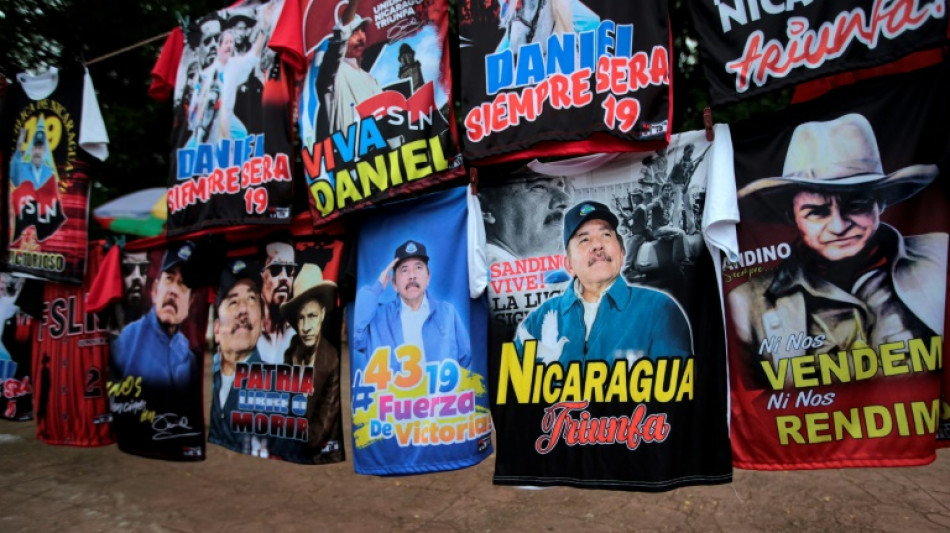
Nicaragua's presidential couple in insatiable bid for power, experts say / Photo: Oswaldo RIVAS - AFP

 Zach Hickerson Recounts Hayden Panettiere's Final Moments in New Interview

 Luxembourg Housing Petition Passes Threshold for Parliamentary Consideration

 Raheem Sterling Receives Suspended Sentence After Lamborghini Crash

 Audience to Choose the Set List at Luxembourg's First FAMIL Jukebox Night

 Luxembourg Pay Rise Delayed as Regional and World Headlines Develop

 Chennai Urbanist Sashna Develops 'Anniki' Card Game to Gamify Tamil Nadu History

 Transport Minister Defends Land Seizure Powers for Toronto-Quebec City High-Speed Rail

 UAE Weather Forecast: Scattered Showers and Fog Expected as Temperatures Drop
First they jailed their opponents, now they've set their sights on the Catholic Church: Nicaragua's first couple -- President Daniel Ortega and his wife, Vice President Rosario Murillo -- are in a bid for absolute control over the lives of citizens, experts say.
The former guerilla and his partner have steadily increased their grip on power since he returned to the nation's top office in 2007, particularly via constitutional reforms that removed presidential term limits.
This style of government "concentrates discretionary decision making in the hands of the presidential couple," sociologist Elvira Cuadra, who lives in exile, told AFP.
The shift towards authoritarianism effectively allows Ortega to rule for life, she said.
"What we have is the building of a cult of personality," said Eliseo Nunez, an analyst and former legislator also living in exile.
Things have become markedly worse in Nicaragua since the brutal repression of anti-government protests in 2018 that left more than 350 people dead.
In the last year alone, the government arrested 46 opposition figures and critics, while the courts sentenced them to up to 13 years in prison.
Among those detained were seven presidential hopefuls prevented from standing in last November's elections when Ortega won a fourth consecutive term.
It is not just the opposition and detractors being marginalized or persecuted, however. Ortega's Sandinista National Liberation Front party is being purged of dissenting voices within.
And now, the Catholic Church has become the last bastion of resistance and rebellion against the government, riling the presidential couple.
In her daily speeches, Murillo has called criticism by bishops a crime and "a sin against spirituality."
Rolando Alvarez, the bishop of the northeastern city of Matagalpa, has now been confined to his Managua residence for more than a week, after the government accused him and the Catholic Church of inciting violence to destabilize the country.
"What has happened is that the government has always wanted a mute church, it doesn't want us to speak, nor to denounce injustice," said Alvarez.
Legislator Wilfredo Navarro told the Sandinista Canal 4 television station that Alvarez and other priests were "false prophets" and accused them of playing politics.
Ortega and Murillo "have their own ideas, they're closing up the country, canceling critical voices," said Cuadra.
- Opposition persecution -
Authorities have additionally forced the near century-old La Prensa newspaper, a staunch critic of the government, to shut down its print version and remain entirely online.
Its journalists have fled the country.
The Catholic Church's television station and other Christian media have also been shut down.
Parliament, dominated by Ortega allies, has canceled the legal status of more than 1,000 civic organizations and foundations that defend human rights, vulnerable children and freedom of expression, as well as private universities and cultural bodies.
Authorities used a law passed in 2020 to declare many non-governmental groups illegal for not registering as foreign agents and for blocking the government's attempts to scrutinize and control them.
In July, members of a religious order founded by Mother Teresa fled to Costa Rica on foot after the government said they were not authorized to provide social assistance.
Ortega, 76, was part of a governing junta from 1979 to 1985 following the fall of the Somoza family dictatorship before becoming president until 1990, when he was defeated in elections.
He returned to power in 2007 but has since been accused by the opposition of corruption and nepotism -- he named Murillo as his running mate in the last two election campaigns.
Cuadra said one sign of weakness is that the president and vice president "only have support from the police forces."
She added that the president is hobbled by a lack of legitimacy due to last November's elections being widely branded a farce.
However, he still manages to bring in some foreign capital that "gives him oxygen" so that he can "prolong this situation a little longer," she said.
Ortega denies the accusations and claims his detractors are planning a coup d'etat with the help of Washington.
On Friday, the Organization of American States said the country's "environment of oppression has worsened."
E.Flores--AT


