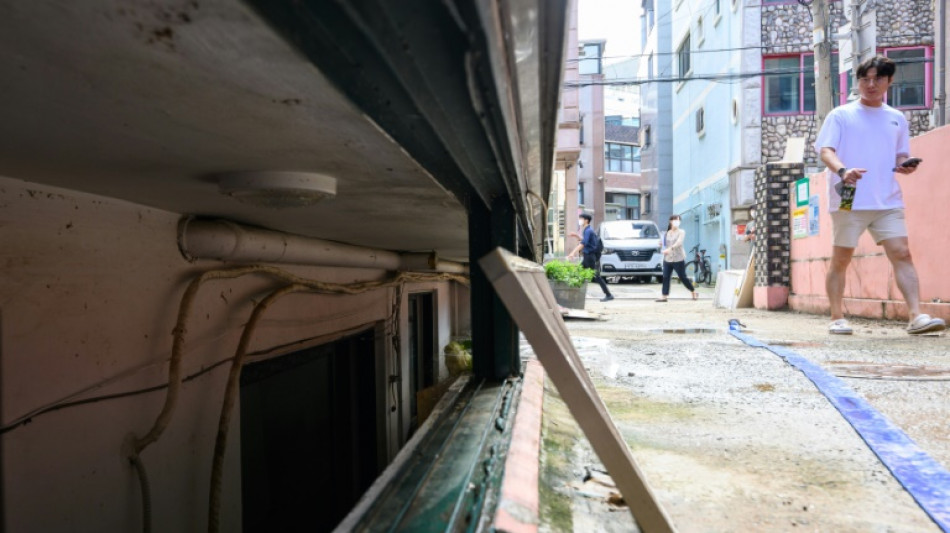
Seoul seeks to ban basement flats after flooding deaths / Photo: Anthony WALLACE - AFP

 Zach Hickerson Recounts Hayden Panettiere's Final Moments in New Interview

 Luxembourg Housing Petition Passes Threshold for Parliamentary Consideration

 Raheem Sterling Receives Suspended Sentence After Lamborghini Crash

 Audience to Choose the Set List at Luxembourg's First FAMIL Jukebox Night

 Luxembourg Pay Rise Delayed as Regional and World Headlines Develop

 Chennai Urbanist Sashna Develops 'Anniki' Card Game to Gamify Tamil Nadu History

 Transport Minister Defends Land Seizure Powers for Toronto-Quebec City High-Speed Rail

 UAE Weather Forecast: Scattered Showers and Fog Expected as Temperatures Drop
South Korea's capital has moved to ban the cramped basement flats made famous by Oscar-winning movie "Parasite" after four people drowned in subterranean dwellings during flooding caused by record-breaking rains this week.
Soldiers and relief workers were clearing debris Thursday from waterlogged, mud-covered homes in Gwanak district, an AFP reporter saw, where three tenants, including a disabled woman and a teenager, died Monday.
Their deaths -- trapped by floodwater in their basement apartment -- have caused public outrage, with President Yoon Suk-yeol visiting their destroyed home this week before calling on officials to do more to help the poor and vulnerable during natural disasters.
The Seoul Metropolitan Government has announced they want to get rid of tiny, cramped basement flats -- known as "banjiha" -- which are typically cheap to rent but prone to damp and flooding.
Around 200,000 households live in such flats, which make up around five percent of housing stock in the South Korean capital, according to official figures.
Seoul said in a press release Wednesday that it will stop issuing permits to construct such homes, while pushing to gradually phase out existing basement and semi-basement flats.
The city plans to begin discussions with the national government to ban the use of basements or semi-basement spaces for residential purposes, it added.
Four out of 11 people killed in this week's record downpours drowned after their basement flats were inundated with floodwater, officials have said.
Such abodes received global attention due to Bong Joon Ho's "Parasite", which won the 2020 Best Picture Oscar and features a poor family living in a dank basement home.
Activists blamed the "banjiha" deaths this week on the government's housing policies, saying they were preventable disasters.
"We condemn the government's negligence regarding those marginalised people in this housing," said the Citizens' Coalition for Economic Justice in a statement.
"As rainfall becomes stronger and more frequent under the influence of climate change, (Seoul) must embark on a fundamental change of its approach to basement residents," it added.
Yoon has also blamed climate change for the rains and flooding, which he said were the worst since weather records began over a century ago.
"Those who struggle financially or with physical difficulties are bound to be more vulnerable to natural disasters," he said.
R.Garcia--AT


