Billboards get Poles talking low birth rate / Photo: Wojtek RADWANSKI - AFP

 Trump again seeks to remove protections for wolves
 'Getting there' - Alcaraz into US Open last 16 along with Sabalenka

 Isak ready to show world his quality, says Van Dijk

 Stuttgart cruise past Cologne to bounce back from Bayern thumping

 'Smart, aggressive' Alcaraz into US Open last 16

 Isak fires Liverpool to first win under Iraola at Ipswich

 Stocks slip as robust US jobs data stokes rate hike odds

 Mistrial declared in case of US woman who killed her three children

 Seville, Alfred win at Diamond League finals, Duplantis hit with injury

 Moody’s Assigns First-Time Insurance Financial Strength Ratings to Freedom Insurance and Freedom Life

 Trump says envoys taking plan to 'end the war' to Moscow, Kyiv

 US Football Hall of Fame revamps selection process

 Judge declares mistrial in case of US woman who killed her children

 Edgar Davids art thief misses sentencing after being 'knocked out by luggage'

 Pegula rallies to reach US Open fourth round

 Defending champ Sabalenka leads way into US Open fourth round

 Bayeux Tapestry 'virtually unchanged', UK museum says, after France spots broken threads

 More than 120 killed in Yemen's worst clashes in years: sources

 Germany hunts climate activist suspected of power grid sabotage

 5 EU countries aim to send rejected migrants to 'return hub' by 2027

 Argentina to return Nazi-looted painting to Jewish collector's heir
 Australian Simmons makes NBA comeback with Kings: reports

 Two broken threads on Bayeux Tapestry, no major damage: French minister

 Meloni marks record in power with eye on 2027 elections
 Israel emptying West Bank refugee camps could be crime against humanity: UN

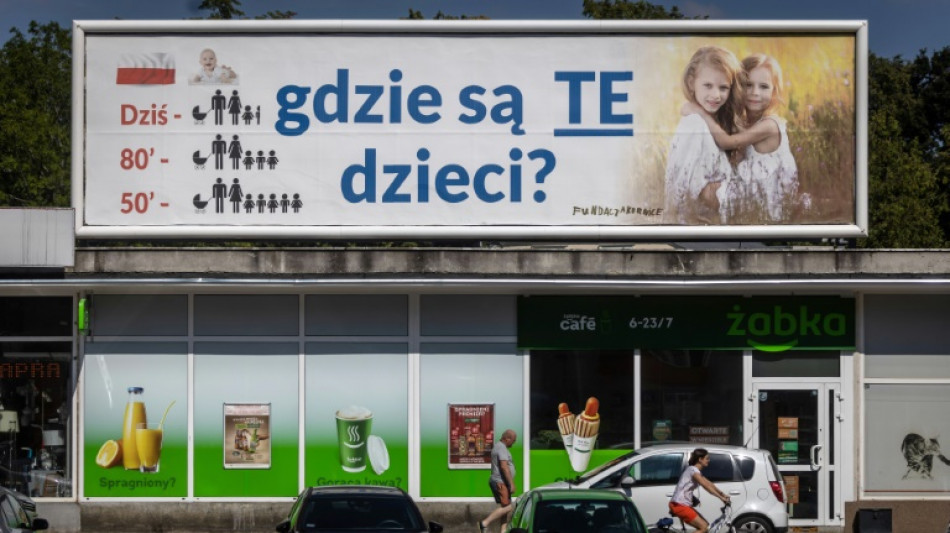
The billboards are hard to miss: large and plastered all over Poland, they show two blonde girls in immaculate white posing in a wheat field.
The caption asks: "Where are these children?"
An accompanying pictogram showing falling birth rate statistics claims the average Polish family had five children in the 1950s, down to three in the 80s and 1.5 today.
The signs, put up in recent weeks by a Catholic foundation, have triggered a fiery debate in the conservative-led country, where family and reproductive rights are an enduring source of tension.
The campaign has already spawned parodies. One version has a billboard with a dumpling pictogram and the line: "Where are these pierogis?"
Observers have been quick to point out that the figures in the original billboard are incorrect: official statistics show Polish women were having fewer than four children on average during the 1950s.
Still, the current birth rate is worrisome: with 1.4 children per woman, Poland is below the EU average and the threshold of generational renewal.
"Our campaign does not have an ideological or political goal," said the Kornice foundation whose president, a wealthy entrepreneur with Catholic ties, is one of Poland's richest men.
"It simply invites people to reflect."
- 'Fundamentalist undertone' -
Kornice had already made headlines for other controversial billboard campaigns, including ones opposing abortion and divorce.
For Paulina Zagorska, a women's activist, "the fundamentalist undertone of these billboards is obvious: their authors attribute the falling birth rate to contraception and challenges to the traditional family model".
Many observers have seized the occasion to denounce the near-total abortion ban introduced by the right-wing government and to condemn its family policies.
According to leftwing opposition MEP Robert Biedron, "there aren't enough children because of a shortage of nurseries and kindergartens... insufficient wages... a fear of pregnancy following inhuman anti-abortion laws".
A study published in May by the research firms SW Research and Garden of Words found that half of Polish women considered their country unfavourable to motherhood, notably because of abortion restrictions and difficult access to medical care.
- National mission -
Yet the birth rate is one of the key pillars of the ruling party's programme, whose staple is a popular monthly child allowance called 500+.
The party's family policies are meant to help young households get off the ground and to guarantee childcare during the early years.
But critics argue that the policies are mostly designed to benefit the traditional family model and to encourage women to stay at home.
The family ministry calls fertility "a vital issue" in its official programme, adding that it must be defended "even at the cost of the temporary withdrawal from the labour market of women who prefer to educate their children".
For Irena Kotowska, a demography expert at The Polish Academy of Sciences, these family policies adopted under the influence of the Church have been "ineffective".
Poland currently numbers 38.2 million people but its population could dwindle by 2.3 million by 2040, according to a Eurostat forecast.
- Historical factor -
Historic trends are also affecting the dwindling numbers.
"Massive unemployment, brought about by the sudden transition to capitalism, led to falling birth rates in the 1990s in the former Eastern bloc countries," Kotowska said.
"So, there aren't many women of childbearing age from those years, and they don't have a lot of children," she added.
The Czech Republic, another ex-communist country with a similar historical trajectory, was able to soften the trend "through progressive politics based on gender equality, institutional support and an adjustment of the labour market."
Kotowska doubts the influx of Ukrainians -- mainly women and children -- who fled Russia's invasion of their homeland for Poland is enough to "reverse the population decline".
Perhaps immigration from Africa and the Middle East could have an effect, though she said it was not realistic.
"I don't think it's conceivable in Poland, where birth policy is intrinsically linked to nationalism and ethnicity," she explained.
Meanwhile, the government recently warned in an official report of the long-term risk of "the death of the Polish nation".
H.Gonzales--AT