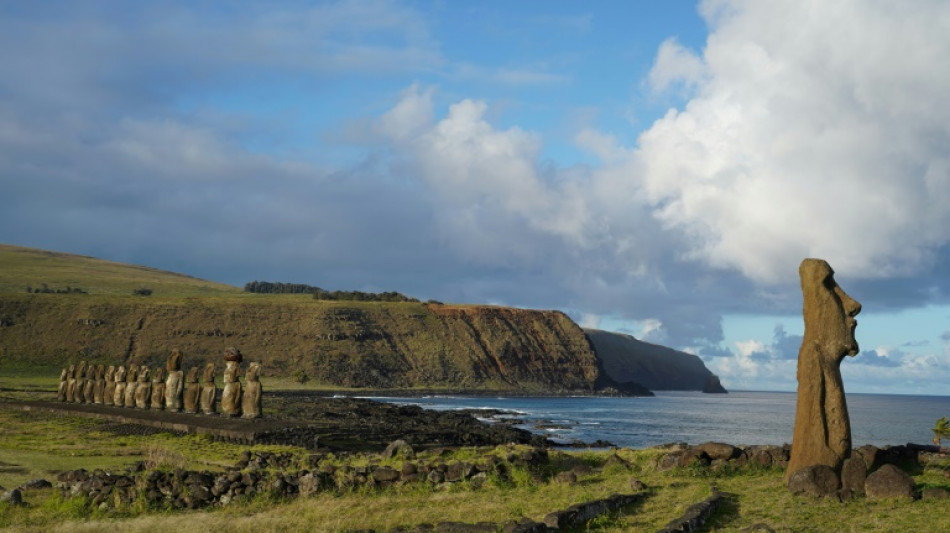
Tourists return but Easter Islanders draw lessons from Covid isolation / Photo: PABLO COZZAGLIO - AFP

 Trump again seeks to remove protections for wolves
 'Getting there' - Alcaraz into US Open last 16 along with Sabalenka

 Isak ready to show world his quality, says Van Dijk

 Stuttgart cruise past Cologne to bounce back from Bayern thumping

 'Smart, aggressive' Alcaraz into US Open last 16

 Isak fires Liverpool to first win under Iraola at Ipswich

 Stocks slip as robust US jobs data stokes rate hike odds
 Mistrial declared in case of US woman who killed her three children

 Seville, Alfred win at Diamond League finals, Duplantis hit with injury

 Moody’s Assigns First-Time Insurance Financial Strength Ratings to Freedom Insurance and Freedom Life

 Trump says envoys taking plan to 'end the war' to Moscow, Kyiv

 US Football Hall of Fame revamps selection process

 Judge declares mistrial in case of US woman who killed her children

 Edgar Davids art thief misses sentencing after being 'knocked out by luggage'
 Pegula rallies to reach US Open fourth round

 Defending champ Sabalenka leads way into US Open fourth round

 Bayeux Tapestry 'virtually unchanged', UK museum says, after France spots broken threads
 More than 120 killed in Yemen's worst clashes in years: sources

 Germany hunts climate activist suspected of power grid sabotage

 5 EU countries aim to send rejected migrants to 'return hub' by 2027

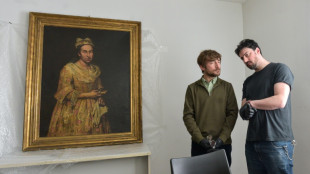 Argentina to return Nazi-looted painting to Jewish collector's heir
 Australian Simmons makes NBA comeback with Kings: reports
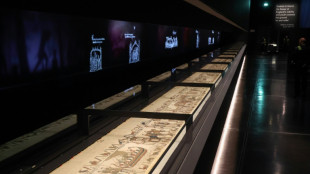 Two broken threads on Bayeux Tapestry, no major damage: French minister

 Meloni marks record in power with eye on 2027 elections
 Israel emptying West Bank refugee camps could be crime against humanity: UN

During more than two years of the coronavirus pandemic, Easter Island was closed to tourism -- forcing inhabitants to turn to a more sustainable way of life and relearn forgotten skills.
Now that the island's borders are open once again, local people, including the Rapa Nui indigenous population, want to resist the temptation to return to their pre-pandemic lifestyle.
"The time has come that the ancients predicted," Julio Hotus, a member of the Easter Island council of elders, told AFP.
Hotus said the Rapa Nui people's ancestors had warned about the importance of maintaining food independence because of the risk the island faced of one day becoming isolated, but that recent generations had ignored the warnings.
Before the pandemic, the island's food supply was almost exclusively provided by Chile.
Easter Island lies 3,500 kilometers (2,100 miles) off the west coast of Chile and is world renown for its monumental statues of human figures with giant heads, called moai.
With a population of just 8,000, it used to attract 160,000 tourists a year -- "an avalanche" according to Hotus -- but in March 2020 Easter Island closed its borders over Covid.
- No tourists, no income -
Olga Ickapakarati used to sell small stone moai figurines to tourists but once she was left without an income, she turned to agriculture and fishing to survive, just as her ancestors had lived before contact with European explorers.
"We were all left with nothing, we were left in the wind .... but we began planting," Ickapakarati told AFP.
She took advantage of a program that delivered seeds before the island was shut off from the outside world.
Ickapakarati planted spinach, beets, cilantro, chard, celery, basil, pineapple, oregano and tomatoes.
What she didn't eat, she shared with neighbors, just as many families did in creating an island-wide support network.
"All the islanders are like this. They have good hearts. If I see that I have a surplus of something, I give it to another family," said Ickapakarati, who lives with her children and grandchildren.
This new focus on sustainable living does not mean an end to tourism on Easter Island.
Last week, the first airplane of tourists for 28 months landed on the island, to much excitement from the locals desperate to see new faces.
But there will be no immediate return to the two flights a day of yesteryear. There will be just two a week for now, although the number will gradually increase.
Large hotel chains have decided to stay closed.
"We will continue with tourists, but I hope that the pandemic has taught a lesson that we can apply for the future," said Hotus.
- 'Archeological heritage at risk' -
Another thing the pandemic did was to create awareness of the necessity to look after natural resources affected by climate change, such as water and energy. And also the emblematic moais.
Carved from volcanic rock by the Polynesian Rapa Nui people between 1200 and 1500, there are more than 900 on the island, which measures 24 kilometers by 12 kilometers.
The statues can measure up to 20 meters in height and weigh more than 80 tons.
Most remain at the quarry where they were originally carved but many others were carted to coastal areas to look inland, presumably for ceremonial purposes.
The moais have been damaged by heavy rainfall, strong winds and the ocean waves crashing against the statues and their bases, leading to fears for their future.
"Climate change, with its extreme events, is putting our archeological heritage at risk," said Vairoa Ika, the local environment director.
"The stone is degrading" and needs to be protected.
"The problem with the moais is that they are very fragile," added Pedro Edmunds Paoa, the island's mayor, who says the statues' worth is "incalculable."
He said that authorities need to "forget about the tourist" vision and take protective measures, even if that means covering the statues "with glass domes", which would ruin not just the authentic view but also tourists' photographs.
He also wants inhabitants to make maximum use of natural resources and to prioritize locals in employment, while resurrecting the ancestral practise of fostering community solidarity.
"From now on the tourist must become a friend of the place, whereas before they were visiting foreigners," said Edmunds Paoa.
Ch.P.Lewis--AT