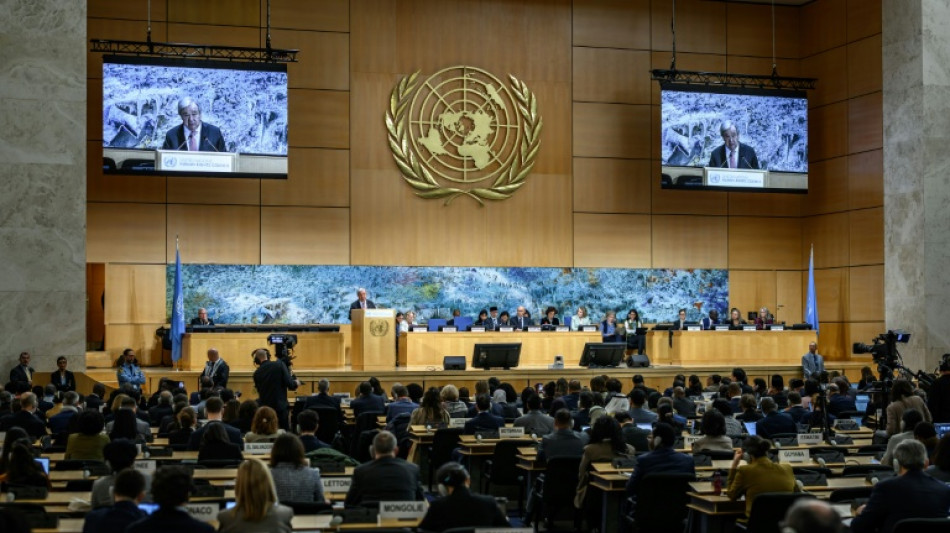
Venezuelan foreign minister demands 'immediate release' of Maduro / Photo: Fabrice COFFRINI - AFP

 Steve Young Says 49ers' 'Grinding Personalities' Prevent Early Peak
 Oil Prices Drop Nearly 3% on Libyan Pipeline Restart and Middle East Supply Concerns
 Construction Boarding to Launch AI Training Program for Vocational Students in October 2026
 Kuwait’s CMA to Launch Fourth Strategic Plan in April 2027
 Belgian F-16s Deploy Counter-Drone Rockets in Riga for First Time

 The Historical Origins of Thanksgiving: From Pilgrims to National Holiday
Venezuela's Foreign Minister Yvan Gil Pinto on Monday demanded the immediate release of Nicolas Maduro, who was ousted as president in a January 3 raid by the United States.
Addressing the UN Human Rights Council in Geneva, Gil demanded "the immediate release by the government of the United States of America of the constitutional president of the Bolivarian Republic of Venezuela, Nicolas Maduro Moros, and his wife, the first lady Cilia Flores".
Maduro, who autocratically ruled Venezuela between March 2013 and his capture by US forces nearly two months ago, is in US custody along with his wife, awaiting trial.
Maduro, 63, has pleaded not guilty to drug trafficking charges and declared that he was a "prisoner of war".
"January 3, 2026, marked a turning point of extreme gravity," the Venezuelan foreign minister told the UN rights council.
"An illegal military action against our country resulted in the deaths of more than 100 people and the arbitrary detention" of Maduro and his wife, Gil said.
"Despite this action, carried out in a context of profound technological and military asymmetry between our country and the nuclear power of the United States ... we have chosen to open a diplomatic channel to resolve our differences with that country," he said.
"Not through submission, but in the sovereign equality of states. Not through fear, but with the conviction that dialogue is the only civilised path between nations."
- Aiming for 'reconciliation' -
Gil said Venezuela was insisting on the need for "international cooperation based on the legal equality of states".
Venezuela's top diplomat stressed that his country was "working toward a process of acknowledging past wounds, forgiveness, and reconciliation", referring to a new amnesty law passed.
The legislature unanimously adopted the landmark amnesty law last Thursday, and interim leader Delcy Rodriguez hailed its passage, describing it as a step toward "a more democratic, fairer, freer Venezuela".
Opposition figures have criticised the new legislation, which appears to include carve-outs for some offences previously used by authorities to target Maduro's political opponents.
It explicitly does not apply to those prosecuted for "promoting" or "facilitating ... armed or forceful actions" against Venezuela's sovereignty by foreign actors.
Rodriguez, who had served as Maduro's vice president since 2018, has levelled such accusations against opposition leader and Nobel peace laureate Maria Corina Machado, who hopes to return to Venezuela at some point from the United States.
The law also excludes members of the security forces convicted of "terrorism"-related activities.
But the amnesty extends to 11,000 political prisoners who, over nearly three decades, were paroled or placed under house arrest.
L.Adams--AT