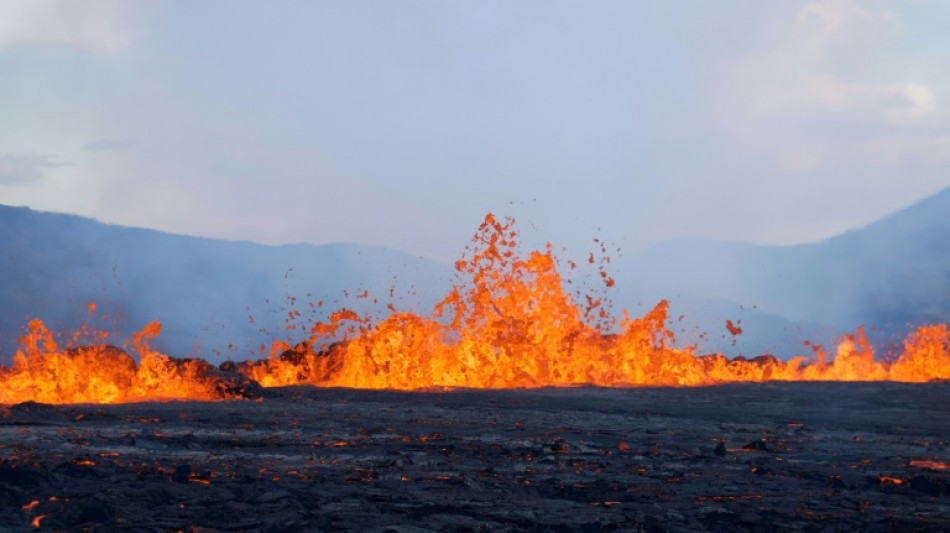
'Indescribable': the heat and roar of Iceland's volcano / Photo: Jeremie RICHARD - AFP

 Zach Hickerson Recounts Hayden Panettiere's Final Moments in New Interview

 Luxembourg Housing Petition Passes Threshold for Parliamentary Consideration

 Raheem Sterling Receives Suspended Sentence After Lamborghini Crash

 Audience to Choose the Set List at Luxembourg's First FAMIL Jukebox Night

 Luxembourg Pay Rise Delayed as Regional and World Headlines Develop

 Chennai Urbanist Sashna Develops 'Anniki' Card Game to Gamify Tamil Nadu History

 Transport Minister Defends Land Seizure Powers for Toronto-Quebec City High-Speed Rail

 UAE Weather Forecast: Scattered Showers and Fog Expected as Temperatures Drop
The ground rumbles underfoot, then roars as red-orange lava fountains shoot up from the ground, the intense heat cloaking the nearby crowd awestruck by Iceland's latest volcanic eruption.
"It's indescribable", says 40-year-old French tourist Magalie Viannisset, one of the curious onlookers gazing in wonder on Thursday at the fissure that opened up a day earlier in an uninhabited valley just 40 kilometres (25 miles) from Iceland's capital Reykjavik.
"You feel it in your heart. Imagining it or seeing it on TV is nothing compared to seeing it in real life -- there is heat, smells, the sound of the lava flowing", she tells AFP.
As the lava fountains hit the ground, a blanket of magma reaching temperatures of 1,200 degrees Celsius (2,192 degrees Fahrenheit) spreads into the valley, plumes of smoke giving off an odour of rotten eggs from the sulphur.
Occasionally, helicopters whirring overhead interrupt the roar of the lava.
Some intrepid visitors walk right up to the cooling magma, including scientists measuring its thickness and taking samples to study in their labs.
Others, both locals and tourists overjoyed at being in the right place at the right time, keep a safer distance, taking in the dramatic views from nearby hilltops.
"It's absolutely stunning," says Theo, a 14-year-old Norwegian visiting with his family.
The Icelandic Meteorological Office has estimated the fissure is around 360 metres long, with lava fountains about 10-15 metres high.
The lava covers an area of about 74,000 square metres, it said.
- 'Feel Earth's power' -
Visitors must make a strenuous trek to reach the site on the Reykjanes peninsula, around two hours from the nearest car park.
Walking along the trail, people can be heard speaking English, French, Spanish, Italian, and of course Icelandic.
The winding trail runs near the lava fields created last year by the nearby Mount Fagradalsfjall eruption, which spewed up molten rock for six months.
Like scars, cracks in the ground along the trail serve as reminders of the seismic activity that has been stirring underfoot in the region for the past year and a half.
Known as the land of fire and ice, Iceland has 32 volcanic systems currently considered active, the highest number in Europe. The country has had an eruption every five years on average.
However, until last year, the Reykjanes peninsula had not experienced one since the 13th century, when a volcano erupted for 30 years from 1210-1240.
Geophysicists have said the 2021 eruption could signal the beginning of a new period of eruptions lasting centuries. For now, the craters it left behind remain silent.
As the trail approaches the Meradalir Valleys (the Valleys of the Mares), the latest eruption comes into view, enthralling trekkers with nature's raw force.
"You feel the power of the Earth. You look at the stone and you see it melting, it is not a usual thing", marvels Agusta Jonsdottir, a 52-year-old Icelandic woman.
Icelanders never seem to tire of watching volcanoes.
"We came early and we were sitting in the moss, watching and enjoying for a couple of hours. And it was so calm", says Audur Kristin Ebenezersdottir, 53.
"Just you and the nature -- it's very nice."
T.Sanchez--AT


