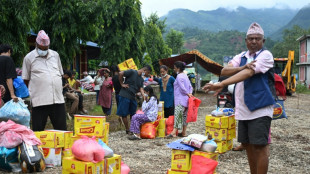
Scientists call for more research into 'climate endgame' / Photo: DAVID MCNEW - AFP/File

 Putin denies plan for new Russia military call up
 Caruana Galizia: 'one-woman WikiLeaks' who exposed Malta's shady side
 Kuwait's Iranians under pressure since start of war

 EU lawmakers demand Brussels force Meta to 'protect' European children
 Clooney turns AFP photographer in jokey red carpet switch
 Retirement Income Planning Florida Launches No-Cost 'Income Gap Analysis' Program for Pre-Retirees

 Iraola hails Barcola mentality after blockbuster Liverpool move
 Michelsen shocks Nakashima in US Open clash of rising Americans

 US govt sides with OpenAI in New York Times copyright lawsuit

 Grammy-Winning Jazz Vocalist Cassandra Wilson Dies at 70

 Maui Wildfire Survivors Report Major Losses to Troubled Rebuilding Contractors

 WMO Says Powerful El Niño Is Likely to Persist Into February 2027
 Honda Presses Suppliers for Deep Cost Cuts in $9.4 Billion Savings Drive
 Philadelphia Festival Revisits the Signing and Legacy of the U.S. Constitution

 Russia to close branches of Germany's Goethe Institute

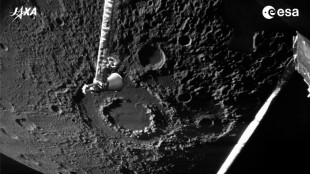 Spacecraft bound for Mercury faces 'tricky' arrival

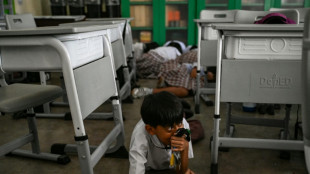 Philippines holds drills to safeguard students from armed intruders

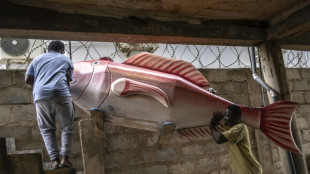 In Ghana, larger-than-life coffins tell the stories of the dead
 Menoncello, Reece headline Top 14 new-season signings

 Families descend on Nepal in search of missing tourists

 Far-right AfD eyes huge win in east German state vote

 Brazil-Japan to play World Cup rematch at Singapore tournament

 Defence chiefs back boosting US military presence in Australia

 Nepal seeks climate justice after Himalayan disaster

 Stocks rise, yields ease as oil slips on Trump hint at short bombing campaign

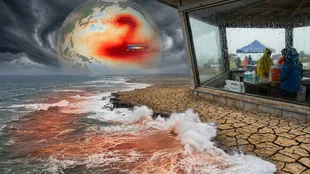
The world must prepare for a "climate endgame" to better understand and plan for the potentially catastrophic impacts of global heating that governments have yet to consider, scientists warned Tuesday.
Climate models that can predict the extent of global warming depending on greenhouse gas emissions are increasingly sophisticated and provide policymakers with an accurate trajectory of global temperature rises.
What is less well explored is the cascading impact of certain events, such as crop failures and infrastructure loss due to extreme weather events, which are made likelier to occur with every degree of warming.
Researchers at the University of Cambridge and the Potsdam Institute for Climate Impact Research (PIK) outlined what is currently known about "catastrophic outcomes" and found gaping knowledge gaps.
Writing in the journal the Proceedings of the National Academy of Science, they proposed an international research agenda to help governments plan for "bad-to-worst cases".
These included four main areas of concern -- what the authors termed the "four horseman" of climate change: famine and malnutrition, extreme weather, conflict, and vector-borne diseases.
"Irreversible and potentially catastrophic risks caused by human induced climate change must be factored into our planning and actions," said Johan Rockstrom, PIK director and a study co-author.
He said that the more research is done on Earth's climate tipping points -- such as the irreversible melting of the ice caps or the Amazon rainforest turning from a carbon sink to source -- showed the ever-greater need to factor in high-risk scenarios into climate modelling.
"Key is to do the math of disaster, in order to avoid it," he said.
- 'Mismatched caution' -
The authors pointed out that successive UN climate science reports have mainly focused on the predicted effects of 1.5C-2C of warming and largely discounted the possibility of more excessive temperature rises.
Government plans put Earth on course to rise as much as 2.7C this century, a far cry from the 1.5-C cap envisaged in the 2015 Paris climate accord.
The study suggested that a scientific disposition to "err on the side of least drama" led to a lack of focus on potential impacts at 3C of warming or higher.
"This caution is understandable, yet it is mismatched to the risks and potential damages posed by climate change," it said.
In addition, risk assessments for so-called low-likelihood, high-impact events are notoriously difficult to accommodate in long-term climate modelling.
The researchers calculated areas of extreme heat -- with an annual average temperature of over 29C -- could cover two billion people by 2070.
They warned that temperatures posed a major risk of multiple "breadbasket failures" due to drought such as that gripping western Europe and heatwave such as the one that hit India's wheat harvest in March/April.
The team called for a special UN science report focusing on "catastrophic climate change scenarios" similar to its 2018 report on 1.5C of warming.
"We have to get serious about understanding the profound risks that come with moving our planet into unknown territory," said Joeri Rogelj, director of research at Imperial College London's Grantham Institute, who was not involved in the study.
"Researching these extreme cases means that we'll be able to better prepare, including by being more serious about reducing emissions now."
Th.Gonzalez--AT