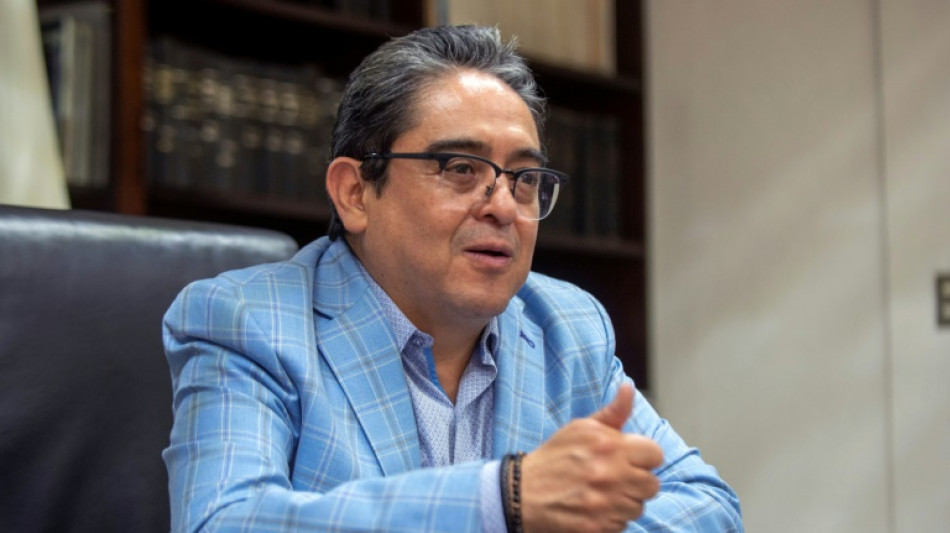
Guatemalan corruption at one of 'worst' levels, says ombudsman / Photo: Carlos ALONZO - AFP

 Zach Hickerson Recounts Hayden Panettiere's Final Moments in New Interview

 Luxembourg Housing Petition Passes Threshold for Parliamentary Consideration

 Raheem Sterling Receives Suspended Sentence After Lamborghini Crash

 Audience to Choose the Set List at Luxembourg's First FAMIL Jukebox Night

 Luxembourg Pay Rise Delayed as Regional and World Headlines Develop

 Chennai Urbanist Sashna Develops 'Anniki' Card Game to Gamify Tamil Nadu History

 Transport Minister Defends Land Seizure Powers for Toronto-Quebec City High-Speed Rail

 UAE Weather Forecast: Scattered Showers and Fog Expected as Temperatures Drop
Corruption in Guatemala is at unprecedented levels under an "authoritarian" government that punishes prosecutors and judges investigating organized crime, the country's ombudsman told AFP in an interview.
"We're going through one of the worst moments" with respect to corruption, said Jordan Rodas, the Central American nation's top defender of human rights, whose five-year term in office is due to end in mid-August.
Before he leaves, Rodas has decided to lift the lid on the state of Guatemala under its last two presidents, Jimmy Morales (2016-20) and the incumbent Alejandro Giammattei.
"We are under an authoritarian regime. We have a masquerade of democracy but (it's) very fragile," said Rodas, who claims Guatemala's institutions have been "co-opted."
His accusations come after police on Friday arrested journalist Jose Ruben Zamora and raided the offices of the newspaper he founded after it accused key political figures of corruption.
In June, the Inter-American Commission on Human Rights (IACHR) added Guatemala to a list of countries committing serious human rights violations that includes Cuba, Venezuela and Nicaragua.
The IACHR accused Guatemala of "progressively weakening democratic institutionality" and "irregularities in the process of electing magistrates," amongst other undemocratic processes.
Earlier this year, the United States designed Giammattei and Attorney General Consuelo Porras as corrupt actors.
On Saturday, journalists protested outside the courts in the center of Guatemala City against Zamora's detention.
Rodas, 53, took office in August 2017 and within a week was already in conflict with the government.
He managed to prevent Morales from expelling the International Commission Against Impunity in Guatemala (CICIG), a United Nations entity working in conjunction with Guatemala's public prosecutor on corruption cases.
The CICIG accused Morales of electoral corruption, alongside business allies previously considered untouchable.
But while Morales lost his judicial battle with Rojas, he refused to renew the CICIG mission in 2019 and the corruption investigations ground to a halt.
Rojas said his relationship with the government was "tense, oppressive, harassing."
The state has got the upper hand since the CICIG left, says Rojas, by co-opting institutions and eroding the separation of political and economic powers.
He accuses the government of a "well-defined strategy" of persecuting former CICIG officials and those from Guatemala's Special Prosecutor Against Corruption (FECI), as well as independent judges.
Several people involved in investigating corruption have gone into exile out of fear, including former attorney general Thelma Aldana and Juan Francisco Sandoval, the former FECI chief.
Sandoval, considered by the United States as a champion of the anti-corruption fight, was sacked in July 2021 by Porras.
Rojas says the international community "could do more" to fight corruption in Guatemala, including hitting more people with sanctions, including businessmen who "feed this perverse strategy".
Last week, Washington sanctioned another 16 Guatemalans, including the current FECI chief Rafael Curruchiche, appointed by Porras.
F.Wilson--AT


