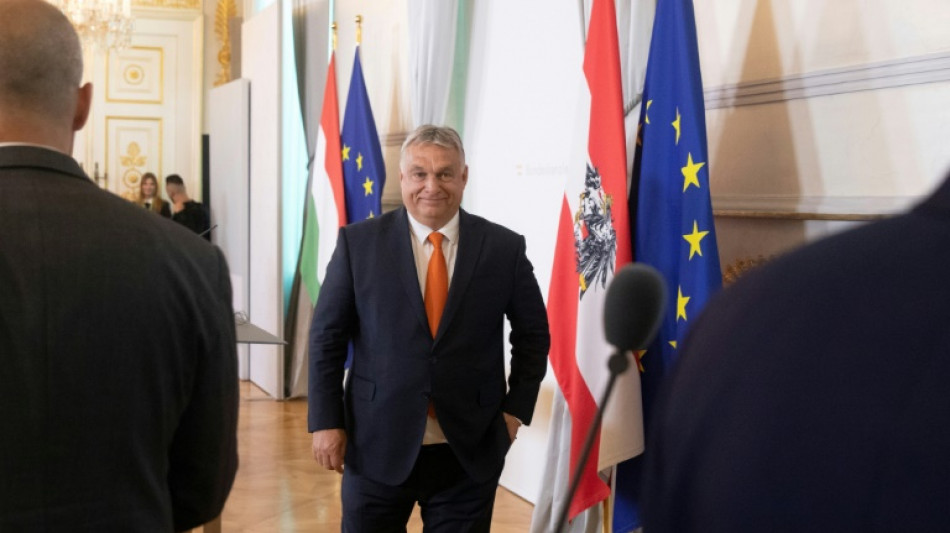
Hungary's Orban defends 'cultural standpoint' in race row / Photo: Alex HALADA - AFP

 Zach Hickerson Recounts Hayden Panettiere's Final Moments in New Interview

 Luxembourg Housing Petition Passes Threshold for Parliamentary Consideration

 Raheem Sterling Receives Suspended Sentence After Lamborghini Crash

 Audience to Choose the Set List at Luxembourg's First FAMIL Jukebox Night

 Luxembourg Pay Rise Delayed as Regional and World Headlines Develop

 Chennai Urbanist Sashna Develops 'Anniki' Card Game to Gamify Tamil Nadu History

 Transport Minister Defends Land Seizure Powers for Toronto-Quebec City High-Speed Rail

 UAE Weather Forecast: Scattered Showers and Fog Expected as Temperatures Drop
Hungary's nationalist Prime Minister Viktor Orban on Thursday defended his comments against creating "peoples of mixed-race", saying they represented a "cultural" standpoint, drawing a stinging rebuke from Washington.
"It happens sometimes that I speak in a way that can be misunderstood... the position that I represent is a cultural... standpoint," Orban told reporters during a visit to neighbouring Austria.
Orban sparked a storm of criticism after he warned against mixing with "non-Europeans" in a speech in Romania's Transylvania region, home to a Hungarian community, on Saturday.
The United States on Thursday denounced the remarks as "inexcusable".
State Department spokesman Ned Price read to reporters a statement from US envoy against anti-Semitism Deborah Lipstadt who said that "rhetoric of this nature is inexcusable" some "75 years after the Holocaust".
Decades "after the end of the Holocaust, it is inexcusable for a leader to make light of Nazi mass murder," Lipstadt said.
Price added that the United States and its allies around the world are united by "shared values" along with interests.
"The remarks that we heard from Prime Minister Orban are not reflective of the shared values that tether the United States to Hungary," Price said.
Austrian Chancellor Karl Nehammer said earlier in a joint news conference with Orban that the issue had been "resolved... amicably and in all clarity", adding his country "strongly condemned... any form of racism or anti-Semitism".
- 'Nazi text' -
The International Auschwitz Committee has urged the European Union -- and Nehammer specifically -- to distance themselves from "Orban's racist undertones".
Austria is the first EU country to host Orban for talks since he won a fourth straight mandate in an April landslide.
Besides the race row, the two leaders discussed migration and energy security amid tensions over Russia's invasion of Ukraine.
Vienna sees itself "as an honest broker" and is anxious not to sideline Hungary, an Austrian official told AFP on condition of anonymity.
Jewish community representatives voiced alarm after Orban, an ultra-conservative known for his anti-migrant policy and virulent rhetoric, said that "we do not want to become peoples of mixed-race".
The 59-year-old also seemed to allude to the Nazi German gas chambers when criticising a Brussels plan to reduce European gas demand by 15 percent following Russia's invasion of Ukraine.
Hungary was the only EU member to oppose the plan, which passed on a majority vote this week.
An adviser to Orban, Zsuzsa Hegedus, resigned on Tuesday, slamming his speech as "a pure Nazi text".
In response, Orban stressed his government's "policy of zero tolerance when it comes to anti-Semitism and racism", according to a letter made public.
"I am proud of the results which Hungary achieved against racism in recent years," Orban told reporters on Wednesday.
Both Orban and Nehammer said they would not support any embargo on Russian gas, on which their countries are heavily dependant, with Orban describing any such embargo as a "wall".
"My advice to the European Union is not to hit this wall," said the Hungarian, who recently slammed the EU's sanction policy against Russia as "Europe shooting itself in the lungs".
He added that he wished Brussels would come up with a new "strategy that is good for the Ukrainians, good for us, good for the European economy and good for the households that have to pay the price of energy".
H.Romero--AT


