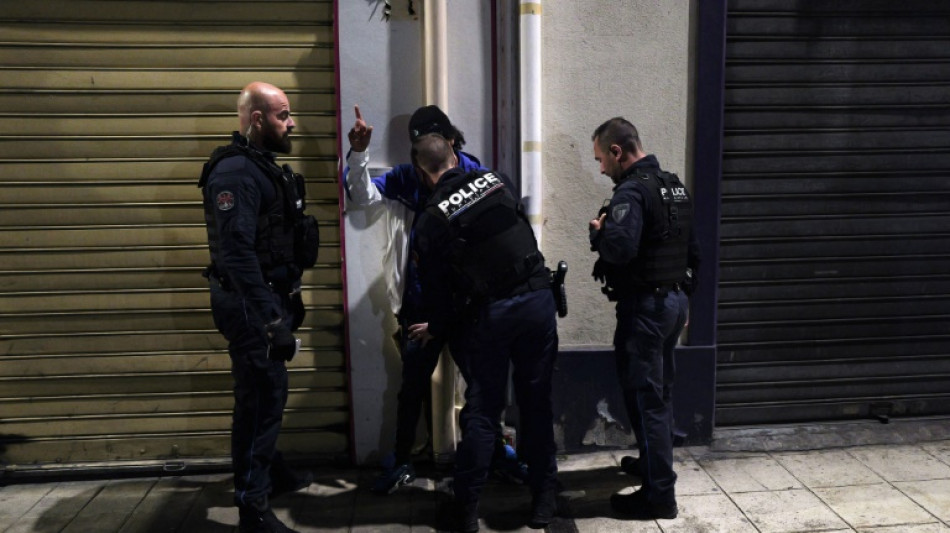
French cities impose curfews for teens to curb crime / Photo: Valery HACHE - AFP

 DiDi Advances Robotaxi Operations in China with New R2 Vehicle and Expanded Safety Infrastructure

 XPENG Launches Two New Models in UK; Pony.ai Robotaxi Enters Pilot

 Pivotree Announces Third Quarter 2026 Results

 ImageWorks Display Advances Whole-Store Solutions with a Re-Imagined Planniq Strong and Planniq Chill

 Broad Clinical Labs Drives Strong Digital Engagement by Connecting Customers with Published Research Through Bioz

 InterContinental Hotels Group PLC Announces Transaction in Own Shares - November 17

 Pilot-Founded Solara Global Jet Offers Charter, Leases and Air Cargo Nationwide and Overseas

 Three Inaugural CombatX Champions Crowned at BRAVE CF Road to BRAVE Event in Hungary
 China's Factory Activity Contracts as Export Orders Weaken

 US Retail Sales and Fed Minutes Set Up a Critical Test for Consumers

 Oil Heads for Second Weekly Loss as Supply Surplus Emerges

 Asian Markets Slide as AI Concerns Hit Chip Stocks

 Canada Signals Openness to Chinese Automakers if US Trade Talks Fail

 US Mortgage Rate Falls for Fourth Week but Remains Above 7%

 Italy Raises 2026 Growth View but Warns Energy Will Keep Inflation High

 Euro-Area Growth Slows to 0.4% While Employment Stalls
 UK Economy Grows 0.7% in Third Quarter as Services Lead Expansion

 India's Retail Inflation Reaches 6.09% as Food Prices Accelerate
Several French cities have this summer introduced a curfew for teenagers in a bid to curb youth violence, but even some mayors are not sure if the ban should be enforced.
While some experts say that curfews for minors do not reduce crime, one French mayor begs to disagree.
"It's become very quiet," said Cedric Aoun, the mayor of Triel-sur-Seine located 35 kilometres (21 miles) west of Paris.
The 11 pm to 5 am curfew has been introduced in Triel-sur-Seine for under-18s after a series of incidents involving damage of public property and theft.
Aoun said many families have started taking their parental responsibilities more seriously.
"Parents are much more careful," he said.
More towns in France are enforcing curfews for teenagers irrespective of their mayors' political leanings as authorities seek to respond to youth crime.
In the southern city of Nimes, a temporary curfew has been introduced for children under 16 after a spate of urban violence linked to drug trafficking.
The southern city of Beziers, Saint-Ouen-sur-Seine north of Paris and Villecresnes in the southeastern suburbs of the French capital have adopted similar bans.
Last year, six percent of crimes were suspected to have been carried out by teens aged between 13 to 17, according to the interior ministry. More than a third of violent robberies without a weapon were attributed to suspects in that age group.
- 'No business on the street' -
But it is difficult to assess the effectiveness of the curfews for minors in many places.
During a recent nighttime patrol in Triel-sur-Seine, police officers stopped a group of minors who huddled together in a square 45 minutes after the start of the curfew.
Some teenagers said they were unaware of the ban.
Still, the head of the town's municipal police praised the measure.
Anthony Rouet said the curfew "allows us to take preventive action before damage is done".
So far his team had mostly been talking to teens about the night-time ban on being in the streets, not issuing them with tickets, he added.
But he also acknowledged that, when police did report some teenagers to the judiciary, this had not deterred them from reoffending.
"They weren't punished and came back and started vandalising and stealing again," said Rouet.
Some parents support the ban.
"At 17, you have no business being out on the street" at night, said Mickael Chapparelli, 35.
But many think otherwise, another resident said.
"Here, parents of most of the children who hang around until 2 am say it's no problem," said the resident, speaking to AFP on condition of anonymity.
"And when they get into trouble, they say it's not their son."
The mayor of Villecresnes, Patrick Farcy, lamented police staffing shortages.
They do not respond to calls late at night except during the weekends, and street lighting is turned off in some areas to limit gatherings.
He said authorities had reported around 40 violations of the curfew since the beginning of the summer, but not all parents had received the related fines.
"Too much time passes between the offence being reported and the fine being issued," Farcy said.
- 'Psychological' -
The mayor of Pennes-Mirabeau outside the southern port city of Marseille said the effectiveness of the curfew was hard to estimate.
Last year, he temporarily ordered children under 13 off the streets between 11 pm and 6 am, but has not reintroduced the ban this year.
The mayor, Michel Amiel, said the effectiveness of the ban was "difficult to quantify."
"It is mainly psychological," he added.
Rights campaigners argue for more community engagement rather than bans.
Nathalie Tehio, head of the French Human Rights League, called for the development of "educational measures" rather than "repressive" bans.
Her group has taken legal action against the ban in Triel-sur-Seine.
"This is not an effective response," she said.
elt-jra-vxm-bdq-as/ah/ach
N.Walker--AT