
Omega Protein and Ocean Harvesters Urge Science-Based Review Before Imposing New Menhaden Restrictions

 US regulator, 22 states accuse Amazon of 'manipulating' ad auctions: lawsuit

 TRON Founder Justin Sun Shares Outlook on Bitcoin, Stablecoins and Global Finance at Bitcoin Asia 2026

 Tributes to 'eternal' Messi on Argentina retirement

 Arteta hails Arsenal's 'finishers' after Saka kills off Villa

 Yamal, Raphinha bag braces as Barcelona rout Rayo

 Alcaraz makes winning return at US Open, Sabalenka safely through

 Everton agree to sign Monaco's Balogun: reports

 Milei calls for F1 to return to Argentina

 Alcaraz wins US Open first-round match after injury layoff

 Kyiv orders heightened security amid intense Russian drone strikes

 Sabalenka kickstarts US Open three-peat bid as Fils crashes out

 Fils upset by resurgent Tsitsipas at US Open

 Trump says AI data center opponents want to be 'backwards and poor'

 Pakistan ditch coaches, send seven players home after England defeats

 Galliano pulls Met Gala exhibit after antisemitism backlash

 Afghan people should 'not be abandoned': top Red Cross official

 Six defining moments of Lionel Messi's Argentina career
 Trump blasts US backlash against data centers

 It 'hurts' says Messi of decision to retire from international football

 Benzema ends brief stint with Al Hilal in Saudi league

 Djokovic's Grand Slam future uncertain after brutal US Open defeat

 Turkey says regional defence pact not against any country

 US vows to keep economic pressure on Iran as G20 finance talks begin

 Shein valued at $26.3 bn in Hong Kong market debut

 Crude prices rise above $90 per barrel on US-Iran strikes

Letter from Veteran Biologist Addresses Scientific Questions Over Osprey Declines
WASHINGTON, DC / ACCESS Newswire / July 29, 2025 / In a letter submitted to the Atlantic States Marine Fisheries Commission (ASMFC), Peter Himchak, Senior Scientific Advisor to Omega Protein, warned that "there has been an inordinate amount of focus on menhaden generally, and the reduction fishery in particular" in discussions about recent osprey declines in the Chesapeake Bay.
Omega Protein, which processes menhaden into fishmeal, fish oil, and related nutritional products, is supplied by Ocean Harvesters under a long-term harvesting agreement. Himchak submitted the letter on behalf of the company ahead of the ASMFC's Summer Meeting.
Himchak, who served for 39 years as a fisheries biologist with the New Jersey Division of Fish and Wildlife and as a long-time advisor to both the ASMFC and the Mid-Atlantic Fishery Management Council, sat on the ASMFC's Atlantic Menhaden Technical Committee and Stock Assessment Sub-Committee from 1988 until 2006.
In the letter, Himchak criticized the ASMFC's Work Group on Precautionary Management in Chesapeake Bay for proposing "draconian management recommendations 'without determining if there is or is not an adequate supply of menhaden to support predatory demand in the Bay.'" He warned that moving forward with such actions without first determining whether there are, in fact, fewer menhaden in the Bay or whether the fishery has any impact on osprey "risks gravely impacting a more than 150-year-old industry and hundreds of jobs while doing nothing to improve the osprey situation."
Himchak wrote that the ASMFC's Technical Committee (TC) already has a significant workload in advance of the Commission's Annual Meeting, but raised four areas of scientific inquiry the TC could investigate that would provide the Board with more complete information.
1) He asked whether "the phenomenon of reduced osprey production [is] confined to the times and areas in which the menhaden reduction fishery operates," referencing USGS data showing declines in osprey abundance in coastal areas of multiple states-not just the Chesapeake-and increases in interior regions. He also noted that the fishery does not begin fishing until May or later-after migrant ospreys arrive in the region from late February to early March and begin building nests from mid-March to mid-April-raising questions about how the fishery could influence osprey's months-earlier decisions about where to nest.
2) He wrote that there have been sizable increases in populations of multiple menhaden-dependent predators since at least the turn of the century, and that a stomach contents analysis of striped bass, which are only somewhat dependent on menhaden, indicated they "are not starving and would be considered healthy." Therefore, he asked, "is it more likely that ospreys are being outcompeted or that the reduction fishery uniquely impacts osprey?"
3) Regarding eagle-osprey interactions, he noted a recent Maryland DNR release announcing "large increases in the state's bald eagle population." He referenced myriad studies finding that bald eagles are "kleptoparasitic"-a term used to describe their well-documented habit of attacking hunting osprey to steal their food or prey on adults, young, and eggs. Citing a study from Voyageurs National Park, he wrote that "increased numbers of eagles were associated with a reduction in the numbers of osprey nests, their nesting success and heronry size," and asked whether "issues of competition and depredation [can] be ruled out as a cause of osprey's lack of breeding success." He further pointed to "significant scientific and anecdotal evidence of the dominant and adverse impacts eagles have on osprey."
That concern was echoed in a newly released Saving Seafood special report titled "Bald Eagle Recovery in Chesapeake Bay Raises Red Flags for Osprey." The report compiled over three decades of peer-reviewed research, field observations, and published accounts documenting instances in which eagles had a negative impact on osprey populations. In one study, researchers found "eagle abundance was negatively associated with nest reuse (i.e., persistence) and success of ospreys." Significantly, the researchers found "little evidence of bottom-up limitations," such as poor weather or declining fish stocks, and emphasized the role of eagle aggression, including harassment and food theft. While this body of research does not prove the resurgence of bald eagles in the Chesapeake to be the cause of osprey reproduction issues, it does indicate it is a possibility deserving of further investigation.
The full report is available at: https://www.savingseafood.org/science/bald-eagle-recovery-in-chesapeake-bay-raises-red-flags-for-osprey
4) Himchak also asked the Technical Committee to consider whether osprey foraging success is being affected by climate-driven environmental changes, including storm frequency, shoreline hardening, warming waters, or hypoxia. Citing a 2024 study by Bryan Watts, he noted that "deliveries of all forage species to osprey nests declined steadily from 1974 to 2021," and asked whether "ospreys' apparent lack of foraging success is tied to changes in local conditions that are impacting either local abundance of forage or osprey's hunting success."
He concluded the letter by writing, "The commission must be guided by science. Precipitous actions, taken in the name of precaution, are not always harmless. Neither Ocean Harvesters nor Omega Protein can survive without the current low level of access to the menhaden resource in the Bay. There simply are not enough 'fishable days' - that is, days where the weather and sea conditions allow vessels to operate - in a year to safely conduct a profitable fishery solely in the ocean. The menhaden fishery is managed in the most conservative manner in its 150 year or so history, and the reduction fishery is operating at its lowest sustained levels - in the Bay and overall - for as long as we have reliable records (i.e., since the 1950s). Precaution is already the policy. Before taking actions that could cause irreversible economic harm to this historic fishery, the Board should ensure that all reasonable avenues of inquiry into the issues facing osprey are explored."
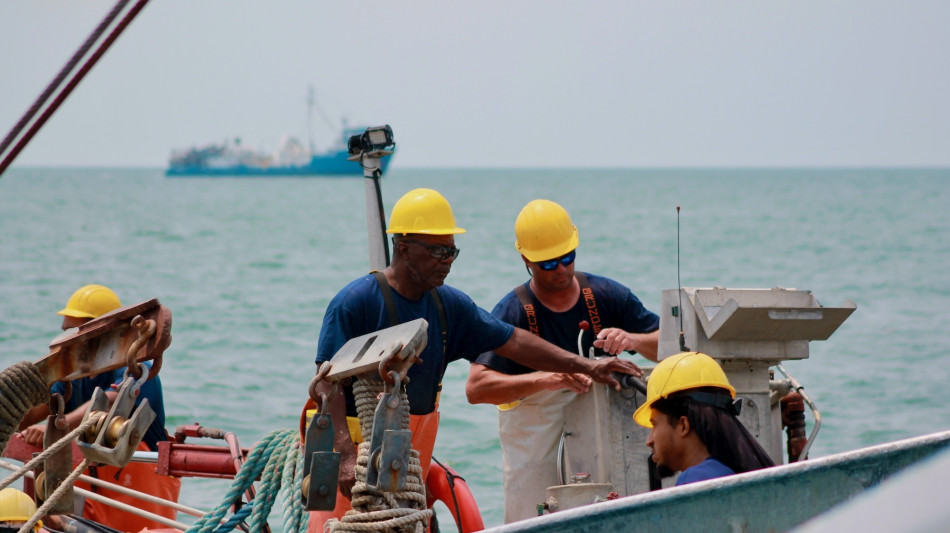
Commercial menhaden fishermen at work. (Photo: Ocean Harvesters)
About the Menhaden Fisheries Coalition
The Menhaden Fisheries Coalition (MFC) is a collective of menhaden fishermen, related businesses, and supporting industries. Comprised of businesses along the Atlantic and Gulf coasts, the Menhaden Fisheries Coalition conducts media and public outreach on behalf of the menhaden industry to ensure that members of the public, media, and government are informed of important issues, events, and facts about the fishery.
Press Contact
Stove Boat Communications
(202) 595-1212
[email protected]
SOURCE: Menhaden Fisheries Coalition
View the original press release on ACCESS Newswire
R.Lee--AT