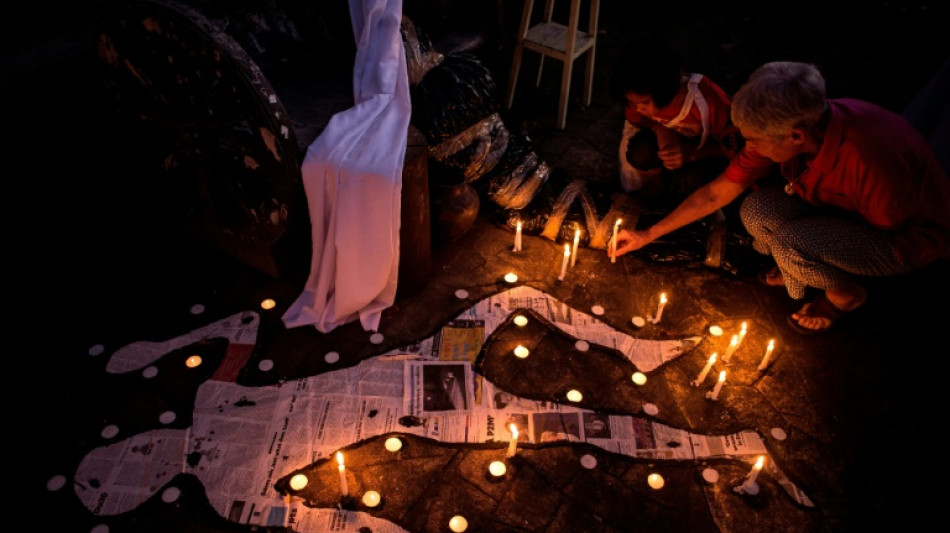
Duterte unlikely to face court over Philippines drug war killings / Photo: NOEL CELIS - AFP/File

 England were 'waiting for death' in World Cup semi-final defeat: Tuchel

 NFL star fined for displaying name of slain Palestinian girl
 Witsel retires from internationals after 18-year Belgium career

 US Fed raises rates to battle inflation in move likely to rile Trump
 Fitzpatrick 'not comfortable' over Dubai golf finale

 Gaza apartment block collapse kills 21, including 12 children
 Gaza apartment block collapse leaves 21 dead
 US House targets data centers as midterm backlash grows

 French ex-minister Dati goes on trial in Renault-Nissan corruption case
 'Being Heumann' captures joy in fight for disability rights
 Retired great Nadal to play in exhibition matches
 IR-MED and Dice Technologies Announce collaboration to Evaluate and Advance Pressure-Injury Prevention Platform in Japan

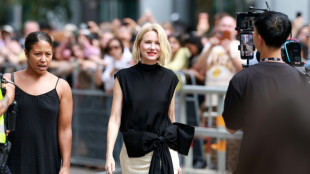 Watts, Pitt, Cruz to light up Spain's top film festival

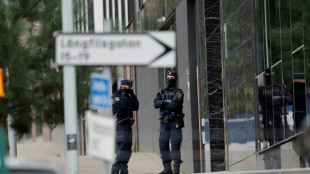 Sweden expels Iran embassy employee over anti-Jewish threats
 Toogood Gold's Table Mountain Sits in the Shadow of a Nevada Gold Rush

 MEXC July–August Security Report: 38.66M USDT in Risk Funds Intercepted, Futures Insurance Fund Hits 792M USDT

 'Breathing toxin every day': Indonesians choked by haze feel helpless
 Stocks edge higher ahead of US Fed rate call
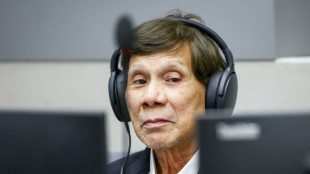 Philippines ex-leader Duterte makes first in-person ICC appearance
 2027 Formula One calendar includes Monaco sprint race
 Palestinians are the real victims, Thunberg tells Ed Sheeran

 Hashim Thaci: From 'George Washington of Kosovo' to Hague convict
 Amnesty says Iran committed 'crimes against humanity' in crackdown on 2022 protests

 EU to ban social media for under 13s, curb access until 15

 Philippines ex-leader Duterte makes first appearance at ICC
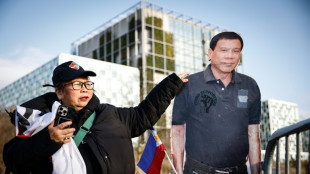
Philippine President Rodrigo Duterte often incited violence and ordered police to shoot dead suspects in a drug war that has killed thousands. But analysts say he is unlikely to face charges after he steps down Thursday.
Duterte's signature policy to rid the country of drugs has been widely condemned and sparked an international probe into a possible crime against humanity.
But the 77-year-old is still hugely popular among many in the Philippines who support his quick-fix solutions to crime, and he remains a potent political force.
Last month's election results reinforced Duterte's bulwark against potential prosecution after he leaves office, analysts said.
Ferdinand Marcos Jr, son of the country's late dictator, won the presidency after striking a powerful alliance with Duterte's daughter, Sara, who was elected vice president.
Marcos Jr has backed Duterte's drug war and signalled his government will not cooperate with the International Criminal Court's (ICC) investigation into the killings.
"The election basically decided that there would not be a serious investigation into President Rodrigo Duterte's role in the drug war for the next six years," said Greg Wyatt, director for business intelligence at PSA Philippines Consultancy.
A self-professed killer, Duterte told officers to fatally shoot narcotics suspects if their lives were at risk.
He defended the crackdown, saying it had saved families and prevented the Philippines from turning into a "narco-politics state".
Government data show more than 6,200 people have died in police anti-drug operations since Duterte was swept to power in 2016.
Rights groups say Duterte created a climate of impunity and estimate that tens of thousands have been killed by police, hitmen and vigilantes, even without proof they were involved in drugs.
Only three policemen have been convicted for slaying a drug suspect.
Under pressure from the UN Human Rights Council and the ICC, the government has examined around 300 cases of drug operations that led to deaths.
Justice Secretary Menardo Guevarra told AFP in October that a review of 52 cases had cast doubt on the officers' common claim of self-defence.
Charges have been filed in five cases.
Lawyers representing families of victims have vowed to take legal action against Duterte in the Philippines after June 30.
But they admit the odds are stacked against them.
"We are not that hopeful but it's worth a shot," said Edre Olalia, president of the National Union of Peoples' Lawyers.
Olalia said it can take years for a case to be resolved in the creaky judicial system. And lawyers struggle to gain access to evidence held by police.
- 'Window dressing' -
A major challenge to mounting a case against Duterte will be the Ombudsman he appointed, said jailed Duterte critic and Senator Leila de Lima.
"His clout with the present Ombudsman, the only official authorised to file charges against him in relation to the EJKs (extra-judicial killings), survives even after he leaves office," de Lima said in a statement to AFP.
The last hope for many families seeking justice is the ICC, said Carlos Conde, a senior researcher at Human Rights Watch.
ICC judges authorised a full-blown investigation into the anti-narcotics campaign in September, saying it resembled an illegitimate and systematic attack on civilians.
It suspended the probe two months later, after Manila said it was looking into the alleged crimes.
Conde said the government was trying to "hoodwink" the international community, particularly the ICC.
"A lot of what they've been doing is just window dressing, they are just trying to buy time," he said.
ICC prosecutor Karim Khan announced Friday that he intended to resume his probe into the drug war "as quickly as possible", saying Manila's request to defer the investigation was unjustified.
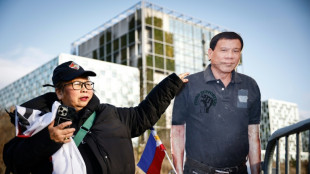
Duterte has refused to cooperate with The Hague-based court, claiming it has no jurisdiction.
He pulled the Philippines out of the ICC in 2019 after it launched a preliminary investigation into his drugs crackdown.
Even if the ICC gathers enough evidence to bring a case against Duterte, its rules prevent him from being tried in absentia.
"ICC, I know you're listening, stop the drama that you'll indict me," Duterte said Thursday, offering to act as a lawyer for anyone in uniform who shoots dead a criminal after he leaves office.
Another option for justice was an "unofficial truth commission", said Ruben Carranza, a senior expert at the New York-based International Center for Transitional Justice.
Carranza, who was previously involved in efforts to recover money and assets stolen by the Marcoses, said it would allow families of drug war victims to tell their stories.
"In a country like the Philippines," he said, "I think it's important to fight for the truth whenever it's possible."
S.Jackson--AT