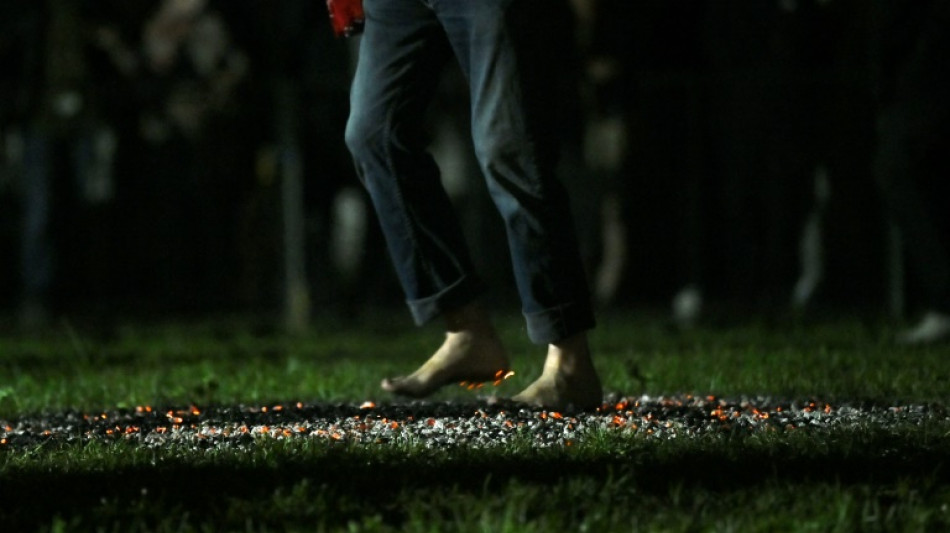
Fire walkers defy pain in ancient Greek ritual / Photo: Sakis Mitrolidis - AFP

 Zelensky warns airlines Russian skies not safe due to Ukraine drones

 UK vows anti-settler measures as Israel warns of retaliation

 New pro Koivun among US Presidents Cup picks

 G20 finance leaders close talks marked by US welcoming Russia

 From Hollywood to big time tennis: teen makes US Open debut

 Man City secure Premier League record deal to sign Fernandez

 Kaepernick says NFL 'blackballing me' decade after protest

 Atletico loan David from Juve, send Lemar to Elche

 Chelsea 'keeper Sanchez makes deadline-day move to Como

 Kroenke to buy baseball's Los Angeles Angels: statement

 US defends Trump's Venezuela oil deal

 OpenAI to launch new model with 'stronger safeguards' after hack

 Fans mourn 'bittersweet' final Ariana Grande gig in London

 Norway's King Haakon VIII swears allegiance to constitution

 Syria site infrastructure 'consistent with nuclear reactor': IAEA

 Juventus sign Woltemade, Sarr on loan from Premier League

 US strikes Iran in latest tit-for-tat attacks

 China's Xi arrives in Egypt as US sanctions threat looms over Iran links

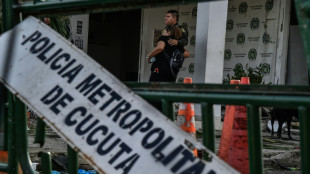 Car bomb at Colombian police station kills one, injures 11

 Rain delays start of play on US Open

 Man City agree blockbuster deal to sign Chelsea star Fernandez: reports

 Alkemya Metacore Secures $50M via Tokenised Equity to Scale Nickel Energy and Security Tech

 Man City chase Fernandez, Arsenal sell Jesus on deadline day

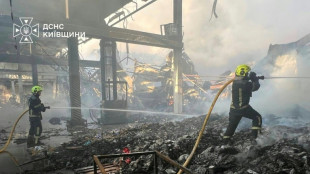 EU says Russian 'hybrid attacks' won't halt aid to Ukraine

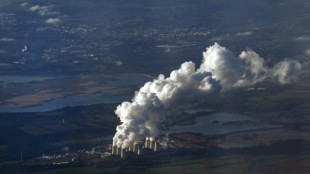 Explosives used in sabotage attack on German power lines

Under a cloud of incense smoke, a group of men and women in a village in northern Greece swayed slowly to the music before removing their shoes and rushing, barefoot, onto waiting embers.
The fire walking ritual, held on the day of the Orthodox feast of Saint Constantine and Saint Helena on May 21, has been practised for over a century in four villages of the Greek region of Macedonia, which borders Bulgaria.
Each year, this ceremony -- called "Anastenaria" ("sighs" in Greek) -- attracts crowds of visitors.
Considered a pagan ritual to honour the ancient Greek gods Dionysus and Artemis, the ancient custom was once banned by the powerful Greek Orthodox Church.
For the past several decades, cooler heads have prevailed.
But the rite remains shrouded in mystery.
"Those who walk on fire don't like to talk about it much," explained Sotiris Tzivelis, 86, who grew up in the village of Agia Eleni, near the city of Serres.
"Back then, when someone fell ill, we would call the 'anastenarides' to help heal them," he told AFP.
The family requesting help would make a special handkerchief, to be blessed during the ceremony.
It is one of these handkerchiefs that the ceremony leader, Babis Theodorakis, gives participants to mark the start of the ritual in the "konaki" -- a room decorated with Orthodox icons where participants prepare by dancing to the sound of the lyre and the drum.
When ready, they head to a nearby meadow and form a circle around the glowing embers.
"I have never walked on fire, but every year, I give our family's handkerchief to the dancers before taking it back at the end of the ritual," said Tzivelis.
- Pagan ritual -
According to local tradition, the rite originated in the villages of Kosti and Brodivo in southeastern Bulgaria, where Greek communities lived before emigrating to Greece in the early 20th century with the collapse of the Ottoman Empire.
"How to walk on fire without getting burned, I can't explain it to you!" said Babis Theodorakis, the ceremony leader.
Apostolis Vlaspos, 65, who has practised the ritual for 20 years, described it as "something internal, an indescribable force".
"The first time I walked on fire, I saw the image of Saint Constantine, whom we call 'grandfather', and I felt like an electric shock," he said.
After circling the glowing embers three times, participants begin to walk on them, swaying to the music and clutching icons under their arms.
When they return to the "konaki", visitors rush to photograph them and check that they have no burns on their feet -- proof of a miracle, according to believers.
The ceremony concludes with a meal of mutton specially slaughtered for the occasion.
"Those who say that people walking on fire are in a trance are wrong," said villager Kostas Liouros, 67.
"What happens to them is natural and requires mental peace and great concentration," he explained.
"Some say we drink alcohol or that before removing our socks and shoes, we coat our feet with herbs and things like that, but none of that is true," added another participant, who declined to give his name.
R.Garcia--AT