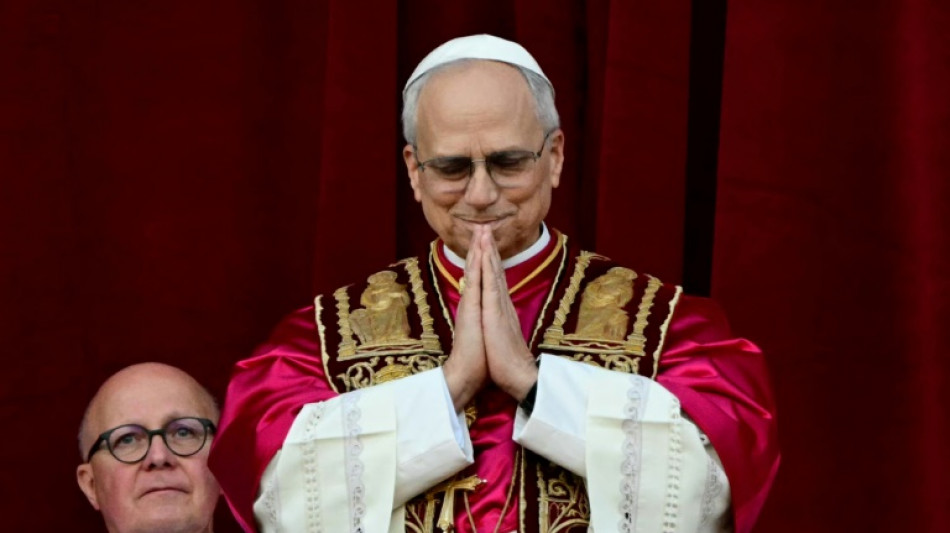
Pope Leo XIV: Soft-spoken American spent decades amid poor in Peru / Photo: Tiziana FABI - AFP

 Australia defends Pacific climate meeting despite doubts on attendance
 Iran attacks US sites after American strikes, wedding deaths
 Stocks drop, yields at three-decade highs on Mideast flare-up

 EU summons Russian envoy, eyes sanctions after Germany drone 'attack'
 Stocks drop as yields and oil prices spike on Mideast flare-up
 Cricketers to get best rooms at Asian Games, says Japan chief
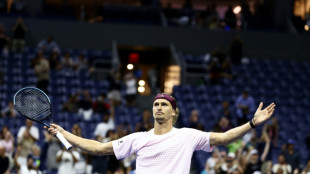 Zverev out-lasts Sonego in wild five-setter to advance at US Open
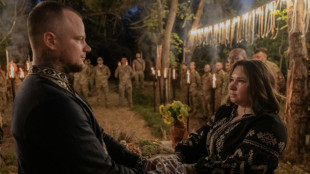 Amid war, Ukrainian soldiers celebrate love at ritual wedding
 Venice to roll out red carpet for Clooney on opening night
 Hong Kong democracy activist Wong pleads guilty to foreign collusion: AFP

 Stocks sink, yields at multi-decade highs and oil spikes on Mideast flare-up

 US defends Trump Venezuela oil deal as energy secretary lands in Caracas
 Jubilant Monfils celebrates birthday with US Open win
 The Japanese idealist behind the last deradicalisation NGO in Somalia
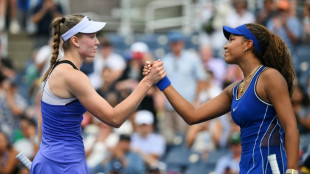
 Rybakina, Gauff advance as Zverev launches US Open campaign
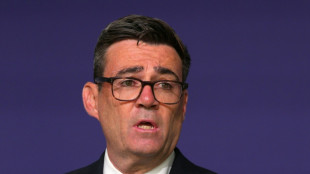 Macron in Britain to help unveil tapestry, hold Burnham talks
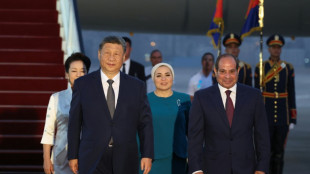 China's Xi to hold talks with Sisi in rare visit to Egypt
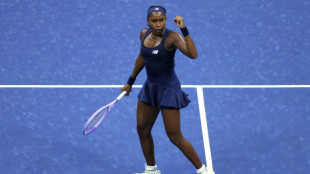 Confident Gauff reaches US Open 2nd round with straight-set win
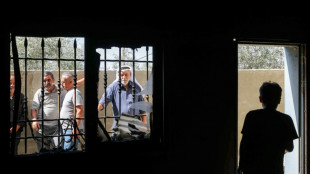
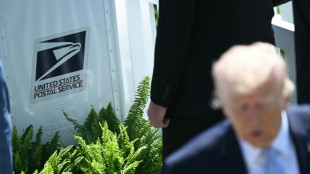 US postal whistleblower warns ballot system could disrupt midterms
 Independent Pharmacy Cooperative Acquires USave Pharmacy Group
 John Ternus takes over as Apple enters era of AI, foldable phones
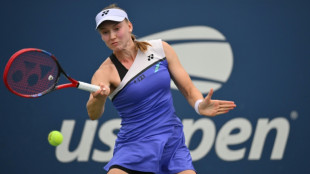 Second-ranked Rybakina eases into US Open 2nd round
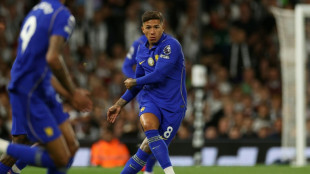
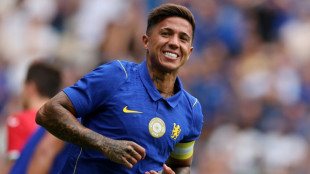 Man City sign Fernandez, Ndiaye as Premier League clubs set new spending record
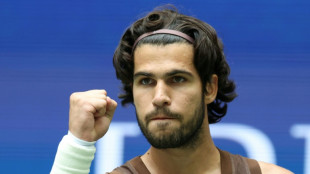 Alcaraz aims to step it up in round two of US Open title defense
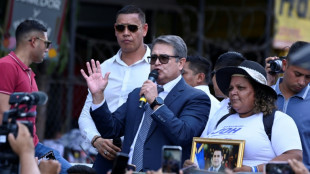 Honduran judge drops corruption charges against ex-leader Hernandez
Robert Francis Prevost, the first pope from the United States, has a history of missionary work in Peru but his powerful role within the Roman Curia has also given him a keen grasp of the inner workings of the Church.
The new Leo XIV, who was born in Chicago, was entrusted by his predecessor Francis to head the Dicastery for Bishops, a key Vatican department that advises the pontiff on appointments.
That role allowed the mild-mannered Prevost, 69, to become known by cardinals within the Curia, the Holy See's government, despite his decades spent outside of Rome and his native United States.
"Leo XIV is a pastoral pope in his approach, attentive to the peripheries. He's a natural candidate for the pragmatic reformist bloc," said Francois Mabille, a researcher at the Paris-based think tank IRIS and author of a book on Vatican strategy.
He called Prevost a "moderate consensus candidate" with experience in the Global South who lacks a "clear-cut ideological profile," making him more acceptable to the Church's conservative bloc.
Francis's confidence in Prevost to head one of the Vatican's most important departments spoke to the younger man's commitment to the "peripheries" -- overlooked areas on the fringes of the Catholic world -- together with his reputation as a bridge-builder and moderate.
After Prevost was named the dicastery's prefect, Francis elevated the Archbishop-Bishop Emeritus of Chiclayo, Peru -- who has dual US and Peruvian citizenship -- to cardinal.
On Thursday, the current bishop of that diocese on Peru's Pacific coast, Edinson Farfan, called the new pope "a brother who has passed through these lands".
"From the beginning when he finished his studies he came to Peru, to the mission in the north of Peru in Chulucanas, with a clear option for the poor. And from the moment he arrived in Peru he fell in love with Peru," Farfan told a press conference.
"He has given his whole life to the mission in Peru," he said, adding that Leo XIV was "sensitive to the issue of poverty".
Prevost also becomes the first Augustinian pope. His work over two consecutive terms as the head of the mendicant order keenly focused on missionary work and charity also took him around the globe.
Vatican watchers had given Prevost the highest chances among the group of US cardinals of being pope, given his pastoral bent, global view and ability to navigate the central bureaucracy.
Italian newspaper La Repubblica called him "the least American of the Americans" for his soft-spoken touch.
His strong grounding in canon law has also been seen as reassuring to more conservative cardinals seeking a greater focus on theology.
- 'Can't turn back' -
Following Francis's death, Prevost said there was "still so much to do" in the work of the Church.
"We can't stop, we can't turn back. We have to see how the Holy Spirit wants the Church to be today and tomorrow, because today's world, in which the Church lives, is not the same as the world of ten or 20 years ago," he told Vatican News last month.
"The message is always the same: proclaim Jesus Christ, proclaim the Gospel, but the way to reach today's people, young people, the poor, politicians, is different," he said.
Born on September 14, 1955 in Chicago to parents of French, Italian and Spanish descent, Prevost attended a minor seminary of the Order of St Augustine in St Louis as a novice. He graduated from Philadelphia's Villanova University, an Augustinian institution, with a degree in mathematics.
After receiving a masters degree in divinity from Chicago's Catholic Theological Union in 1982, and a doctorate in canon law in Rome, the polyglot joined the Augustinians in Peru in 1985 for the first of his two decade-long missions in that country.
Returning to Chicago in 1999, he was made provincial prior of the Augustinians in the US Midwest and later the prior general of the order throughout the world.
He returned to Peru in 2014 when Francis appointed him apostolic administrator of the Chiclayo diocese.
Prevost also serves as president of the Pontifical Commission for Latin America.
L.Adams--AT