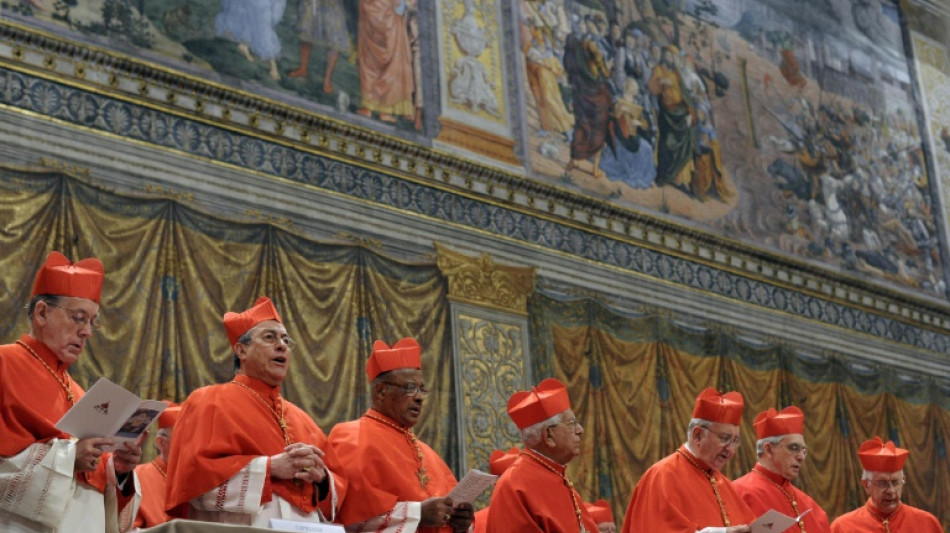
What we know ahead of the conclave / Photo: Handout - OSSERVATORE ROMANO/AFP/File

 DNA tests and funerals in Nepal, a week after deadly floods

 Iran threatens tougher strategy after US strikes kill 4 at wedding
 Chevron unveils deal to double Venezuela venture output in 5 years
 Uganda names its oil 'Pearl Sweet' as it prepares for first exports

 Tiger Woods driver's license suspended for five years after crash

 Germany probes latest sabotage attacks on power grid
 Wall Street stocks mixed as energy prices, bond yields turn lower

 Tiger Woods pleads guilty to reckless driving, license suspended
 Missing passengers likely went down with sunken ferry: N.Cyprus official

 Premier League clubs splash cash to smash transfer record
 Melting glaciers an 'immediate' climate risk: author of UN report

 Folarin Balogun's move to Everton collapses
 Pacific islands to face food shortages over global warming: scientists
 Venice jury head Maggie Gyllenhaal questions lack of women directors
 Stocks drop, bond yields rally on Mideast flare-up
 China expands Egypt investments in first Xi visit in a decade
 Messi departure leaves Argentina facing rebuild after golden era

 Ourbit SuperCEX Launches "Cosmic Wheel Season 3. Oracle Realm" on September 2 with 3M USDT Prize Pool

 Ebola death toll passes 3,000 in DR Congo: official data
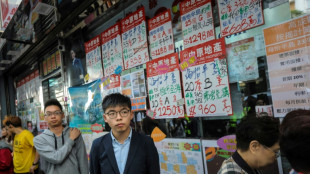 Hong Kong democracy activist Wong pleads guilty to foreign collusion
 World record prize winner Romantic Warrior retires from horse racing
 5,000 US sailors arrive in Thailand after months at sea

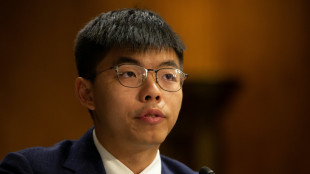 Joshua Wong, Hong Kong's pro-democracy poster child
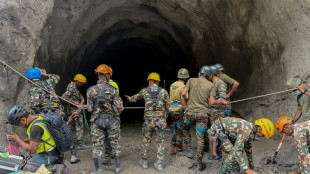 Nepal tunnel rescuers seek trapped workers but hit dead ends
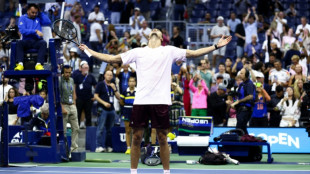 Zverev wins wild five-setter, Rybakina and Gauff ease through at US Open

Cardinals from around the world will meet under Michelangelo's frescoes in the Sistine Chapel on May 7 to elect a new leader of the Catholic Church after Pope Francis's death.
Dating back to the Middle Ages -- when the idea of sovereigns being elected was somewhat revolutionary -- the gathering, known as conclave, has an air of mystery about it, as all participants are sworn to secrecy for life.
Here are some facts:
- Where and when -
The conclave will begin on May 7 and last until a new pontiff is elected.
While it took almost three years to appoint Pope Gregory X in the 13th century -- the longest conclave to date -- modern gatherings are usually a matter of days.
Both Francis and his predecessor, Benedict XVI, were elected after two days of voting.
Cardinals will gather and cast their ballots in the Sistine Chapel, a Renaissance jewel adorned with Michelangelo's celebrated frescoes, located in the Vatican City's Apostolic Palace.
- Who takes part -
All the Church's 252 cardinals were called back to Rome following the death of Francis on April 21, and 224 made it for the funeral last Saturday.
They all had a say in choosing a date for the conclave, but only 135 are expected to take part, as only those aged under 80 are eligible to vote for a new pope.
Most of the so-called "cardinal electors" were appointed by Francis -- around 80 percent. They hail from all corners of the globe, with many from under-represented regions.
But Europe still has the largest voting bloc, with 53 cardinals, compared to 27 cardinal-electors from Asia and Oceania, 21 from South and Central America, 16 from North America and 18 from Africa, according to the Vatican.
Italy is the most represented nation with 17 electors. The United States has 10, Brazil seven and France five.
- Secrecy and security -
The word conclave comes from the Latin for "with key", a reference to the lockdown imposed on cardinals staying in the Santa Marta residence at the Vatican until they elect a new pope.
The deliberations of a conclave are held in strictest secrecy on pain of instant excommunication. Smartphones and any Internet access are off-limits and cardinals cannot read newspapers, listen to the radio or watch TV.
Any contact with the outside world is banned, unless for "grave and urgent reasons", which need to be confirmed by a panel of four peers.
Only cardinal electors are allowed to be present during the actual voting, although others including doctors, clerical assistants and housekeeping staff are allowed to enter at different times.
- How voting unfolds -
Cardinals hold four ballots a day -- two in the morning and two in the afternoon -- until one candidate wins two-thirds of the votes.
At the end of each session, the ballots are burned in a special stove. With the addition of chemicals, the stove's chimney stack emits black smoke if no one has been elected or white smoke if there is a new pope.
If no new pope is elected after three days, cardinals take a break and hold a day of prayer and talks.
Any single Catholic adult male can be elected pope, although in practice it is almost always one of the cardinals.
Sick cardinals are allowed to cast their ballots from their beds.
- What happens next -
The winning candidate is asked by the Dean of Cardinals if he accepts the pontificate and, if the answer is yes, what name he chooses as pontiff.
The new leader of the world's 1.4 billion Catholics then comes out onto a balcony overlooking the square as a senior cardinal cries: "Habemus Papam" (We have a pope)!
B.Torres--AT