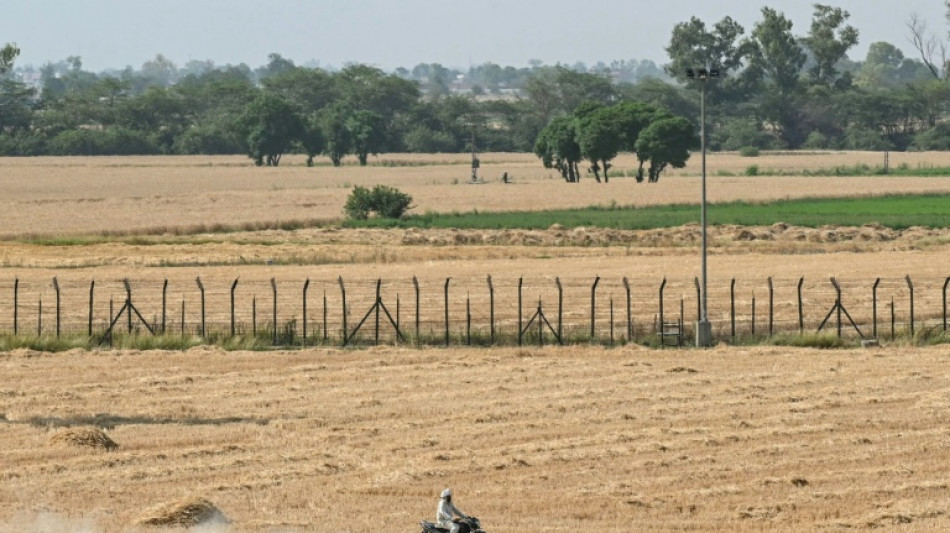
Villagers on India's border with Pakistan fear war / Photo: Narinder NANU - AFP

 DNA tests and funerals in Nepal, a week after deadly floods

 Iran threatens tougher strategy after US strikes kill 4 at wedding

 Chevron unveils deal to double Venezuela venture output in 5 years

 Uganda names its oil 'Pearl Sweet' as it prepares for first exports

 Tiger Woods driver's license suspended for five years after crash

 Germany probes latest sabotage attacks on power grid

 Wall Street stocks mixed as energy prices, bond yields turn lower

 Tiger Woods pleads guilty to reckless driving, license suspended

 Missing passengers likely went down with sunken ferry: N.Cyprus official

 Premier League clubs splash cash to smash transfer record

 Melting glaciers an 'immediate' climate risk: author of UN report

 Folarin Balogun's move to Everton collapses

 Pacific islands to face food shortages over global warming: scientists
 Venice jury head Maggie Gyllenhaal questions lack of women directors
 Stocks drop, bond yields rally on Mideast flare-up
 China expands Egypt investments in first Xi visit in a decade

 Messi departure leaves Argentina facing rebuild after golden era

 Ourbit SuperCEX Launches "Cosmic Wheel Season 3. Oracle Realm" on September 2 with 3M USDT Prize Pool

 Ebola death toll passes 3,000 in DR Congo: official data

 Hong Kong democracy activist Wong pleads guilty to foreign collusion

 World record prize winner Romantic Warrior retires from horse racing

 5,000 US sailors arrive in Thailand after months at sea

 Joshua Wong, Hong Kong's pro-democracy poster child

 Nepal tunnel rescuers seek trapped workers but hit dead ends
 Zverev wins wild five-setter, Rybakina and Gauff ease through at US Open

India's Daoke village is fenced from Pakistan on three sides and 65-year-old resident Hardev Singh, who has lived through multiple wars between the arch-rivals, knows the drill if another erupts.
"All women, children, cattle and most younger men moved back to safe shelters in 1999 and 1971," Hardev said, referring to two of the worst outbreaks of fighting between the neighbours.
"We couldn't go to our fields," he said, adding that it was only the village's elderly men who "stayed back to ensure that our homes were not looted".
Relations between the nuclear-armed neighbours have plummeted after India accused Pakistan of backing the deadliest attack in years on civilians in Indian-administered Kashmir on April 22.
Islamabad has rejected the charge, and both countries have since exchanged gunfire across the de facto frontier in contested Kashmir, diplomatic barbs, expelled citizens and ordered the border shut.
Residents of the frontier villages in India's Punjab state say nothing has changed on the ground yet -- but there is a growing anxiety about the coming weeks.
"The barbaric attack on the civilians in Kashmir was tragic, but no matter what, the lives lost are not coming back," Hardev said.
"Any war would push both our countries back by many years, and there would be an even bigger loss of human lives."
A border fence patrolled by troops slices in two the farmlands near Daoke, home to around 1,500 people.
Gurvinder Singh, 38, recalls the last major conflict in 1999.
Fighting then took place far from Punjab -- in the icy Himalayan district of Kargil -- but the sun-baked fields around his village did not escape unscathed.
"Mines were planted on our fields, and we could not work," Gurvinder said.
He hopes that, if the bellicose statements issued by leaders on either side do turn into military action, his village will be left alone.
"We feel that the actual conflict would happen only in the Himalayas," Gurvinder said, adding that his village is "normal right now".
- 'Not just us' -
In the nearby frontier village of Rajatal, between the Indian city of Amritsar and Lahore in Pakistan, residents remember the days when the golden farmland stretched without restriction.
The frontier was a colonial creation at the violent end of British rule in 1947 which divided the sub-continent into Hindu-majority India and Muslim-majority Pakistan.
Sardar Lakha Singh's memory stretches back to before the fence was erected.
"We used to go to the open ground on the other side to graze our cattle," 77-year-old Lakha said, sitting about 100 metres (328 feet) from fences topped with barbed wire.
Farmers can obtain special passes to go close to the border, including beyond the fence but still within Indian territory.
But they must always be accompanied by a soldier.
"We can't go there whenever we want," said farmer Gurvil Singh, 65. "This reduces the time we get to work on our fields".
Panic gripped border villages last week after rumours suggested farmers would be stopped from accessing fields too close to Pakistan.
Sikh elder Sardar Lakha Singh advised younger villagers to accept their fate and not to worry.
"Whatever is going to happen will happen anyway," he said.
"We didn't know when the 1965 war suddenly started, same in 1971 when the planes suddenly started crossing the border," the grey-beared farmer added.
"So, if it happens again, we don't need to worry in advance."
Gurvinder Singh, 35, said he tried to take the lesson to heart.
"It would be a high-tech war, and not an invasion or a battle of swords like the past," he said.
"When the situation worsens, it would be for the entire country -- and not just us."
H.Thompson--AT