Foreign carmakers strive for 'China Speed' to stay in race / Photo: HECTOR RETAMAL - AFP

 DNA tests and funerals in Nepal, a week after deadly floods

 Iran threatens tougher strategy after US strikes kill 4 at wedding

 Chevron unveils deal to double Venezuela venture output in 5 years

 Uganda names its oil 'Pearl Sweet' as it prepares for first exports
 Tiger Woods driver's license suspended for five years after crash

 Germany probes latest sabotage attacks on power grid

 Wall Street stocks mixed as energy prices, bond yields turn lower

 Tiger Woods pleads guilty to reckless driving, license suspended

 Missing passengers likely went down with sunken ferry: N.Cyprus official

 Premier League clubs splash cash to smash transfer record
 Melting glaciers an 'immediate' climate risk: author of UN report

 Folarin Balogun's move to Everton collapses

 Pacific islands to face food shortages over global warming: scientists

 Venice jury head Maggie Gyllenhaal questions lack of women directors
 Stocks drop, bond yields rally on Mideast flare-up

 China expands Egypt investments in first Xi visit in a decade

 Messi departure leaves Argentina facing rebuild after golden era

 Ourbit SuperCEX Launches "Cosmic Wheel Season 3. Oracle Realm" on September 2 with 3M USDT Prize Pool

 Ebola death toll passes 3,000 in DR Congo: official data

 Hong Kong democracy activist Wong pleads guilty to foreign collusion

 World record prize winner Romantic Warrior retires from horse racing

 5,000 US sailors arrive in Thailand after months at sea

 Joshua Wong, Hong Kong's pro-democracy poster child

 Nepal tunnel rescuers seek trapped workers but hit dead ends
 Zverev wins wild five-setter, Rybakina and Gauff ease through at US Open

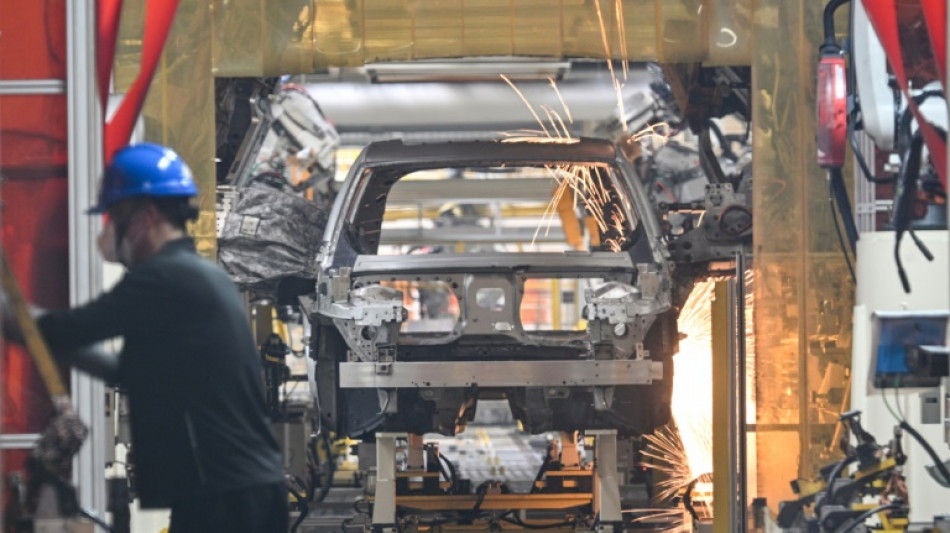
In fluid synchronisation, dozens of robotic arms picked up metal parts and welded them onto vehicle beds, as car skeletons gradually took shape and progressed along an automated factory floor near the eastern Chinese city of Ningbo.
Across the country, car models rolling off assembly lines like this have gone from concept to release in record time -- known in the industry as "China Speed", the envy of foreign competitors.
At EV firm Zeekr's vast Ningbo plant, advanced robotics and artificial intelligence have been leveraged at every stage of the manufacturing process to save huge amounts of time and money.
In the casting shop, a robotic arm that towered over the human foremen supervising it picked up a freshly made piece of aluminium and dunked it into a vat of water, sending steam hissing out, before passing the metal to another machine to cut and press it.
The factory still employs around 2,500 workers to do some delicate tasks and for quality control.
But the heavy lifting is done by hundreds of tireless robots, with some processes going on 24 hours a day.
And it's not just manufacturing that has been accelerated.
Zeekr has a research and development base in Sweden, which allows workloads to be shared across timezones. Its parent company, Geely, also owns Swedish automaker Volvo.
In the factory's car park, hundreds of gleaming, plate-less Zeekr 7X SUVs stood ready to be transported to dealerships.
"The future is our history," read a slogan above the entrance hall.
- 'Make-or-break moment' -
Factories and companies like this have set a new pace in the industry.
"We are at a make-or-break moment for established global automakers," a recent report by consulting firm Bain & Company said.
En route to the factory, AFP saw lorries carrying brand new Zeekr cars headed to Ningbo's huge port, bound for export to places like Australia.
The most innovative Chinese manufacturers spend less than a third of that spent by traditional competitors to develop new vehicles, the Bain report said.
While legacy automakers often take 48 to 54 months to bring out new models, the timeline for younger brands is more like 24 to 30, it added.
Some of Zeekr's models only took 15 months to develop, a spokesman told AFP.
The results are clear in the sheer choice available to consumers: There are currently 2,755 models on offer from 163 brands in the Chinese market, authorities say.
At industry show Auto Shanghai, which opened Wednesday, more than 100 new models were launched.
Jostling in the pack were not just Chinese firms like Zeekr, BYD and Chery, but also foreign rivals hitting the gas to catch up.
Volkswagen and Nissan launched tens of new models developed "in China for China" at the show, with executives insisting they had adapted to "China Speed".
The acceleration has been helped by the shift towards EVs, disposing of the complex internal combustion engine.
"You start by designing the car virtually, making as few prototypes as possible, so you can move very quickly," BCG consultant Mikael Le Mouellic told AFP.
Design and engineering will then work hand-in-hand, and often "reuse recipes that work", he added.
Zeekr's "Sustainable Experience Architecture", for example, can be the bed for A-class to E-class cars, saving time and money.
- Three years to nine months -
Foreign suppliers have also had to adapt.
Traditionally, companies could take up to three years to design, for example, a new headlamp, said Michael Fischer, boss at French automotive parts maker Forvia.
"In China that doesn't work," he said.
Now, "we have a process that is going to be very organised, that's going to secure for quality, but can bring up a new headlamp in as little as nine months".
At competitor Valeo's factory in Changshu, north of Shanghai, four large robots assembled LED headlamps for Zeekr and other brands.
"We don't work 24/7!" joked Valeo's innovation manager in China, Gu Jianmin. "But we use existing solutions, and we work upstream with the automakers."
Development and durability tests that "would have taken months" are helped along by AI and other technology.
"Chinese manufacturers are a little more demanding. But foreigners are trying to catch up," said Gu.
"To emerge in China, you have to be at the same level as the locals."
K.Hill--AT