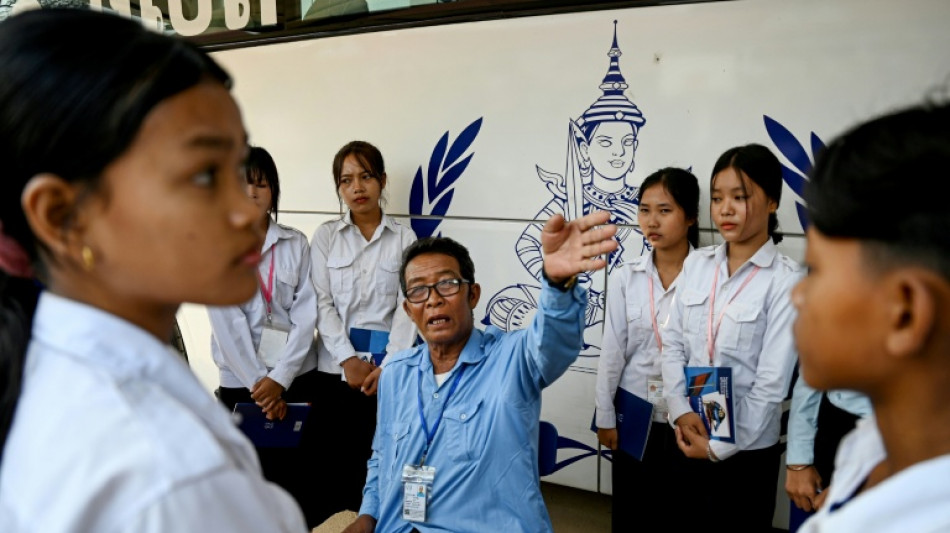
Lessons in horror with Cambodia's Khmer Rouge tribunal / Photo: TANG CHHIN Sothy - AFP

 Fury hits out at 'coward' Joshua as 'Battle of Britain' talks go on
 Maltese tycoon acquitted of masterminding reporter's murder

 George Clooney: a Hollywood icon and campaigner

 Europe, US closer than they look on tech rules, says EU tech chief

 Clooney honoured as Hollywood-light Venice Film Festival kicks off
 Third-ranked Pegula, Medvedev power into US Open third round

 Davis-Woodhall a doubt for Ultimate Championship after car crash

 Third-ranked Pegula powers into US Open third round

 Uber says laying off 'about 10%' of workforce worldwide

 US judge rejects bid to break up Google's ad business

 Rupert Murdoch 'very happy' to be played by Guy Pearce in new film

 Wall Street stocks rise despite bond yields, oil rising

 Brennan claims third Vuelta victory in stage 11 sprint

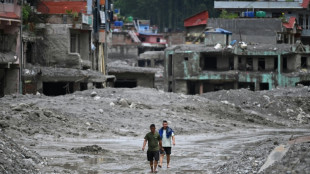
 Nepal flood survivors cling to zipline to cross treacherous river
 US Treasury issues $1 coin with Trump's face on it
 Fernandez 'didn't hesitate' over record Man City move

 Dutch shift 86 tonnes of gold from US, Canada to UK
 Nepal floods should mobilise climate action: UN green fund chief
 Nvidia boss presses G20 ministers to build AI infrastructure

 Liminal Launches Liminal Prime for Institutional OTC and Stablecoin Liquidity

 10 missing as cargo ship sinks after collision off Istanbul

 30 years on, 'Tomb Raider' reboot sees Lara Croft through a 'modern lens'

 King Charles, Macron to view Bayeux Tapestry as French leader starts UK visit

 George Clooney says US run by 'least qualified people'

 China's Xi urges against Mideast interference in rare Egypt visit
Sheltering in the shade of a bus repurposed into a mobile museum, Mean Loeuy tells a group of children about the hell he went through in a Khmer Rouge labour camp.
"At the beginning we shared a bowl of rice between 10 people," recounts the 71-year-old man who lost more than a dozen family members during Cambodia's bloodiest era.
"By the end, it was one grain of rice with a splash of water in the palm of our hands," he says, describing the camp as "like a prison without walls".
The children look on with expressions ranging from nonplussed to horror.
Mean Loeuy is one of a handful of survivors supporting the latest project of the Extraordinary Chambers in the Courts of Cambodia (ECCC), the UN-sponsored tribunal that delivered its last verdict on Pol Pot's brutal regime in September 2022 before wrapping up its trials.
Since January last year, a team led by a lawyer has travelled around Cambodia teaching schoolchildren about the government it ruled as genocidal, sharing 20 years' worth of evidence and testimony from victims such as Mean Loeuy.
The capital Phnom Penh fell to the Khmer Rouge 50 years ago on Thursday, but now two-thirds of Cambodia's population are under 30.
Most grew up without living through the horrors of Pol Pot's rule between 1975 and 1979, nor the 20 years of conflict that followed.
Many young people have no more than an inkling of the grimmest period of their country's history -- one still haunted by the deaths of around two million people through starvation, disease, forced labour or murder.
- Human skulls -
In a high school courtyard in Phnom Srok in the nation's northwest, dozens of children squeeze into the air-conditioned vehicle -- a bus specially adapted to hold interactive history classes, with comics, iPads and other resources.
About 10 kilometres (six miles) away lies the Trapeang Thma reservoir where Mean Loeuy laboured, one of the Khmer Rouge's most notorious projects, accounting for thousands of worker fatalities.
At a Buddhist temple in the town, the skulls of victims of the Khmer Rouge line the shelves.
But Mouy Chheng, 14, admits she had difficulty believing the "brutality" of the ultra-Maoist government that her parents had told her little about.
"I was not born under the Khmer Rouge. I came to learn here... and understand the difficulties under the previous regime. Now I understand a lot more," she tells AFP.
The educational initiative reached more than 60,000 children and teenagers at 92 institutions in 2024, according to the ECCC, and aims to visit 100 schools this year.
In a classroom, lawyer Ven Pov passes a microphone around between 150 or so high school students.
"Why wasn't Pol Pot tried?", "why weren't (convicted Khmer Rouge cadres) given the death penalty?", "how is it possible that famine killed so many?", they ask one after another.
The 56-year-old Ven Pov tries his best to answer their questions but admits he still wonders why the Khmer Rouge committed such atrocities.
"We do not have answers," he says. "We need to do more research."
- 'Symbolic legacy' -
Back in the capital, the ECCC preserves hundreds of thousands of Khmer Rouge documents that are open to researchers and anyone interested.
Of the scores of ageing former leaders of the ultra-Maoist movement living freely in Cambodia, the ECCC convicted only three.
Former prime minister Hun Sen has pushed for peace and social cohesion, but critics say he sought to exploit the hybrid Cambodian-international tribunal to avoid prosecuting more Khmer Rouge cadres -- of which he was once one.
"Justice and reconciliation go hand in hand," says Ven Pov, who attributes the lack of trials to a widespread desire for unity.
"Victims want justice, but they also want peace, national unity and reconciliation."
Nonetheless, Timothy Williams, a professor at Bundeswehr University in Munich, says "transitional justice isn't just about those who committed the crimes, it's also a symbolic legacy for society".
The educational bus could have started its tours 15 years ago, he said, but added: "It's important at a time marked by the strengthening of authoritarian power.
"The lessons of the past are crucial here."
R.Garcia--AT