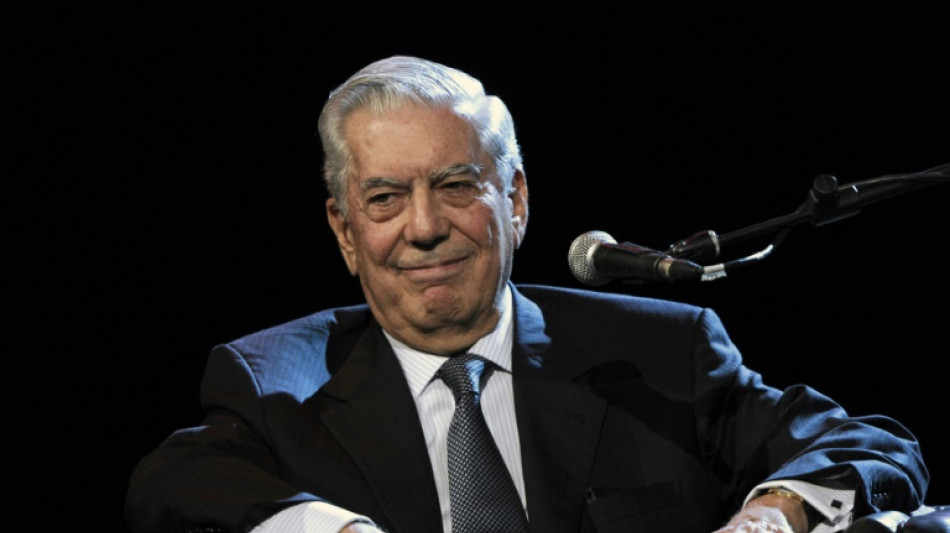
Vargas Llosa, last of Latin America's literary golden generation / Photo: Juan MABROMATA - AFP/File

 NBA strips five first-round draft picks from Clippers for Leonard salary cap violations
 Kane brace helps Bayern win German Cup opener
 Migrant plight, local anger divide Ceuta one month after influx
 Outrage as Maltese tycoon acquitted of reporter's murder
 Rare train of Pacific cyclones fueled by historic El Nino
 Macron, King Charles hail UK-France ties after viewing Bayeux Tapestry
 Fury hits out at 'coward' Joshua as 'Battle of Britain' talks go on
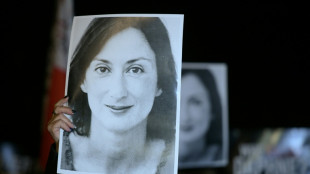 Maltese tycoon acquitted of masterminding reporter's murder
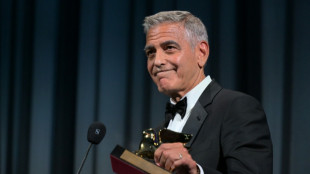 George Clooney: a Hollywood icon and campaigner
 Europe, US closer than they look on tech rules, says EU tech chief
 Clooney honoured as Hollywood-light Venice Film Festival kicks off
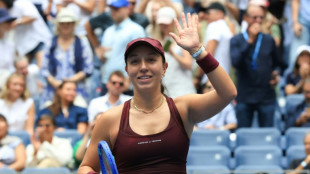 Third-ranked Pegula, Medvedev power into US Open third round
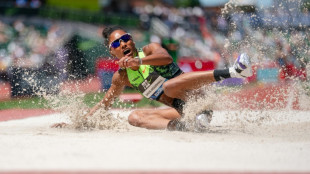 Davis-Woodhall a doubt for Ultimate Championship after car crash
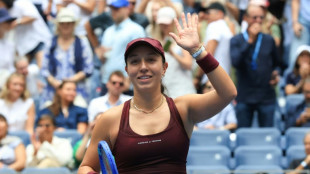 Third-ranked Pegula powers into US Open third round

 Uber says laying off 'about 10%' of workforce worldwide
 US judge rejects bid to break up Google's ad business
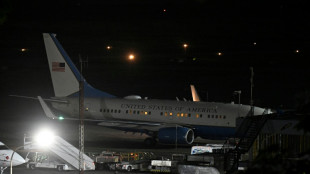
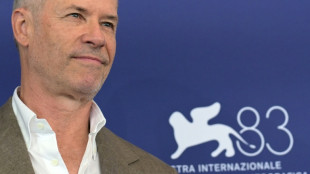 Rupert Murdoch 'very happy' to be played by Guy Pearce in new film
 Wall Street stocks rise despite bond yields, oil rising
 Brennan claims third Vuelta victory in stage 11 sprint

 Nepal flood survivors cling to zipline to cross treacherous river
 US Treasury issues $1 coin with Trump's face on it
 Fernandez 'didn't hesitate' over record Man City move
 Dutch shift 86 tonnes of gold from US, Canada to UK
 Nepal floods should mobilise climate action: UN green fund chief
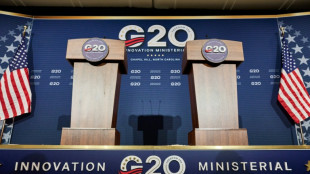 Nvidia boss presses G20 ministers to build AI infrastructure
Nobel laureate Mario Vargas Llosa was the last survivor of a golden generation of Latin American literary giants, his writing exploring universal themes often set outside his native Peru.
Admired for his depiction of social realities but criticised within Latin American intellectual circles for his conservative positions, Vargas Llosa -- who died Sunday at age 89 -- was a leading light of the "boom" generation that included greats like Gabriel Garcia Marquez and Julio Cortazar.
Winner of the 2010 Nobel Prize for Literature, Varga Llosa passionately believed writers should be involved in civil society.
"We Latin Americans are dreamers by nature and we have trouble telling the difference between the real world and fiction," he said.
"That is why we have such good musicians, poets, painters and writers, and also such horrible and mediocre rulers."
But he courted controversy over his support for the war in Iraq and was a passionate admirer of Britain's "Iron Lady" prime minister, Margaret Thatcher.
Author of a vast body of work, spanning historical novels, erotic romances, crime novellas, light-hearted comedies, plays, memoirs and essays, Vargas Llosa also kept his hand in current affairs by working as a journalist.
Unlike Garcia Marquez and other Latin American greats, he rarely strayed into magical realism, his style marked by graphic descriptions of murder, rapes and other violence, perhaps harking back to his days as a crime reporter in Peru's capital Lima when he was just 16.
"A writer must never turn into a statue. I have never liked the idea of a writer stuck in his library, cut off from the world like Proust was," he told AFP in an interview.
"I need to keep a foothold in reality. That's why I do journalism."
- Military school trauma -
Born in Arequipa in southern Peru on March 28, 1936 to a single mother, Vargas Llosa was taken to Bolivia as a baby, only returning a decade later when he met his father for the first time.
It was not a happy relationship, his father being "very authoritarian and severe", Vargas Llosa said in 2019.
"I lost my innocence and discovered loneliness, authority, adult life and fear.
"My salvation was reading good books, taking refuge in worlds... where I could feel free. And I became happy again."
At 14, his father sent him to Lima's Leoncio Prado Military Academy, an experience which he described as "traumatic", seeking solace in the world of books and writing.
On leaving, he worked at La Cronica tabloid before studying law and literature at San Marcos University while dictator Manuel Odria was in power, becoming very politically active.
- A scandalous marriage -
At 19, Vargas Llosa married his aunt Julia Urquidi. Although not a blood relative, she was a divorcee 10 years older than him and it was socially scandalous.
She encouraged his writing and when they moved to Madrid, he began his first novel "The Time of the Hero" (1963) based on his military academy experience, which he later finished in Paris.
Their decade-long marriage inspired his 1977 novel "Aunt Julia and the Scriptwriter".
He worked for a period in Paris as a journalist for Agence France-Presse (AFP) and Radio Television Francaise.
After his marriage broke up in 1964, Vargas Llosa married his cousin Patricia Llosa and had three children.
The couple separated in 2015.
- 'Unreserved admiration' for Thatcher -
All of his early novels are set in Peru, among them "The Green House" (1966), "Conversation in the Cathedral" (1969), and "Captain Pantoja and the Special Service" (1973).
Later writings were set further afield: "The War of the End of the World" (1981) tackled a military conflict in late 1890s Brazil, while "The Feast of the Goat" (2000) portrayed the 1961 assassination of Dominican dictator Rafael Trujillo.
After his Nobel win, he published "The Dream of the Celt" about Roger Casement, a gay British consul who wrote a 1904 report about colonialism's abuses in the Congo before becoming an Irish nationalist.
Like most of Latin America's intelligentsia in the early 1960s, Vargas Llosa initially supported Fidel Castro's leftist revolution, but later grew disillusioned, becoming an advocate of free-market capitalism whose political idol was Thatcher.
After her resignation in 1990, Vargas Llosa wrote of his "unreserved admiration" for Thatcher, praising her 11-year rule as "the most successful revolution in Europe this century and the one with the most powerful effect on the rest of the world".
The same year he ran for president in Peru representing a conservative coalition but lost to Alberto Fujimori, an unknown academic of Japanese descent.
Disappointed in defeat and upset by the dictatorial turn of Fujimori's regime, Vargas Llosa took Spanish nationality in 1993, angering many Peruvians.
burs/hmw/mg/fg/des
N.Walker--AT