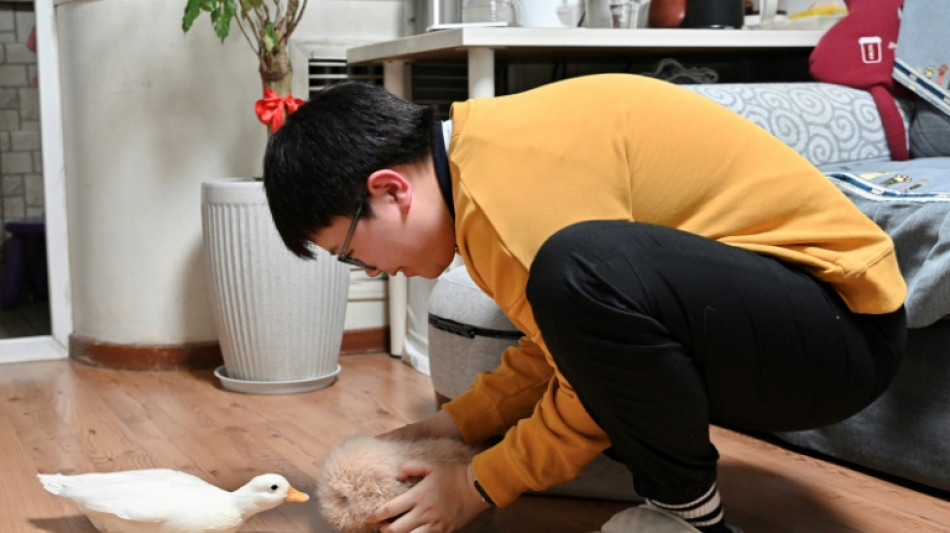
Young Chinese turn to AI pets for emotional relief / Photo: Adek BERRY - AFP

 Gasly a 'class act' says Alpine boss after Monza pole

 Athletic Bilbao crush Simeone's flat Atletico

 Stay far from battlefield, warns Japanese director in Vietnam War film

 Tens of thousands of Croatians protest over hazardous waste

 Haaland heads unconvincing Man City top of Premier League

 US envoys in Moscow as Russia and Ukraine vow not to hit capitals during talks

 Motorsport governing body rejects Alpine boss's claims of bias

 US envoy on West Bank visit says Israel has responsibility for Palestinians

 Ethiopian Miss World contestant spotlights pain of sister's murder

 'Leader' Raphinha rising to Barca striker challenge

 Oasis fans gather in Venice for band reunion film

 Two Nepal rescues revive hopes 10 days after flood

 Pogacar to miss worlds after season-ending Vuelta crash

 Greenwood, Guendouzi handed bans after Fenerbahce-Lyon brawl

 In Iceland, the mystery of the poet, the tomb and the Danish grocer
 Ratko Mladic: Bosnian Serb commander to convicted war criminal

 Bolivian army base blasts kill two, wound dozens

 Alcaraz, Sabalenka into US Open last 16 as Williams sisters lose on return

 Williams sisters fall in thrilling return to US Open doubles

 Bangladesh measles toll nears grim 1,000-child mark

 Bolivia farmers return to streets over diesel price hikes

 Hilltop Painting Brings Trusted Interior and Exterior Painting to Whatcom and Skagit County Homes

 Panama Canal begins reducing crossings due to El Nino

 Trump again seeks to remove protections for wolves

 'Getting there' - Alcaraz into US Open last 16 along with Sabalenka

At a shopping mall in Beijing, Zhang Yachun murmurs quietly to her closest confidant, a fluffy AI-powered robot whose soothing chirps remind her that she is not alone.
Zhang, 19, has long battled anxiety over school and work, and has struggled to form deep friendships with other people.
But since buying a BooBoo, a "smart pet" that uses artificial intelligence to interact with humans, she says life has become easier.
"I feel like I now have someone to share the happy times with," Zhang told AFP in the apartment she shares with her parents and a real pet duck.
Across China, a growing number of people are turning to AI to combat social isolation as the technology becomes more mature and widely accepted.
Wriggly, furry and resembling a guinea pig, BooBoo is produced by Hangzhou Genmoor Technology and retails for up to 1,400 yuan ($190).
Developed with children's social needs in mind, it has sold about 1,000 units since May, according to the company's product manager Adam Duan.
On an outing this month, Zhang ferried her companion, which she named "Aluo", in a cross-body carrier, whispering to the rugby ball-sized creature as it nodded and squeaked.
At a pet shop, she pressed the beige bundle up against the window to admire a ginger cat before buying Aluo a tiny winter coat designed for a dog.
She said the robot plays the same role as human friends, adding: "(It) makes you feel you are someone who is needed."
- Robot boom -
The global market for "social robots" like BooBoo is expected to grow by a factor of seven to $42.5 billion by 2033, according to consulting firm IMARC Group, with Asia already dominating the sector.
For Guo Zichen, 33, a smart pet could help when he is unable to play with his child.
"Right now, family members are spending less time with the children", Guo said as he examined a robotic dog on sale at the flagship store of tech company Weilan in the eastern city of Nanjing.
"Buying one for my kid can help them with studying and other things," he mused.
Weilan's AI dog, called "BabyAlpha", sells for between 8,000 ($1090) and 26,000 yuan ($3,500), and the company says 70 percent of buyers are families with young children.
But Guo said he was sceptical the electronic pup could bring as much joy as an actual canine.
"The biggest difference is that dogs have souls, while (BabyAlpha) looks different in an indescribable way", he said.
"On the whole, you feel like it's not the same as the real thing."
- Shifting society -
While the 1990s introduced electronic pets to the world like Japan's digital Tamagotchis and American-made Furbies that could mimic speech, computerised companions are becoming more functional with AI.
A growing number of AI products in China cater to people's emotional needs, from conversational chatbots to lifelike avatars of the deceased.
Social shifts like the impact of the government's decades-long one-child policy are helping drive market growth, according to experts.
People born in the policy's early years are now in their 40s and facing an economy burdened with soaring home prices, higher living costs and increased work stress, stretching their ability to focus on their own children.
That, in turn, "leaves little room for personal interactions, prompting people to seek alternative ways to meet their emotional needs", said Wu Haiyan, a professor specialising in AI and psychology at the University of Macau.
AI companions provide cognitive stimulation, "enhancing the well-being of... individuals who may otherwise feel isolated", Wu said.
In some cases, she added, people show more trust in AI than humans.
- Same on the inside -
Zhang's father Peng said he understood his daughter's bond with Aluo.
"When we were young, we didn't lack friends. We had loads as soon as we stepped out of the door", the 51-year-old told AFP.
"Now, children in cities seem to be under a lot more pressure, so they may lack friends."
Zhang, an only child, said she has become more willing to share her worries with her parents since she bought Aluo.
Opening up about her troubles at school has meant that "there aren't as many things piled up in my heart", she said.
People of her generation often struggle to communicate face to face, Zhang said, adding that "they might be afraid" to express who they are.
"But what they feel inside has not changed", she added, cradling Aluo in her lap.
W.Morales--AT