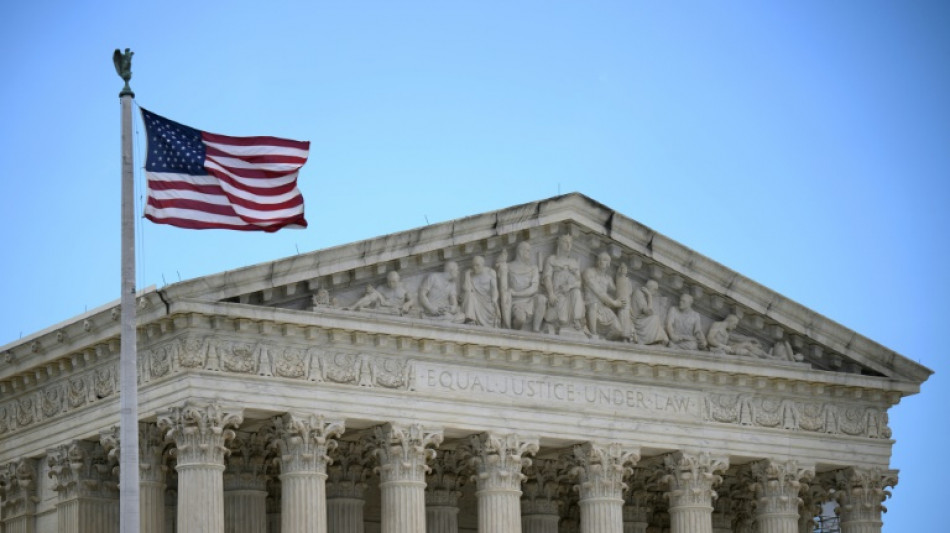
US Supreme Court weighs Texas age-check for porn sites / Photo: Drew ANGERER - AFP

 Inter roar back in five-goal thriller with Napoli

 Haaland keeps Man City perfect in Premier League, blunt Spurs held

 Hamilton worried by Ferrari pace while Antonelli prepares for a fight

 Vuelta stage 15 shortened due to extreme heat, Mas consolidates lead

 Putin meets US envoys for Ukraine war talks

 Modric available for Croatia in Nations League

 Potapova upsets 2025 US Open runner-up Anisimova

 Gasly a 'class act' says Alpine boss after Monza pole

 Athletic Bilbao crush Simeone's flat Atletico

 Stay far from battlefield, warns Japanese director in Vietnam War film

 Tens of thousands of Croatians protest over hazardous waste

 Haaland heads unconvincing Man City top of Premier League

 US envoys in Moscow as Russia and Ukraine vow not to hit capitals during talks

 Motorsport governing body rejects Alpine boss's claims of bias

 US envoy on West Bank visit says Israel has responsibility for Palestinians

 Ethiopian Miss World contestant spotlights pain of sister's murder

 'Leader' Raphinha rising to Barca striker challenge

 Oasis fans gather in Venice for band reunion film

 Two Nepal rescues revive hopes 10 days after flood

 Pogacar to miss worlds after season-ending Vuelta crash

 Greenwood, Guendouzi handed bans after Fenerbahce-Lyon brawl

 In Iceland, the mystery of the poet, the tomb and the Danish grocer

 Ratko Mladic: Bosnian Serb commander to convicted war criminal

 Bolivian army base blasts kill two, wound dozens

 Alcaraz, Sabalenka into US Open last 16 as Williams sisters lose on return

The US Supreme Court grappled with a challenge on Wednesday to a Texas law requiring pornographic websites to verify visitors' ages, part of a growing effort to limit access by minors to online sexual content.
Texas is one of nearly 20 US states to institute such a requirement, which critics argue violates First Amendment free speech rights.
The Texas law was passed in 2023 by the state's Republican-majority legislature but initially blocked after a challenge by an adult entertainment industry trade association.
A federal district court sided with the trade group, the Free Speech Coalition, saying it restricted access by adults to constitutionally protected content.
But a conservative-dominated appeals court upheld the age verification requirement, prompting the pornography trade group to take its case to the Supreme Court, where conservatives have a 6-3 supermajority.
Justice Clarence Thomas opened two hours of oral arguments by asking Derek Shaffer, a lawyer representing the Free Speech Coalition, whether age verification systems can "ever be found constitutional."
"We're talking about hundreds of millions of members to certain sites. Billions of visits," Thomas said. "How much of a burden is permissible on adults' First Amendment rights?"
Shaffer said "properly tailored" age verification could be permissible but the Texas law, which relies on government-issued ID, lacks privacy protections and is "overly burdensome."
Its goal could be accomplished using content filtering programs, he said.
Justice Amy Coney Barrett, the mother of seven children, took issue with Shaffer's advocacy of content filtering.
"Kids can get online porn through gaming systems, tablets, phones, computers," Barrett said. "Let me just say that content filtering for all those different devices -- I can say from personal experience -- is difficult to keep up with."
"And I think that the explosion of addiction to online porn has shown that content filtering isn't working," she said.
Barrett also asked Shaffer to explain why requesting age verification online is different than doing so in a "brick and mortar setting."
"If you go to a movie theater that displays pornographic movies you have to show age verification," Barrett said. "So explain to me why this is so uniquely burdensome here when it's not been in the real world context."
Shaffer said it's different because the internet leaves a "permanent record."
Data "is being collected. It is a target for hackers. It is something that is different than just flashing an ID in physical space," he said.
- 'Chilling' -
The lawyer for the Free Speech Coalition -- which includes the popular website PornHub that has blocked all access in some states with age verification -- also said he believed the intent behind the Texas law went beyond just restricting the access of minors to online pornography.
"I think that their interest is a broader, anti-porn interest in preventing willing adults from accessing this content," Shaffer said.
"They want to make it more difficult. They want to make it costlier. They want to make it chilling."
He said the law would not accomplish its aims.
"Smartphones can access foreign websites. You can use VPNs... to make it seem like you're not in Texas," he said.
"You can go through search engines. You can go through social media. You can access the same content in the ways that kids are likeliest to do."
Texas Solicitor General Aaron Nielson said the case was the "digital version" of laws restricting minors from purchasing age-restricted products in brick and mortar stores.
"A store can only avoid liability by making a quote 'reasonable bona fide attempt' to ascertain the true age of customers," Nielson said.
"We've tried content filtering for decades and the problem has only gotten worse," he said, while age verification has become "simple, safe and common."
"Biometric scanning is okay," Nielson said. "There's no ID or anything like that. It's just a face scan. There's all sorts of things you can do that have no identifying information."
France recently mandated age verification on some porn sites, but with a requirement that platforms offer at least one "double blind" option for users to prove their age without revealing their identity.
The Supreme Court is expected to rule on the case before the end its term this summer.
R.Lee--AT