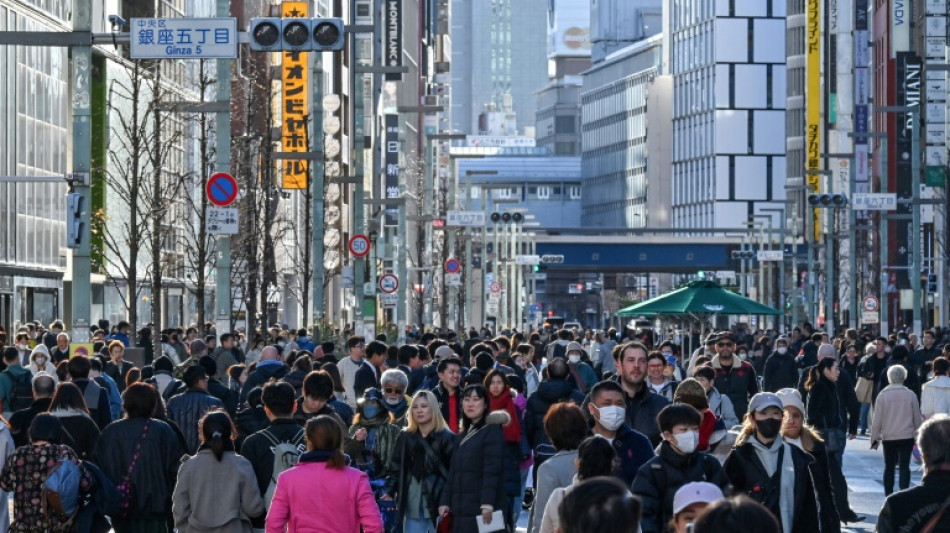
Japan's tourism boom prices out business travellers / Photo: Richard A. Brooks - AFP

 Inter roar back in five-goal thriller with Napoli

 Haaland keeps Man City perfect in Premier League, blunt Spurs held

 Hamilton worried by Ferrari pace while Antonelli prepares for a fight

 Vuelta stage 15 shortened due to extreme heat, Mas consolidates lead

 Putin meets US envoys for Ukraine war talks

 Modric available for Croatia in Nations League

 Potapova upsets 2025 US Open runner-up Anisimova

 Gasly a 'class act' says Alpine boss after Monza pole

 Athletic Bilbao crush Simeone's flat Atletico

 Stay far from battlefield, warns Japanese director in Vietnam War film

 Tens of thousands of Croatians protest over hazardous waste

 Haaland heads unconvincing Man City top of Premier League

 US envoys in Moscow as Russia and Ukraine vow not to hit capitals during talks

 Motorsport governing body rejects Alpine boss's claims of bias

 US envoy on West Bank visit says Israel has responsibility for Palestinians

 Ethiopian Miss World contestant spotlights pain of sister's murder

 'Leader' Raphinha rising to Barca striker challenge

 Oasis fans gather in Venice for band reunion film

 Two Nepal rescues revive hopes 10 days after flood

 Pogacar to miss worlds after season-ending Vuelta crash

 Greenwood, Guendouzi handed bans after Fenerbahce-Lyon brawl

 In Iceland, the mystery of the poet, the tomb and the Danish grocer

 Ratko Mladic: Bosnian Serb commander to convicted war criminal

 Bolivian army base blasts kill two, wound dozens
 Alcaraz, Sabalenka into US Open last 16 as Williams sisters lose on return

After travelling to Tokyo for meetings, Yoshiki Kojima's IT company employees crash out in a capsule hotel, as a tourism boom makes regular rooms too pricey for business trips.
A weak yen is attracting more visitors than ever to Japan, with national tourism figures for 2024, released Wednesday, expected to top 2019's record of nearly 32 million.
But that is also raising prices for Kojima's staff and other Japanese business travellers.
Capsule hotels, a Japanese institution, offer claustrophobic bed-sized pods, often double-stacked in rows.
They have a "shabby" reputation, Kojima said, so he found a more comfortable establishment that boasts high-end mattresses and a TV in each capsule.
"It's clean, convenient and has a traditional shared bath house. My employees say it's fun," he told AFP.
A night in a standard capsule there starts at 5,000 yen ($30) -- but its rates are rising, according to Kojima.
It is still cheaper than a basic private room at a business hotel, which in the Japanese capital cost 20,048 yen ($130) on average in November.
That's up from the pre-pandemic peak of 12,926 yen ($80 at today's rates) in April 2019, shows research by Tokyo Hotel Kai, a group of around 200 hotels.
"I'm happy there are so many visitors to Japan, but I'm agonising every day about finding a flexible way" to run the business, said Kojima, who needs to bring around 20 to 30 employees to the capital for company-wide meetings.
- 'What do I do?' -
The Japanese economy benefits from the surge in foreign tourists because it creates jobs and the visitors spend money, analyst Takuto Yasuda of NLI Research Institute said.
"But it has a negative impact as well, such as Japanese people not being able to travel, or their daily lives being affected by overtourism," he told AFP.
Japan's chronic labour shortages and an increase in hotel supply costs are also pushing up the fees, he added.
Keisuke Morimoto, who runs a kimono shop in Japan's western Nara region, was shocked when he learned a two-night stay at a Tokyo hotel would cost him 60,000 yen.
"Seriously, what do I do for the hotel for my business trip?" he wrote X.
Morimoto told AFP he is thinking of using short-term rental platform Airbnb, which has cheaper options.
Some tourist spots are fighting back against overtourism, including the ancient capital of Kyoto, where residents have complained of visitors harassing the city's famed geisha.
Now Kyoto plans to hike its accommodation taxes, including by up to 10 times for top-end hotels, the mayor said Tuesday.
- Concentrated demand -
Japan wants to welcome 60 million visitors a year by 2030.
This could mean even more expensive domestic business trips to Tokyo, Osaka and major cities, where demand for hotel bookings has spiked thanks to crowds of first-time visitors.
The number of foreign visitors to Tokyo has doubled since 2019, and was up 1.5 times in Osaka, government data show.
To even things out, the government wants tourists to visit lesser-known destinations, encouraging them to stay at least two nights in rural towns.
Yasuda agrees that funnelling visitors elsewhere is key to easing pressure on city hotels.
The occupancy rate in 2024 for business hotels in Tokyo run by major operator Fujita Kanko was 88 percent, and average rates were up 26 percent from last year, the company said.
"Currently, demand is concentrated in major cities such as Tokyo and Osaka, so we are hoping that this will spread to Sapporo, Naha and other smaller regions," the firm said.
IT company boss Kojima may resort to drastic measures.
"I'm thinking of moving our headquarters to Sapporo, or organising a meeting in a hot spring town near Tokyo," he said.
"There are many areas that aren't flooded with tourists, and we can take advantage of that."
A.Anderson--AT