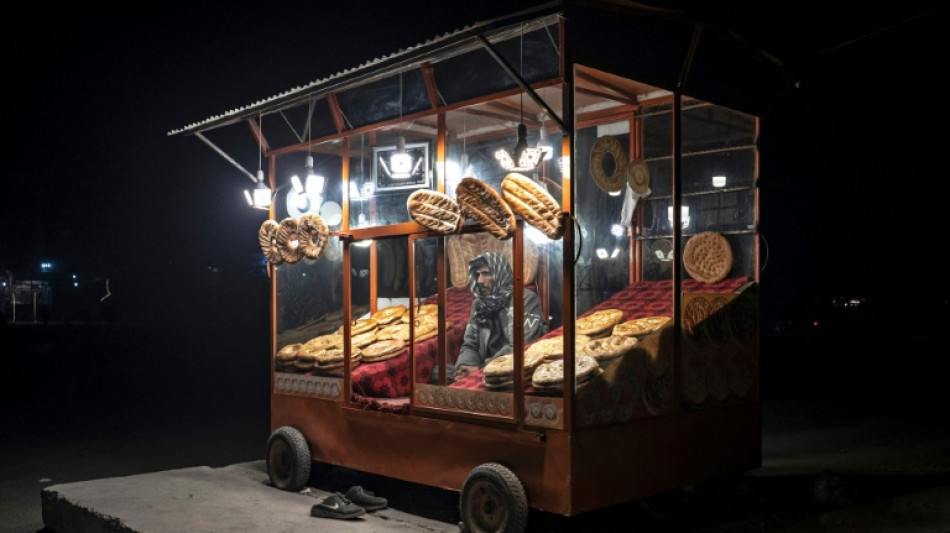
Afghan bread, the humble centrepiece of every meal / Photo: Wakil KOHSAR - AFP

 Zheng stuns Keys as US Open upsets dim American hopes
 Jovic 'loses sanity five times over' to oust Eala and book Gauff clash

 'Like a jewel': Japan's luxury ice revered by bars worldwide
 'The flood is coming': How a Nepal principal saved 900 students

 Kiss's winning run ends as Argentina hold Australia to draw
 Alcaraz excited to face 'dangerous' Paul for US Open quarter-final berth

 Prince William to represent King Charles III at Norway late King Harald's funeral

 Inter and Roma roar back to win thrillers and share top spot

 Don't stop them now: fans party for Freddie Mercury's 80th birthday

 AFP photographer wins top prize for Madagascar protest coverage

 Keys: 'I felt like I couldn't play tennis'

 Simmonds stars as Pau upset Montpellier

 Inter roar back in five-goal thriller with Napoli

 Haaland keeps Man City perfect in Premier League, blunt Spurs held

 Hamilton worried by Ferrari pace while Antonelli prepares for a fight

 Vuelta stage 15 shortened due to extreme heat, Mas consolidates lead

 Putin meets US envoys for Ukraine war talks
 Modric available for Croatia in Nations League

 Potapova upsets 2025 US Open runner-up Anisimova

 Gasly a 'class act' says Alpine boss after Monza pole

 Athletic Bilbao crush Simeone's flat Atletico

 Stay far from battlefield, warns Japanese director in Vietnam War film

 Tens of thousands of Croatians protest over hazardous waste

 Haaland heads unconvincing Man City top of Premier League

 US envoys in Moscow as Russia and Ukraine vow not to hit capitals during talks

Every day before dawn, Jamil Ghafori gets to work on the floor of a cramped Kabul bakery with five other men churning out thousands of traditional flatbreads -- the staple of every Afghan meal.
The common bread Ghafori has made for 27 years is fluffy with a satisfying crunchy edge, where each piece has been slapped onto the wall of an earthen oven sunk into the floor.
Afghans rely on bread, he told AFP. So he and his colleagues, each in charge of one part of the five-step process, take pride in their work.
"We always try to provide good bread for people, our customers must be satisfied," he said in the north of the Afghan capital.
Piles of bread -- some round, some stretched into canoe-like shapes, some sprinkled with sesame seeds or sugar -- overlap like roof tiles lining the slanting display windows of bakeries in the Afghan capital.
Their bright lights pour out over streets on seemingly every corner.
"Afghanistan has a long tradition of relying on bread," said bakery worker Shafiq. "Here bread consumption might go up, but it will never go down."
He said his shop sells around 3,500 a day, as he handed pieces folded into plastic bags out the window from his perch encircled by bread on display.
Men, women and children, rich and poor, rain or shine, stop by multiple times daily at their closest bakery for fresh bread to accompany their meals.
"In Afghanistan, without bread, eating a meal with others is incomplete," said Mohammad Masi, 28, while picking up several rounds on his way home on his bike on a recent chilly night.
"Bread is one of Afghanistan's most beloved and famous foods," he said.
Thick halves of homemade hardy loaves dotted the colourful cloth spread on the floor of Beg Murad Nabizada's home in eastern Kabul, where he shares evening meals with his family of four.
Most days it is the only time they can eat together.
"We prefer to make our bread at home because it's baked with our own hands," 51-year-old Nabizada said, scooping up rice, beans and salad between pieces of bread.
"Since I was born I have never gone a day without bread, thank God," he said. "Even if we had nothing else, we always had a piece of bread."
- Breakfast, lunch and dinner -
For many in Afghanistan -- one of the poorest countries in the world where 12.4 million people live in acute food insecurity, according to the World Food Programme -- bread makes up the largest part of meals.
Afghan bread is one of the few foods that everyone can afford, with prices as low as 10 Afghanis (0.14 US cents) to 50 Afghanis.
"Here, poor people often only have bread to eat... with tea or water," said school teacher Azeem.
"Afghanistan has been impacted by wars, its people are poor, and their economic situation is not good. So when they earn some money, they buy a bit of bread for their families."
Women in blue burkas huddle with children outside the brightly lit bakery windows, hoping someone will buy an extra piece for them.
For Wahida, 30, when her family sank into deep poverty two years ago, she turned to making bread to survive and feed her children.
She produces it at one of the women-run, home-based bakeries dotted around the outskirts of Kabul and often found in rural areas.
"Bread is important, it's beloved and eaten the most," she said.
"Us rural people, we like homemade, and those who don't want to bake buy from bakeries," she added, wetting the back of a stretched piece of dough before reaching deep into the wood- and straw-fired oven to set it baking again.
Homemade or from the bakery, the only thing that matters for Kabul dentist Mohammad Masi is that bread with "breakfast, lunch and dinner is a must".
"If I don't eat bread, I feel like I haven't eaten anything at all."
W.Moreno--AT