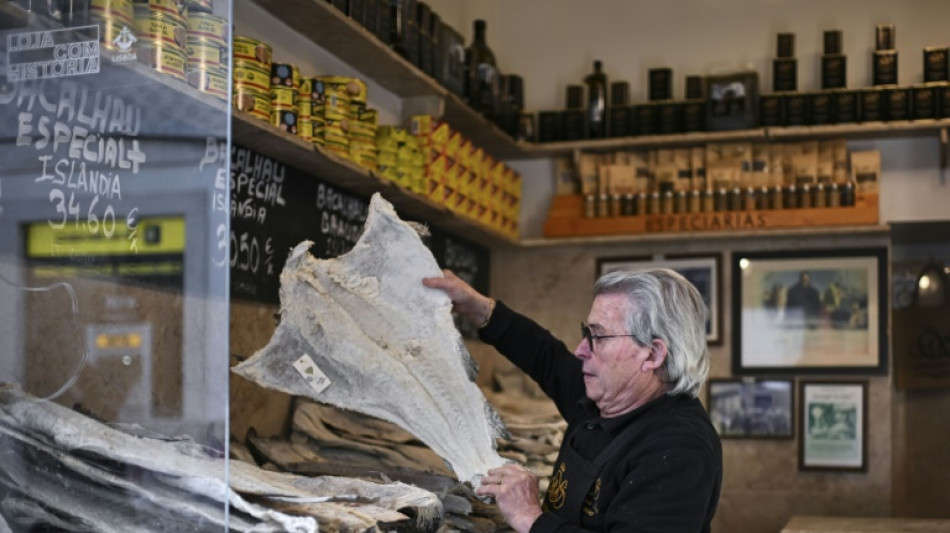
Cod is king in Portugal at Christmas / Photo: Patricia DE MELO MOREIRA - AFP

 Zheng stuns Keys as US Open upsets dim American hopes
 Jovic 'loses sanity five times over' to oust Eala and book Gauff clash

 'Like a jewel': Japan's luxury ice revered by bars worldwide

 'The flood is coming': How a Nepal principal saved 900 students

 Kiss's winning run ends as Argentina hold Australia to draw

 Alcaraz excited to face 'dangerous' Paul for US Open quarter-final berth

 Prince William to represent King Charles III at Norway late King Harald's funeral

 Inter and Roma roar back to win thrillers and share top spot

 Don't stop them now: fans party for Freddie Mercury's 80th birthday

 AFP photographer wins top prize for Madagascar protest coverage

 Keys: 'I felt like I couldn't play tennis'

 Simmonds stars as Pau upset Montpellier

 Inter roar back in five-goal thriller with Napoli

 Haaland keeps Man City perfect in Premier League, blunt Spurs held

 Hamilton worried by Ferrari pace while Antonelli prepares for a fight

 Vuelta stage 15 shortened due to extreme heat, Mas consolidates lead

 Putin meets US envoys for Ukraine war talks

 Modric available for Croatia in Nations League

 Potapova upsets 2025 US Open runner-up Anisimova

 Gasly a 'class act' says Alpine boss after Monza pole

 Athletic Bilbao crush Simeone's flat Atletico

 Stay far from battlefield, warns Japanese director in Vietnam War film

 Tens of thousands of Croatians protest over hazardous waste

 Haaland heads unconvincing Man City top of Premier League

 US envoys in Moscow as Russia and Ukraine vow not to hit capitals during talks

Salt cod has long been a national staple in Portugal, where it is said there are as many recipes for this humble fish as there are days in the year.
And at Christmas the dried and salted fish is central to meals at family gatherings in Portugal, the world's biggest consumer of "bacalhau" as it is called here, just as turkey is at Thanksgiving in the United States.
The most traditional way to prepare salt cod is to bake it in the oven and serve it with boiled potatoes.
But it can also be grilled, turned into fritters or even used to replace meat in a lasagna.
"When I'm asked to come up with a menu for Christmas, I am bound to suggest a salt cod recipe," said chef Ricardo Simoes of the Federico restaurant located at a luxury hotel in central Lisbon.
"We have an incredible culture" around the preserved fish, the 42-year-old added, saying he "likes to play" with traditional recipes to give them a touch of sophistication.
This year he has designed a cod confit matched with prawns and drizzled with coriander juice.
Portugal consumed nearly 55,000 tonnes of salt cod last year, an average of around six kilos (13 pounds) per inhabitant, according to the Cod Industry Association (AIB).
Roughly one-third of cod sales happen around Christmas, according to the group.
As the holiday season approaches, supermarkets across the country of around 10 million people prominently display hundreds of salt-encrusted cod piled high.
- 'Meat of the poor' -
The central role of cod in the country's cuisine is surprising since the fish, which thrives in deep icy waters such as those around the North Atlantic, has never existed in Portuguese seas.
Introduced to the country in the 16th century, salt cod represented a nutritious and non-perishable food source for Portuguese sailors on their long sea expeditions to the Americas and Asia.
At first this fish was a food exclusive to the aristocracy but it gradually became popular as well among lower classes as supply increased, bringing down prices.
Salt cod started being regarded as "the meat of the poor". It is also referred to as "o fiel amigo" or "the faithful friend".
Consumption boomed in the 20th century during the decades-long dictatorship of Antonio de Oliveira Salazar, which subsidised cod fishing expeditions off Canada's eastern coast and Greenland, the director of a Lisbon museum dedicated to the history of cod, Claudia Gomes, told AFP.
Today salt cod dishes are often sought out by tourists who visit the country.
"Coming to Portugal and not tasting salt cod is like going to Brazil without visiting Rio de Janeiro," said Jessica Baptista, a 33-year-old Brazilian tourist, as she left the D'Bacalhau restaurant in Lisbon.
Specialising in traditional cod recipes, the eatery cooks "a minimum of eight tonnes of cod every month," said its owner Julio Fernandes, 68.
- Youth losing interest -
Portugal accounts for almost 20 percent of the world's consumption of this fish, which is caught mainly in Iceland and Norway.
The sector employs more than 2,500 people in Portugal, with sales worth 500 million euros ($519 million) last year, according to AIB figures.
Producers predict a fall in consumption this year due to a rise in price which jumped nearly 15 percent to hit nearly 14 euros a kilo in 2024.
They also find younger generations are losing interest, in part due to the time it takes to prepare salted cod.
The fish must be soaked in several changes of cold war before cooking.
"Reaching out to young people is our big challenge," said Vera Xavier, head of production at the Riberalves cod processing plant near Lisbon.
N.Mitchell--AT