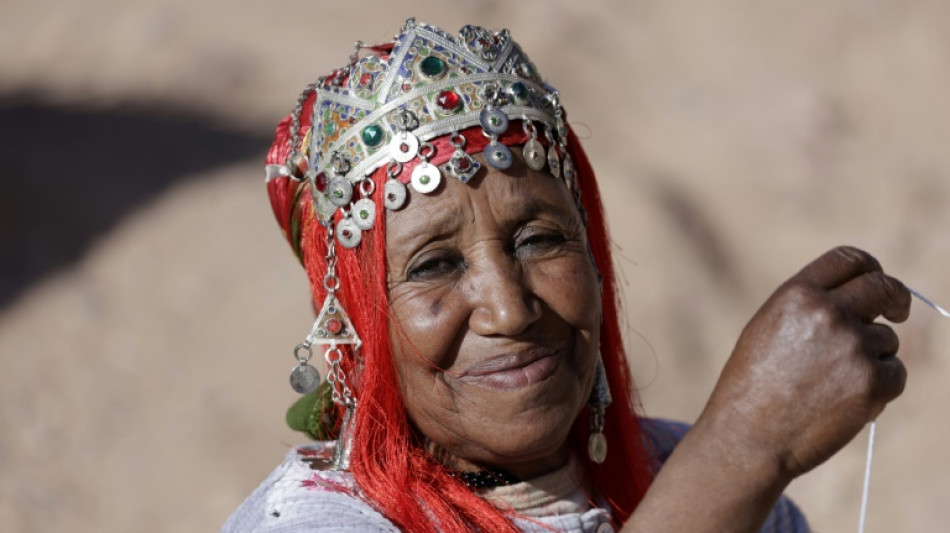
Morocco's women rug weavers battle to save age-old craft / Photo: - - AFP

 US aircraft carrier departs Thailand after port call

 Haze emergency grips Malaysian Borneo town

 Messi creates both Miami goals in 2-2 draw with Atlanta

 Rybakina books US Open fourth-round berth, inches closer to No. 1

 Sobering reality: Curbs on alcohol in northeast Syria cause discontent

 Wobbly Osaka 'shocked' to battle past Mertens and reach last 16

 Indian Oscar-nominated filmmaker turns camera on his cancer
 Argentina 'let off hook' by Australia as Kiss's winning run ends

 Argentina threatens to sanction oil projects around Falklands
 Gauff into round four at US Open after straight-set win

 Bordeaux hammer Racing in Top 14 start as Bielle-Biarrey extends deal

 Zheng, Potapova pull off upsets to reach US Open last 16

 Swiatek into US Open fourth round in tight two-setter

 Werro wins in Brussels, as Russell and Dos Santos shine

 Kolbe breaks jaw and shoulder injury sidelines Savea

 US military strikes oil tankers as Iran vows tougher reprisals

 Zheng rallies to stun Keys, Anisimova out in US Open third round

 Bayern held to draw by stubborn Schalke

 Lens lose again ahead of Champions League date

 Olympic champion Zheng storms home to reach US Open last 16

 Big-spending Spurs must make better attacking decisions, says De Zerbi

 South Africa dominate New Zealand in second half to lead series

 Kiefer Sutherland still in action, but ibuprofen lending helping hand

 'Are we ready?' Oasis film captures band's frosty reunion

 Commemoration held for late Bosnian Serb war criminal Ratko Mladic

In southern Morocco, women are the guardians of the age-old craft of carpet weaving, an intricate art form that often leaves them with meagre earnings.
Women like Ijja Benchri, who creates carpets on a wooden weaving loom outside her small home in the village of Taznakht, follows traditions going back many generations.
"I started when I was 11 or 12, imitating the women I saw weaving," said Benchri, 60.
"Little by little, I learnt, and it became my life's work."
Known for their bold geometric patterns and vibrant colours, the handwoven rugs are a fixture in local markets and a favourite among tourists.
In 2022, traditional carpets accounted for nearly 22 percent of the kingdom's artisan exports, according to government data.
The mountain villages around Taznakht are famous for their Ait Ouaouzguite carpets, named after a native Amazigh tribe, one among a grouping of several communities indigenous to North Africa long referred to as Berbers.
The carpets are woven by the women on small traditional looms, either at home or in specialised workshops.
They are then categorised into various styles, depending on their region of origin and their designs.
Some of Morocco's finest rugs are crafted from high-quality sheep wool in Jbel Sirwa just south of the Atlas Mountains, and dyed using natural pigments from plants like henna, pomegranate peels, or indigo.
Though industrial dyes have replaced natural ones for most weavers because they are cheaper and can be produced more quickly.
"This tradition has been handed down for centuries, from mothers to daughters," said Safia Imnoutres, who leads a local women's weaving cooperative.
She was one of the women showcasing their creations at a recent festival in Taznakht dedicated to safeguarding the heritage.
- 'Comes from within' -
Creating a single carpet can take two to four weeks depending on its size, said Benchri, speaking in Tamazight, the community's language recognised as an official language alongside Arabic in Morocco.
"I choose the colours as I go, according to my feelings," she added.
Imnoutres also described the process as "instinctive", guided by emotion rather than a predetermined design.
"Weaving is an expression of the women's feelings, when they are joyful, when they are melancholic," she added. "It's an art that comes from within."
But beyond its artistic value, weaving is a vital source of income.
Every Thursday, many travel to a weekly market to sell their rugs, often to middlemen who set the prices.
On average, a large rug sells for just 250 Moroccan dirhams (around $24), with its final price later raking astronomical profits.
In cities like Marrakech, some 250 kilometres (160 miles) north of Taznakht, they are sold in bazaars for up to ten times the original price.
Other rugs are listed at up to $6,000 on online platforms.
"We earn very little," said Benchri. "The intermediaries decide the price, and we have no choice but to accept it because this is our livelihood."
These diminishing returns, she added, have contributed to making the craft less attractive for younger women and jeopardising the handcraft tradition.
Additionally, the influx of cheaper, machine-made rugs has deepened competition.
To address these challenges, a new exhibition space in Taznakht allows some weavers to sell their work directly to buyers, cutting out middlemen.
The centre also tries to open new avenues for these women to sell their products independently through courses in digital marketing.
"If this heritage isn't made financially viable, we risk losing it," Imnoutres warned.
E.Flores--AT