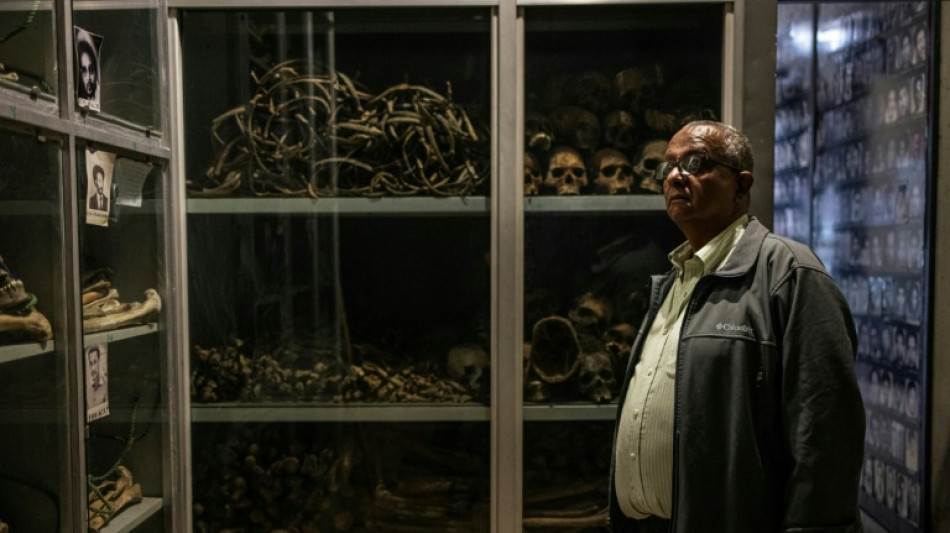
'Justice not done' 50 years after Ethiopia revolution / Photo: Michele Spatari - AFP

 Philippine sensation Eala looks forward to Asian Games 'fun'
 Jakarta airport extends closure after volcano eruption
 Lonely woman director in Venice sees industry backsliding on gender
 Tech firms rally on mixed day for Asian markets, with eyes on US inflation

 World number one An sends Asian Games warning with China hat-trick
 PSG go for three in a row as Champions League returns
 "Super-human' Alcaraz books US Open quarter-final clash with Shelton

 ECB set to hike interest rates as Iran war flares anew
 AI data centers are less thirsty now, tech giants say

 North Korea vows nuclear-armed navy as US ally drills open

 Under-fire Labuschagne named in Australia Test squad for South Africa

 Enjoying the moment: Alcaraz steps it up to reach US Open quarter-finals

 Five dead, five injured after Amazon cargo plane overshoots Miami runway

 La Rochelle half-backs lead fightback against Toulouse

 US envoys have 'more effective proposals': Ukraine official

 Defending champion Alcaraz powers into US Open quarter-finals
 Amazon cargo plane overshoots Miami runway, hits vehicles, catches fire

 Toll from Yemen clashes passes 300 as civilians flee homes
 Sabalenka books US Open quarter-final clash with Noskova

 German AfD supporters jubilant at far right's thumping win

 Zelensky warns war likely to continue into winter after US talks

 Arsenal deliver statement fightback to end Chelsea's flying start

 Leclerc accepts blame as Hamilton laments Ferrari approach

 Sabalenka surges past Townsend to reach US Open quarter-finals

 Smiling face of Germany's far-right AfD: Ulrich Siegmund

In his apartment in Ethiopia's capital, Ermias Woldeamlak stares at the photos of his three older brothers, all of them killed during a period of military terror a generation ago.
"Elias was 20 or 21, Thomas was 19, Berhan was 18," he says.
Half a century has passed, "but I still feel very sad," Ermias adds. "I remember it as fresh as something that happened yesterday."
Thursday marks 50 years since a Marxist-Leninist military junta known as the Derg seized power in Ethiopia, overthrowing Emperor Haile Selassie and a monarchy that had ruled Ethiopia for 700 years.
Tens of thousands died at the hands of the new regime, which ruled with callous brutality until its own overthrow in 1991.
Its 87-year-old leader Mengistu Haile Mariam lives on quietly in Zimbabwe despite being convicted of genocide and sentenced to death in absentia in 2008.
For Ermias, that impunity is impossible to stomach.
Without the extradition of the regime's "greatest criminal", and without financial reparations for the victims' families, "justice has not been done", said the 64-year-old documentary filmmaker.
- 'I saw a lot of killing' -
Ermias was just a teenager when the revolution happened.
Initially led by left-wing students, it was quickly overtaken by the army which established the Provisional Military Administration Council (its local acronym spells Derg) on September 12, 1974.
Ermias's brothers were among the young rebels in the Ethiopian People's Revolutionary Party (EPRP) who tried to seize back control from the army.
The clashes triggered the rise of Mengistu, a hardline colonel, to the leadership in 1977, and unleashed a two-year period of brutal repression that became known as the "Red Terror".
Ermias's oldest brother, Elias, was arrested in November 1976 after being found in their grandmother's home with red paint -- illegal because it was used for rebel slogans.
Elias spent months in prison and was tortured, his brother says.
The family would regularly bring him food and clothes until one day in March 1977, the prison guards said they should no longer bother coming.
The next brother Thomas was executed on the steps of a church in Addis Ababa and his body put on public display as a warning.
The family only learned of the death of Berhan, who had been in hiding, after the fall of the Derg in 1991.
Ermias says he was also imprisoned and tortured after being caught with pro-rebel leaflets.
He was often left hanging with his feet and hands bound to a wooden stick, an excruciating position that left him with pain in his arms for years afterwards.
"I saw a lot of killing," he recalls. "I remember seeing bodies of people who were with me the night before (who had been) taken out and killed.
"Those things, you can't forget."
- 'Tens of thousands' murdered -
The exact scale of the Derg's crimes remains unknown.
Jacob Wiebel, a historian at Durham University in Britain who specialises in the subject, says "tens of thousands" were murdered, and many more tortured.
Dozens of the junta's leaders were later convicted for rights abuses, but the trials "were insufficiently funded, drawn out and lacking in due process," Wiebel told AFP.
Zimbabwe refuses to extradite Mengistu and in 2011, many Derg leaders saw their death sentences commuted to life imprisonment, including such notorious figures as Legesse Asfaw, known as the "Butcher of Tigray", a region in northern Ethiopia that suffered particular repression.
Ermias says he wishes that Ethiopia could follow the example of Rwanda where trials over the 1994 genocide encompassed not just leaders, but many lower-level perpetrators.
Nor, he says, have Ethiopian leaders made any real effort to help victims work through their trauma with a Truth and Reconciliation Commission or offer any kind of financial compensation.
He worries this has allowed Ethiopia to fall back into war and ethnic division in recent years.
"The extent and the way it's happening is different, (but) if people don't learn from history, they repeat the same mistakes," he said.
E.Rodriguez--AT