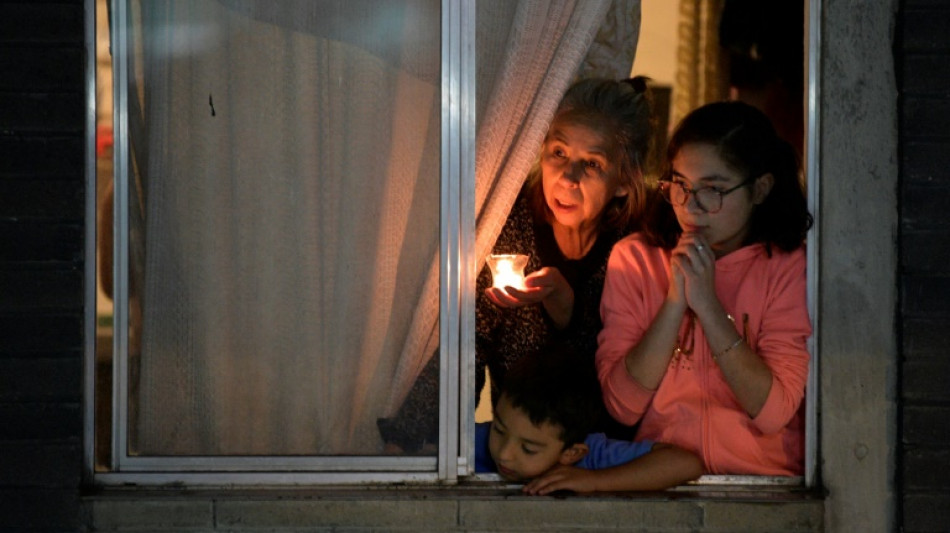
Despite court victory, 'parental alienation' plagues Colombian mothers / Photo: Raul ARBOLEDA - AFP/File

 Malta Chamber of Commerce and FIMBank Sign Alliance Agreement to Boost Corporate Finance

 Rene Eyre Revisits Autobiographical Performance 'Say A Little Prayer' in London

 UAE's HCT Holds Record Graduation and Announces Major Training Expansion

 NASA Awards $10B Lunar Contract Framework to SpaceX, Blue Origin

 Katy Perry Tells Fans Ex-Husband Russell Brand 'Should Be in Jail' During UK Concert

 South African election results renew debate over identity-based voting

 South African voters report smoother local election but declining IEC trust
 Dolly Parton museum and Nashville hotel open after singer’s death

 George and Amal Clooney attend New York political-comedy reading

 British buyers pay substantial premiums for period-home appearance

 Thomas Markle released to house arrest after child-abuse-image charge

 Dawn of War 4 developers chose Adeptus Mechanicus for tactical variety

 Italy face unbeaten South Africa in Turin Nations Championship match

When Sandra filed a complaint against her partner for sexually abusing their son, she said she became the target of Colombia's justice system.
Instead of receiving the help she needed, Sandra -- who asked that her real name be withheld for fear of reprisal -- was accused of manipulating her son to turn on his father.
The accusation was made using a controversial legal principle that Colombia has since scrapped but is still in force in many countries.
Ultimately, the boy was removed from her care for years, she said.
"They treated me like a crazy person, a malicious, negligent mother."
Sandra fell victim to a concept known as "parental alienation syndrome" -- coined by American psychiatrist Richard Gardner in the 1980s to describe a child developing animosity towards one parent due to their mind being poisoned by the other.
It is recognized as a form of child abuse in several countries, but rejected as a pseudo-concept by the United Nations.
Last year, Colombia's Constitutional Court ruled that it can no longer be relied on in court when it comes to determining custody cases, for example.
It was the first such ruling in Latin America, but too late to spare Sandra two years of pain.
"I questioned myself a lot, whether I really was crazy," she told AFP, having lost custody of her son for two years in 2022.
She got the boy back after the Constitutional Court ruling, but not before he was forced to stay with the very man she was trying to get him away from.
- 'Unfounded and unscientific' -
Sandra is not alone.
"Parental alienation syndrome" has been predominantly used against mothers, rather than fathers, according to a report by an independent UN expert to the Human Rights Council last year.
"The use of the unfounded and unscientific concept, is highly gendered," according to the report, often adding an extra layer of discrimination against women already in abusive situations.
The so-called "syndrome" has been dismissed by several medical, psychiatric and psychological associations, and in 2020 it was removed from the World Health Organization's International Classification of Diseases.
Yet its use persists in a handful of countries, including Argentina, Bolivia, Brazil, Chile, Spain, France, Peru, Puerto Rico, Mexico and Uruguay -- often in custody cases.
It "uses stereotypes to paint women as vengeful, jealous, crazy... or manipulative," Colombian forensic psychologist Maria Paula Chicurel told AFP.
But lawyer Ester Molinares, among its proponents, argues that scrapping the concept would "leave judges without the tools to determine what is happening in a family that is falling apart."
- 'Persecution does not stop' -
Sandra was found by the courts to have alienated her son from his father.
She said the boy was given to his father's best friend, and then to him, despite the abuse allegations she had leveled against him.
Another Colombian victim, Camila -- also not her real name -- told AFP she was similarly vilified, accused of imparting "parental alienation syndrome" on her two daughters after she accused their father of sexually inappropriate behavior towards the girls.
A justice official "threatened me that they had the power to take my girls away from me... I was very scared."
Instead of opening an investigation into her partner, the justice system took aim at Camila, even going so far as to sue her for filing a "false complaint."
Observers say that to bypass the Constitution Court ruling, some investigators and lawyers rely on the same concept of parental alienation, but using a different name such as "interference" or "maliciousness" against mothers.
Sometimes it is used by rich or influential men to secure custody of their children over the women they have separated from.
"We have been in this process for five years, the persecution does not stop..." Camila told AFP of her own case.
Her ex-partner, for his part, remains uninvestigated.
W.Nelson--AT