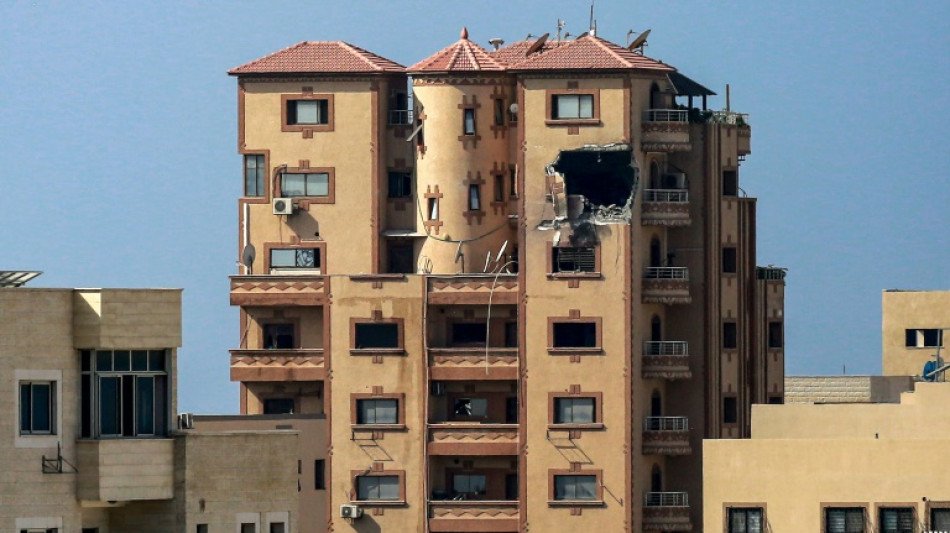
Media probe finds Israeli tank fire likely hit AFP Gaza office / Photo: Bashar TALEB - AFP/File

 Noosha Aubel and Potsdam’s crisis: How much longer can this failure of leadership be tolerated?
 US envoy sees 'movement' toward three-way talks with Russia, Ukraine

 Thousands bid farewell to Bosnian Serb war criminal in Belgrade

 EU chief announces 200-mn-euro investment package for Greenland

 Lebanon says Israel conducts wave of deadly strikes
 Cipheras Group - Apex AI Fund Deploys 290-Billion-Parameter Proprietary Large Language Model
 Germany's Merz 'shocked' by far-right state win but vows to stay course

 UK finance minister Healey pledges strict fiscal discipline as budget looms
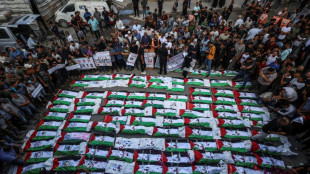
 Mbappe embraces Ballon d'Or talk after historic World Cup exploits
 Tech firms rally, with eyes on US inflation update
 Jaguar Land Rover to cut 4,000 jobs as European car sector hits skids
 US average diesel price rises to record $5.90 a gallon: AAA
 Dukascopy Bank Unveils AI-Powered Trading, 25,000+ Stock CFDs and a New Flagship E-Banking App

 Tech firms rally but Asian markets mixed, with eyes on US inflation

 Nepal holds day of mourning as families pray missing still alive
 African players in Europe: Mbeumo fires solo goal as United draw
 Malaysia cancels haze emergency, but warns problems remain

 Philippine sensation Eala looks forward to Asian Games 'fun'
 Jakarta airport extends closure after volcano eruption

 Lonely woman director in Venice sees industry backsliding on gender
 Tech firms rally on mixed day for Asian markets, with eyes on US inflation

 World number one An sends Asian Games warning with China hat-trick
 PSG go for three in a row as Champions League returns
 "Super-human' Alcaraz books US Open quarter-final clash with Shelton

 ECB set to hike interest rates as Iran war flares anew
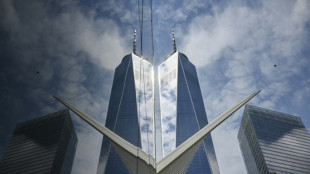
A collaborative investigation by AFP and international media outlets published Tuesday points to Israeli tank fire likely being the cause of blasts that damaged the global news agency's Gaza bureau on November 2.
A consortium led by investigative outlet Forbidden Stories and involving around 50 journalists from 13 outlets carried out a four-month probe into several strikes involving journalists and media infrastructure since the war in Gaza erupted on October 7.
The strike on the AFP bureau, less than a month into the fighting sparked by Palestinian militant group Hamas attacking Israel, did not cause any casualties as staff had evacuated the site.
But the office's 11th-floor server room was severely damaged.
On a balcony on the floor below, an AFP camera was capturing live images of the Israeli offensive in the Hamas-ruled territory and beaming them to viewers around the world.
As the camera kept rolling, it caught the very moments the bureau was hit.
As part of the investigation, journalists and experts pored over archives of this live footage, images of the aftermath of the strike and satellite imagery to try to determine the cause of the blast.
Five experts consulted said the damage to the server room was likely caused by a tank, a weapon not owned by any other party in the conflict apart from Israel.
The Israeli military has said "the building was not targeted in any way", and in June said the incident was under review.
Here is a breakdown of what the investigation has revealed:
- What happened? -
Since 1993, AFP has had a bureau in the Gaza Strip.
In 2015, it moved to the three top floors of the 12-storey Hajji building in Gaza City's Rimal neighbourhood, two blocks from the Mediterranean Sea.
When conflict broke out on October 7, some of AFP's team of seven journalists, one technician and one accountant in the territory had been working for the agency for over two decades.
AFP has been particularly proud of the Gaza bureau, especially in view of the limited presence of foreign press in the Palestinian territory, the agency's global news director Phil Chetwynd said.
AFP staff "have a great attachment to the people who work there and the very difficult work that they do", he said.
Adel Zaanoun, a journalist whose career with AFP in Gaza spans three decades, said the bureau in the Hajji building, with its view onto the Mediterranean Sea and over large parts of the city, had been useful for coverage, but also "a safe haven in times of war".
"It's our second home," he said.
It is from the office in the Hajji building that staff initially covered the conflict, with the agency sharing the bureau's address and coordinates with the Israeli military within the first day of the war.
The AFP team left on October 13, the same day Israel demanded all civilians leave Gaza City.
But the camera on its 10th-floor balcony continued filming.
As tanks slowly encircled Gaza in early November, it was live streaming images from the city.
On November 2 around midday local time, blasts rocked the AFP bureau, severely damaging the server room and leaving a gaping hole in one of its outside walls.
The live camera on the balcony on the floor below, connected to solar panels, was not hit and kept rolling.
After a few temporary interruptions, it only stopped coverage definitively on November 12, when no one was around to reboot the transmission system.
AFP on November 4 called on Israel for "an in-depth and transparent investigation" into the exact involvement of its military in the strike.
The Israeli military said there had been an Israeli "strike near the building to eliminate an immediate threat" that "might have caused debris", but "the building was not targeted in any way".
- What do the live footage and images of damage show? -
Archived live footage from the camera shows bright flashes in the distance several seconds before blasts rock the building, with several experts establishing a correlation between the two.
Five said it was likely tank fire that had hit the building.
Trevor Ball, a former US army explosives expert, said the damage to the server room was consistent with tank fire.
On a scale of one to 10, "I would go with a 10 due to the small amount of damage and fragments consistent with tank rounds," he said.
British ammunition expert Adrian Wilkinson noted the damage inside the 11th-floor server room was consistent with a 120mm M339 "bunker buster shell" containing 2.3 kilos of explosive known to have been used by Israeli tanks during the Gaza war, and not owned by any other party in the conflict.
"No other actor has a weapon system that fires line of sight with a warhead of 2.3 kilos, which is consistent with the damage caused inside the building," he said.
Damage showed "the device certainly detonated inside the building", he added.
"A debris strike would not cause the damage observed," he added, dismissing the Israeli military's claim.
He said the building was likely targeted.
"The weapon type and accuracy inherent in the Israeli tank weapon system means that the weapon hit the target it was aimed at," he said.
"Why it was fired? I cannot comment."
A weapons expert from the French military, who agreed to speak on condition of anonymity, said that there was a "more than a seven out of 10" chance that it was an Israeli tank shell that caused the damage.
"If it had been a different kind of projectile, we would have seen different kinds of shrapnel," he said.
War Noir, an independent weapons researcher who works under a pseudonym, said it was highly probable the live stream footage had caught a tank firing at the building.
"It is very likely that most of the attacks in the streams were caused by a tank gun," he said.
Asked for clarification about the November 2 attack during the investigation, the Israeli military appeared to repeat its previous statement.
"The offices of the AFP agency were not the target of the attack and damage to them could have been caused by the shock wave or shrapnel," it said, without clearly saying to what attack they referred or mentioning the date.
It added the incident was under review.
- Remaining questions -
Where did the tank fire originate from?
For each strike, the live footage captures a flash, a strike on the building and then the sound of a muzzle blast.
Knowing the speed of sound, consortium journalists calculated the distance between the flash of the weapon going off and the camera that captured the sound of its detonation, placing the origin of fire at around three kilometres (1.8 miles).
Positioning that radius over a satellite map, it located the possible point of departure to a wasteland northeast of the AFP bureau.
While analysis of images could not clearly establish a line of sight from that plot, the investigation could not categorically exclude that one existed.
The ongoing nature of the conflict meant that a journalist could not be sent back there to take extra pictures.
But Israeli tanks were in that area around that date.
Satellite images of the area on November 3, the day after the strikes, show what look like vehicle tracks on that patch of wasteland.
Satellite imagery company Maxar sent partners views of other areas of the city on November 2, the day of the strikes on the AFP bureau, but for the full wasteland area said it did not have "imagery that we can provide".
It also remains unclear why the building was struck.
AFP has no indication that any Hamas members were in the building on November 2 or in the days prior, said global news director Chetwynd.
The team did not hear any unusual activity going on near the camera in parts of the live stream footage that they viewed from November 2 and days before.
It is also unclear if the live stream was being targeted.
But the strikes come within a series of incidents involving the Israeli army and media over the course of the war.
Less than an hour before the strike on the AFP office, a strike hit another tower block nearby called the Ghefari building, on whose 16th floor a local outlet called the Palestinian Media Group (PMG) was also shooting live footage.
Its clients since the start of the war had included international news agency Reuters.
That strike damaged the 16th floor of Ghefari, wounding one of its journalists.
PMG's Hassan Madhoun said a second strike again hit his offices in the Ghefari tower on November 3 from a different direction, and he was certain "it was targeting the cameras".
In southern Lebanon on October 13, an AFP team and reporters from other media outlets including Reuters and Al Jazeera were capturing images of clashes on the Israeli border, when they were also hit, killing a Reuters journalist and seriously wounding an AFP photographer who later had a leg amputated.
Al Jazeera was streaming live from the location at the time.
An AFP investigation in December also pointed to a tank shell only used by the Israeli army in the high-tension border region.
More recently, Israel last month briefly blocked the AP news agency's live video of Gaza from southern Israel.
For Shuruq Asad, spokeswoman for the Palestinian Journalist Syndicate (PJS), the intent of the November 2 strike was clear.
"This is a clear and direct attack on a press office," she said.
"Israel knows the importance of the live streams... how important they are for the international press which use these wire services."
Irene Khan, the UN Special Rapporteur on the promotion and protection of the right to freedom of opinion and expression, said such footage could also sometimes be used as evidence.
"Where there is strong potential for a war crime being committed, obviously the live stream becomes critical evidence," said Khan.
- What's next? -
Chetwynd, AFP's global news director, called for "a very clear and transparent investigation into both the incident in southern Lebanon and the incident in our bureau in Gaza".
"Any kind of attack in which journalists or media structures are damaged or hurt is extremely serious and in both these incidents there are real concerns that there was some kind of targeting of either individuals or media infrastructure," he said.
UN expert Khan stressed, that even if the offices were empty, "according to international humanitarian law, media infrastructure is civilian infrastructure, so targeting it would be potentially a war crime".
burs-gf-sbh-cf-ah/jm
W.Moreno--AT