
Climate change drove extreme rain in southeast Africa storms: study

 Malaysia's JDT claims unbeaten run world record

 Bolivian economy minister fired after Congress vote
 Russell roars to Dutch GP sprint pole, Antonelli fifth
 Russell takes pole for Dutch GP sprint

 England start life after Bazball with rout of Pakistan

 'Duck run' pest control catching on in S.Africa's winelands
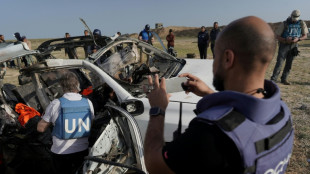 UK, Canada, Australia slam Israel ending probe into aid worker killings

 Spurs spending spree vital to raise standards: De Zerbi

 US, Canada try to wrap up trade deal before latest Trump deadline

 World No.1 Sinner withdraws from US Open with knee injury

 Judge allows UK rugby brain injury court case to continue to trial

 Trump announces temporary tariff relief on ground beef imports

 Pope to visit San Marino, address Italian political event

 All Blacks just as good as Springboks, says captain Savea

 Romania holding suspected 'low-level agent' after pistols found near Berlin: Germany

 UK forecasts 'biggest' El Nino will smash records, spark hottest year

 Cyclist Alaphilippe attracts tributes as reports say he has quit

 Top-ranked An, holder Yamaguchi reach badminton worlds semi-finals

 Iran president says time to end war while in position of strength

 Antonelli fastest in sole Dutch GP practice session

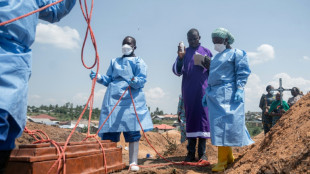 2,500 dead and rising -- UN says DR Congo Ebola outbreak 'growing exponentially'

 England all out for 409, lead Pakistan by 238 runs in 1st Test

 Premier League returns with Arsenal eyeing title dynasty

 Bayern knew about Musiala's condition 'a long time ago' says Kompany

 Ex-Pakistan PM Khan taken back to jail after hospital checks
A string of deadly storms pummelled Madagascar, Malawi and Mozambique with more intense rainfall because of climate change, new research found Monday.
Three tropical cyclones and two tropical storms hit Southeast Africa in just six weeks in the first months of this year, causing widespread flooding.
More than a million people were affected and at least 230 people died.
The analysis was carried out by the World Weather Attribution (WWA) network of scientists, which has pioneered ways to speedily link extreme weather events to climate change.
They said that it was climate change that had made the heavy rains brought by the back-to-back storms both heavier and more likely.
"Again we are seeing how the people with the least responsibility for climate change are bearing the brunt of the impacts," said WWA co-founder Friederike Otto, of the Grantham Institute at Imperial College London.
After Tropical Storm Ana smashed into the region in January, Tropical Cyclone Batsirai hit Madagascar in early February, followed in quick succession by Tropical Storm Dumako and Tropical Cyclones Emnati and Gombe.
WWA scientists used weather observations and computer simulations to compare rainfall patterns under today's climate to that of the pre-industrial area, before global warming.
They focused on two of the wettest periods -- during storm Ana in Malawi and Mozambique and during cyclone Batsirai in Madagascar.
"In both cases, the results show that rainfall associated with the storms was made more intense by climate change and that episodes of extreme rainfall such as these have become more frequent," WWA said in a report of their findings.
That tallies with overall climate research showing that global warming can increase the frequency and intensity of rainfall.
- Data plea -
But the scientists were not able to determine exactly how much climate change influenced the extreme events because of a shortage of high quality historical rainfall records for the region.
This is a particular concern in poorer nations, which are also especially vulnerable to the impacts of climate change.
"Strengthening scientific resources in Africa and other parts of the global South is key to help us better understand extreme weather events fueled by climate change, to prepare vulnerable people and infrastructure to better cope with them," said Izidine Pinto, of the University of Cape Town and the Red Cross Red Crescent Climate Centre.
WWA said that of 23 weather stations in the affected area in Mozambique, only four had relatively complete records going back to 1981.
In Madagascar and Malawi there were no weather stations with suitable data.
Madagascar, one of the poorest countries in the world, has also been ravaged by drought in its southern region, leading to malnutrition and pockets of famine.
In December, the WWA said global warming had played only a minimal role in that crisis, contradicting a UN description of the situation as a "climate change famine".
T.Perez--AT