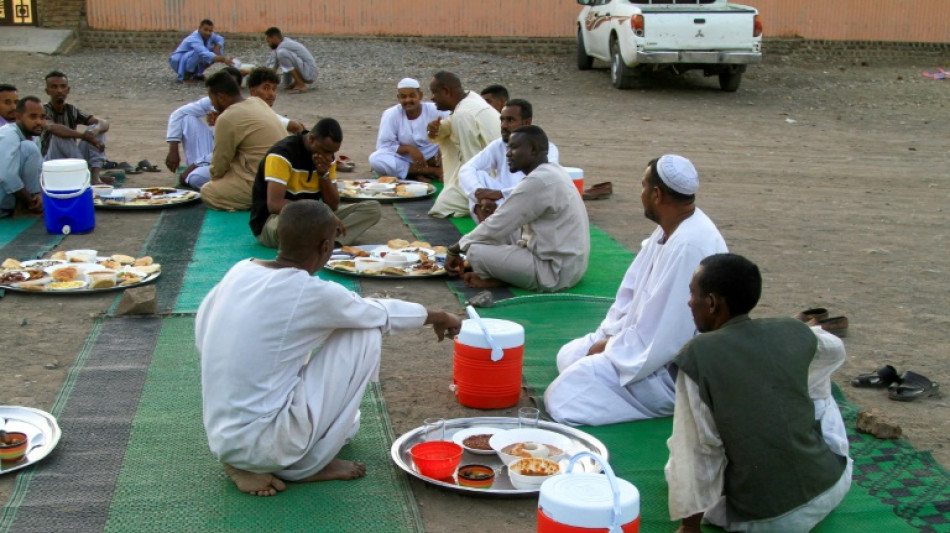
Famine stalks Sudan in second Ramadan plagued by war / Photo: - - AFP

 Nepal flood death toll rises as rescuers scour tunnels

 France's Mistral sees value soar with 3 bn euro cash infusion

 Nepal glacier saw exceptional heat before collapse caused deadly floods: researcher

 Ethiopia boosts drone production to fight rebels
 Yemen rebels hit Saudi Arabia with wave of strikes, wounding 73

 Nepalis mark a year since deadly protests that toppled government

 Rubio launches Latin America tour to cement US influence

 France tries 14 over deadliest Channel migrant crossing disaster

 Australia threatens hefty fines if big tech fails 'duty of care'
 Zverev romps into quarter-finals as Darderi downed

 Kauai on tornado watch as Hurricane Lowell nears Hawaiian islands

 Pakistan roll the dice in search of consolation win over England

 Yen extends gains as traders eye rate hike, tech rallies again

 'The ber months': Christmas arrives early in the Philippines
 N. Korea calls Russia bridge a sign of tighter ties

 US sanctions threaten to crush Iranian students' dreams
 Former champ Gauff holds off Jovic to reach US Open quarter-finals

 Battery X Metals to Appoint Accomplished Technology and Consumer Brands Executive Nicholas Reichenbach to Board of Directors
 Equitech-Bio Expands Reagent Portfolio with New IgG Offering and Publication-Backed Product Validation from Bioz

 CPG Life Fund I Launches $20 Million Operator-Led CPG Fund

 Who is the Best Female Cosmetic Surgeon in Florida?

 CANEX Metals Announces C$6.5 Million Strategic Financing Led By C$3 Million Investment by Eric Fier

 Helio Sets September Roadshow Across Austin, Houston, Phoenix, Scottsdale
 Gaming Realms PLC Announces Interim Results

 Universal Edge Technologies Establishes Senior Advisory Committee, Names Mark Powell and Mark P. Mills as Founding Members
Sudan this week entered its second straight Ramadan in the throes of a deadly war that has left much of the country gripped by the spectre of famine.
"Ramadan? We've been doing that for months!" said Khartoum resident Othman Idriss, referring to the daytime fast observed by the faithful during the Muslim holy month.
"We have been eating one meal a day for months and we no longer even have the means to prepare it ourselves," he told AFP in a phone call.
"They serve it to us in a soup kitchen organised in a mosque."
Before the war erupted on April 15, towards the end of last year's Ramadan, Idriss ran a small food store.
But since the fighting between rival generals turned the capital's streets into a bloody war zone, he has been unable to return to the shop or the neighbourhood of the capital where it once stood.
The nearly 11-month war, which pits the regular army of General Abdel Fattah al-Burhan against the paramilitary Rapid Support Forces (RSF) of his former deputy Mohamed Hamdan Daglo, has killed tens of thousands, displaced millions and reduced much of the country's infrastructure to rubble.
In North Kordofan state, where the RSF holds sway, Mohammed Soleiman insists on keeping his shop in the city of Al-Rahad open even though customers are few and far between.
The paramilitaries "charge taxes on all the trucks, so the prices go up and there are fewer and fewer products arriving," Soleiman told AFP.
- No wages -
Until recently, Imad Mohammed was able to use a banking app to receive cash transfers from relatives abroad to help feed his family.
Despite a currency in freefall and triple-digit inflation even before the war broke out, the app had served as a lifeline to thousands, allowing them to make transfers and purchases and to receive cash.
But weeks ago, even that last financial safety net was lost, when telecommunications were suddenly cut in several states and cities.
"For 11 months, I have received no salary," said Mohammed, a teacher from Wad Madani, south of Khartoum.
Like all public employees in the battle zones, Mohammed has been left with next to no income.
Some staff have sporadically received parts of their wages, while others have had nothing at all.
"We're beginning Ramadan and we are already hungry," he said.
The United Nations estimates that 18 million of Sudan's 48 million people are acutely food insecure, five million of whom have reached the last level before famine.
Less than five percent of Sudanese "can afford a full meal", said the World Food Programme, which fears "the largest famine crisis in the world".
- Hungry children -
A child dies of malnutrition every two hours in the Zamzam camp for displaced people in North Darfur state, according to Doctors Without Borders.
On the other side of Darfur, in the Kalma displaced persons' camp, Ishaq Mohammed said he and his seven family members felt abandoned.
"The humanitarian organisations left with the war, the odd jobs that we managed to find before have disappeared, so for months we have only eaten one meal a day and, often, we go without to give it to the children," he told AFP.
That sense of abandonment is echoed by Sudan specialists who warn that the conflict has been forgotten.
British researcher Alex de Waal said that while a decade ago any UN emergency appeal could expect to raise two-thirds of the funds requested, in recent years that has dropped to 30 percent.
"Currently the funding appeal to Sudan is funded to no more than three percent," de Waal said.
"That is a really deeply alarming scenario."
As funding fails to materialise, food is only getting more scarce, said de Waal.
"We have not yet got to the data to indicate that we are in famine. But that data blackout is no cause for any complacency," he said.
According to the aid group Save the Children, nearly 230,000 children and new mothers in Sudan are "likely to die from hunger" without urgent intervention.
In better times, Khartoum families would flock to Sudan's pre-war breadbasket Al-Jazira state for Ramadan weekends.
But after RSF forces swept through the state in December, there is no mood for celebration and the rich aromas of Ramadan specialities are gone, replaced by the stench of gunpowder.
"This year, Ramadan has no flavour," said Al-Jazira resident Nahed Mustafa.
L.Adams--AT