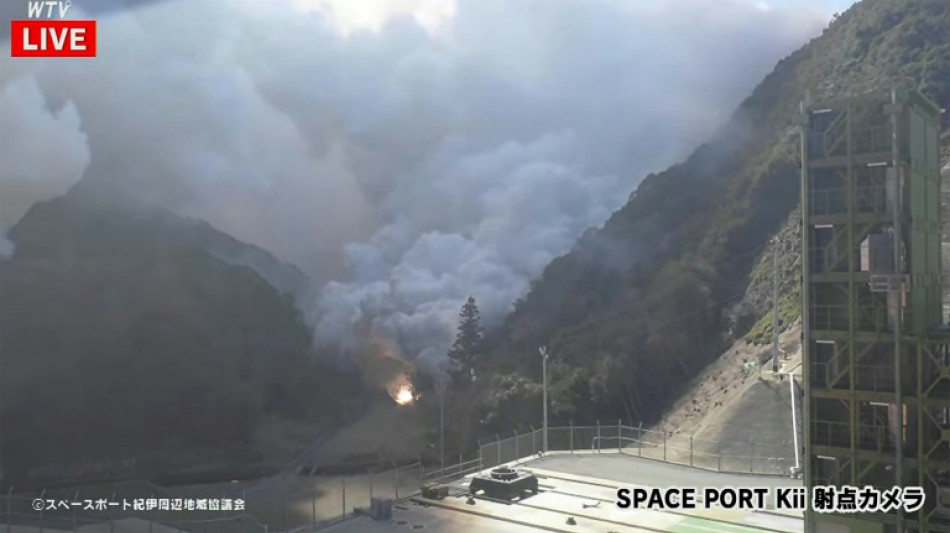
Japan space rocket explodes seconds after launch / Photo: - - AFP

 Nepal flood death toll rises as rescuers scour tunnels

 France's Mistral sees value soar with 3 bn euro cash infusion

 Nepal glacier saw exceptional heat before collapse caused deadly floods: researcher

 Ethiopia boosts drone production to fight rebels
 Yemen rebels hit Saudi Arabia with wave of strikes, wounding 73
 Nepalis mark a year since deadly protests that toppled government

 Rubio launches Latin America tour to cement US influence

 France tries 14 over deadliest Channel migrant crossing disaster

 Australia threatens hefty fines if big tech fails 'duty of care'
 Zverev romps into quarter-finals as Darderi downed

 Kauai on tornado watch as Hurricane Lowell nears Hawaiian islands
 Pakistan roll the dice in search of consolation win over England

 Yen extends gains as traders eye rate hike, tech rallies again

 'The ber months': Christmas arrives early in the Philippines

 N. Korea calls Russia bridge a sign of tighter ties

 US sanctions threaten to crush Iranian students' dreams
 Former champ Gauff holds off Jovic to reach US Open quarter-finals

 Battery X Metals to Appoint Accomplished Technology and Consumer Brands Executive Nicholas Reichenbach to Board of Directors
 Equitech-Bio Expands Reagent Portfolio with New IgG Offering and Publication-Backed Product Validation from Bioz

 CPG Life Fund I Launches $20 Million Operator-Led CPG Fund

 Who is the Best Female Cosmetic Surgeon in Florida?

 CANEX Metals Announces C$6.5 Million Strategic Financing Led By C$3 Million Investment by Eric Fier

 Helio Sets September Roadshow Across Austin, Houston, Phoenix, Scottsdale
 Gaming Realms PLC Announces Interim Results

 Universal Edge Technologies Establishes Senior Advisory Committee, Names Mark Powell and Mark P. Mills as Founding Members
A rocket made by a Japanese company exploded seconds after launch on Wednesday, in a spectacular failure for the start-up's bid to put a satellite into orbit.
Tokyo-based Space One's 18-metre (60-foot) Kairos rocket blasted off in the coastal Wakayama region of western Japan, carrying a small government test satellite.
But around five seconds later, the solid-fuel rocket erupted in fire, sending white smoke billowing around the remote mountainous area as orange flames raged on the ground, live footage showed.
"The launch of the first Kairos rocket was executed, but we took a measure to abort the flight," Space One said in a statement, adding that "details are being investigated".
Burning debris fell onto the surrounding slopes as sprinklers began spraying water in dramatic scenes watched by hundreds of spectators young and old gathered at public viewing areas including a nearby waterfront.
"I had high hopes for this, so I'm disappointed. I want to know what happened," one elderly man told public broadcaster NHK.
The fiery failure marks a blow to Japan's efforts to enter the potentially lucrative satellite-launch market.
Space One is hoping to become the nation's first private firm to put a satellite into orbit, and the plan had been for Kairos -- an ancient Greek word meaning "the right moment" -- to do so around 51 minutes after take-off.
Parts shortages and other problems had reportedly led Space One to postpone the launch of Kairos five times before Wednesday's attempt, most recently on Saturday.
- 'Didn't even imagine' -
The mayor of Kushimoto, the town of 15,000 residents in Wakayama where the failed launch took place, voiced his surprise and disappointment.
"I didn't even imagine an outcome like this," Katsumasa Tashima told reporters shortly after the explosion.
But the town "will continue to support Space One, and we want to continue to offer our help so that the first rocket will have a successful launch", he said.
Space One was established in 2018 by a team of major Japanese tech businesses, including Canon Electronics, IHI Aerospace, construction firm Shimizu and the government-owned Development Bank of Japan.
Last July, another Japanese rocket engine exploded during a test around 50 seconds after ignition.
The solid-fuel Epsilon S was an improved version of the Epsilon rocket that had failed to launch the previous October.
The malfunction came after Tokyo in March 2023 failed a second attempt to launch its next-generation H3 rocket.
The H3 has been mooted as a rival to SpaceX's Falcon 9, and could one day deliver cargo to bases on the Moon.
Last month, Japan's space agency managed a successful blast-off for the new flagship rocket.
That followed Japan's successful landing in January of an unmanned probe on the Moon -- albeit at a wonky angle -- making it just the fifth country to achieve a "soft landing" on the lunar surface.
In April last year, another Japanese start-up, ispace, tried in vain to become the first private company to land on the Moon -- losing communication with its craft after what it described as a "hard landing".
A.Taylor--AT