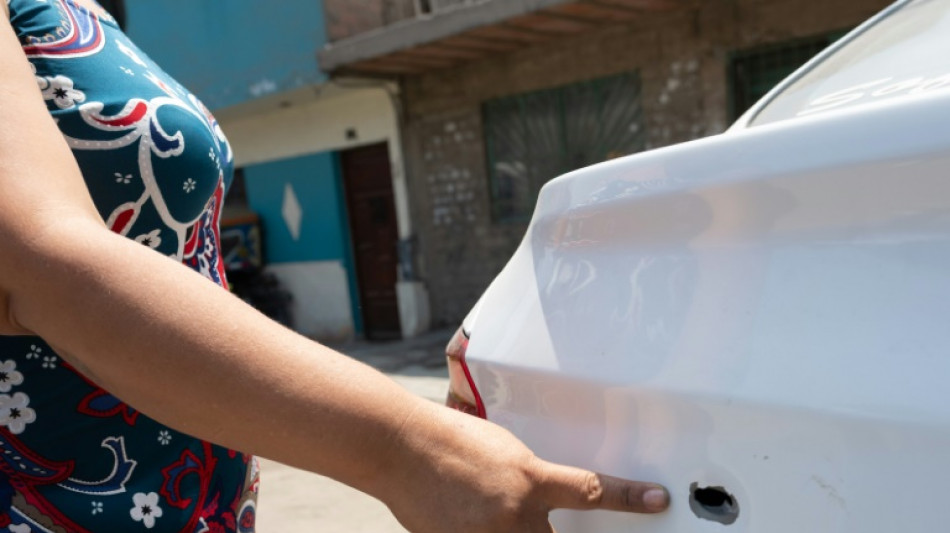
Pay up, or else: Latin America cowed by lucrative extortion / Photo: Cris BOURONCLE - AFP

 Galloway accuser could not foresee publishing-sector fallout, lawyer argues

 New York City Center revives In the Heights as a timely community story

 Godzilla Minus Zero shifts focus toward postwar human drama

 Mehbooba Mufti urges dialogue and renewed Central Asia links for Kashmir

 Seacliff Healthcare Seeks Specialist GP in Thirroul

 US stocks fall before midterm Election Day as technology shares weaken

 BLS Polymers makes strong market debut at ₹248 per share

 Petrol and diesel prices remain broadly steady across major Indian cities

 Reliance shares remain in focus after near-12% surge

 2026 Arizona Midterms: Key Races, Ballot Measures, and Voter Deadlines

 Coal India prepares possible $1 billion Mahanadi Coalfields listing

 Julia Stiles and Ezra Sosa Share Emotional Farewell After 'DWTS' Elimination

 US Buildings Threatened by Wildfires Could Triple by 2060

 Why Pregnancy Cost Estimates Fail: A Family’s $9,000 Surprise

 US Strikes Iranian Targets in Strait of Hormuz Ahead of Midterms

 Brodeur’s Overtime Goal Secures Bethlehem’s Second Consecutive Sectional Title

 Rare 1970 Plymouth ‘Cuda 426 Hemi Listed for $400,000

 The Digital Burden: Why Instant Messaging Feels Like a Full-Time Job

 Alberta Tabled Controversial Riding Boundary Maps Amid Gerrymandering Accusations

 Hong Kong court set to sentence activist Joshua Wong in security case

 Australia raises benchmark rate to highest level in 18 years

 'The Remarried Empress' Cast Discusses Bringing Fantasy Royal Drama to Life

 Asian stocks retreat as AI worries outweigh steep oil-price drop

 Hamad International Airport stages emergency drills during WATAN 2026

 Global failure to punish attacks leaves journalists at continuing risk

Before he opened a new sauna in eastern Lima, Eduardo started receiving extortion messages from a local gang. He ignored them.
Then, one night, a gunman on a motorbike opened fire on the unoccupied premises, which were still being refurbished, and a video of the attack was sent to his phone.
The gang was demanding an installation fee of $13,300 dollars and a monthly payment of $1,300 for Eduardo to be able to open his business.
This kind of extortion racket has become the bane of citizens' existence from Mexico through Central America to Colombia, Ecuador and Peru.
Million-dollar profits make the shakedown business more lucrative than drug trafficking, human trafficking, and likely even illegal mining, intelligence sources told AFP.
Businesses small and large, transport companies, residential areas and entire towns find themselves forced to shell out payments to criminal groups.
"I walk around almost in secret because I imagine they have studied everything and know where I live, where I have breakfast, where I have lunch, where I spend the night," said Eduardo, 40, who asked not to be identified by his real name for fear of repercussions.
In Peru, extortion has even impacted football. International striker Paolo Guerrero this month threatened to quit his club in the city of Trujillo -- which is under a state of emergency over gang activity -- after he received threats against his family.
- 'We know who you are' -
Officials say the main gangs running extortion rackets are Los Pulpos in Peru, the Clan del Golfo in Colombia, and Tiguerones in Ecuador.
Venezuela's feared Tren de Aragua has also expanded into several neighboring countries in recent years.
The groups have become "criminal companies" in search of markets and "partners in other countries," said Peruvian anti-crime prosecutor Jorge Chavez.
Fear of the gangs has not stopped people from filing complaints about extortion, with Peru recording more than 19,400 reports in 2023 -- a five-fold increase over the past two years.
Ecuador, which is under a state of emergency over gang activity, has seen a similar increase.
In Mexico, one extortion is reported every hour, according to the Coparmex business association.
Across the region, gangs employ similar methods.
"We know who you are, and we know what time your business opens. We know when you go to the market, we know where your child goes to school," are common warnings that arrive via WhatsApp, said Andres Choy, president of Peru's Association of Shop Owners, which has 22,000 members.
He estimates that 13,000 of them were blackmailed last year.
A follow-up warning might entail a "photo of a family member walking". Many decide to close their businesses or send their children abroad, he said.
Anita, 43, a widow with two daughters, told AFP how racketeers launched an explosive and shot at her hardware store in Lima in January.
"The threats changed my life. I have to hide with my girls within four walls," she said.
- 'Parallel State' -
The gangs have practically created a "parallel State", in which they control territories and establish a tax system, said Ecuadoran Colonel Roberto Santamaria, police chief of Nueva Prosperina, one of the most violent districts in the gang-ridden port city of Guayaquil.
He said they often resort to using minors to collect their money as they cannot be charged. Another faction is charged with carrying out attacks on those who do not comply with demands.
Sometimes, one gang might cede the "administration" of its area to another for a regular flow of cash.
Santamaria said that in a suburb with 2,000 houses in Nueva Prosperina, each household is forced to pay a two-dollar daily "tax."
In the Colombian town of Buenaventura, home to around 300,000 people, "everyone has to pay", whether to open a business, construct a building or carry out renovations, said Elizabeth Dickinson, an analyst with the International Crisis Group in the country.
- Dirty loans and AI porn -
In Peru, aside from the classic mafia protection racket, criminal groups also offer small loans with weekly interest rates of up to 20 percent.
"When the 'client' can't pay, the extortion begins: if you don't pay we will burn down your kiosk, grab your family, your sister or your children to hurt or kill them," said prosecutor Chavez.
Recently, call centers have cropped up offering credit with lower interest rates via a mobile application. To get the loan, you have to share personal information which is then used to blackmail the whole family.
Criminals also use Artificial Intelligence (AI) to superimpose women's faces on naked bodies, extorting victims to prevent the images from being spread further.
But while people live in fear, the wheels of business keep turning. Neither wanted to say if they eventually paid, but Eduardo opened his sauna, and Anita's hardware store is still operating.
R.Chavez--AT