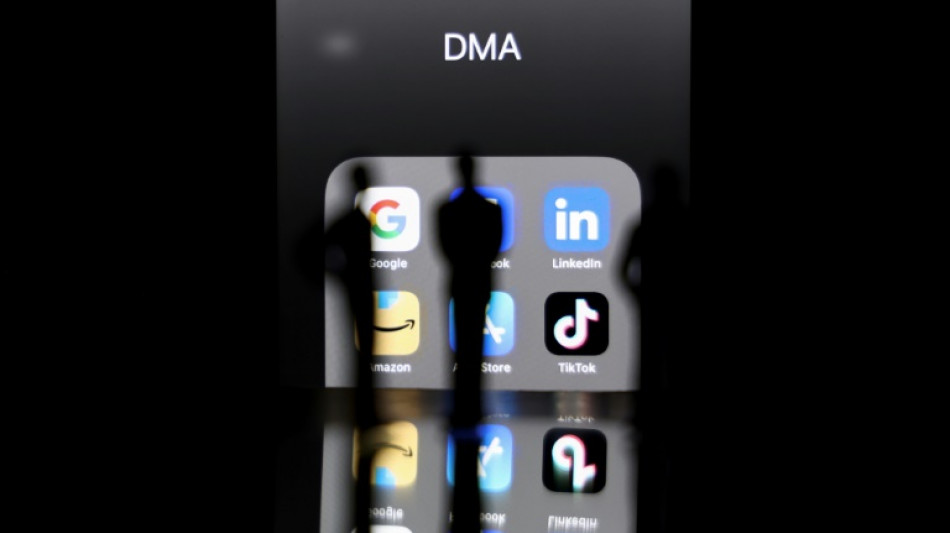
Tech titans yield to new EU rules before March deadline / Photo: Kenzo TRIBOUILLARD - AFP/File

 South Africa economy shrinks ahead of local elections

 CapTLX Expands Institutional-Oriented Platform for Access to U.S. Capital Markets

 UK's Prince George starts at Eton College

 French far right keeps guarded silence over AfD Germany triumph

 Russia-Ukraine talks possible this month, Zelensky says, as Moscow pounds Kyiv

 Turkish Airlines will be new Liverpool shirt sponsor in £300 mn deal

 On London's Brick Lane, a data centre sparks local battle

 Nepal flood death toll rises as rescuers scour tunnels

 France's Mistral sees value soar with 3 bn euro cash infusion

 Nepal glacier saw exceptional heat before collapse caused deadly floods: researcher

 Ethiopia boosts drone production to fight rebels

 Yemen rebels hit Saudi Arabia with wave of strikes, wounding 73

 Nepalis mark a year since deadly protests that toppled government

 Rubio launches Latin America tour to cement US influence
 France tries 14 over deadliest Channel migrant crossing disaster
 Australia threatens hefty fines if big tech fails 'duty of care'

 Zverev romps into quarter-finals as Darderi downed
 Kauai on tornado watch as Hurricane Lowell nears Hawaiian islands

 Pakistan roll the dice in search of consolation win over England

 Yen extends gains as traders eye rate hike, tech rallies again

 'The ber months': Christmas arrives early in the Philippines

 N. Korea calls Russia bridge a sign of tighter ties

 US sanctions threaten to crush Iranian students' dreams

 Former champ Gauff holds off Jovic to reach US Open quarter-finals

 Formation Metals Extends A-Zone 200 Metres to the South and Identifies a New Vein Set, Returning 2.53 g/t Au over 11.8 Metres and 1.41 g/t Au over 20.6 Metres at the Advanced N2 Property

2024 will be a year of change for the world's biggest tech companies as they bow to EU rules that come into force next month, shaking up how Europeans use vastly popular platforms from Google to Instagram.
The European Union long ago set its sights on big tech, aiming to rein in globally dominant companies like Apple, Google and Microsoft.
The landmark law known as the Digital Markets Act (DMA) breaks new ground because, rather than acting after the fact, it seeks to prevent companies from becoming powerful enough to edge out rivals.
"This is really a big, big intervention in markets that affect people's lives every day," said Fiona Scott Morton, senior fellow at think tank Bruegel.
Brussels in September named six so-called "gatekeepers" that face tougher curbs: Google's Alphabet, Amazon, Apple, TikTok parent ByteDance, Meta and Microsoft.
It singles out 22 "core" platform services by the big six, including Amazon Marketplace, Apple's App Store, Facebook, Instagram and Google's Chrome browser.
"The point of the law is to open up these platforms and make the interface widely accessible so that there can be competition," Scott Morton told AFP.
The firms have until March 7 to comply, with a flurry of changes announced since the start of the year -- even as Apple, TikTok and Meta pursue challenges to aspects of the law.
"We'll get some of the benefits of the opening up of these markets pretty quickly," Scott Morton predicted.
- Wind of change -
One of the biggest changes announced so far came from Apple, which said in January it would allow alternative app stores on the iPhone for the first time.
The firm has moved grudgingly to comply, while also legally contesting that its app stores across all products including the iPhone should count as one.
Google's EU users are seeing banners asking if they want to keep their Google services, like YouTube and Chrome, linked -- and therefore allow data sharing.
Another big change will be choice screens: the EU wants firms to make it easier for users to choose their default search engine or browser, in an attempt to challenge Google search's dominance.
Google has promised to overhaul its results page, with a group of links to price comparison websites and removing some features such as Google Flights.
Microsoft has also announced steps to comply -- including letting Windows users in the European Economic Area (EEA) -- uninstall its Edge browser from their computers, and scrapping pop-ups urging new users to try the interface.
The EEA includes the bloc plus Iceland, Liechtenstein and Norway.
Advertising services by Amazon, Google and Meta must also adjust to the new rules, and Amazon last month detailed changes to its ad service, including providing more information about pricing.
Letting users decide how much of their data should be shared between the biggest companies' various platforms is one of the headline changes sought by the EU.
Meta said last month that users in the EU, in the EEA and in Switzerland will be able to create a separate Facebook Messenger account if they do not want it linked to their Facebook account.
Individuals will also be able to access Facebook Marketplace and Facebook Gaming without using their main account information.
At the same time, Meta is contesting the law's application to Facebook's Messenger and Marketplace services.
Likewise, Chinese-owned TikTok, the only non-US business on the EU's list, says it does not meet various thresholds for the law to apply and has been wrongly designated.
- Core Apple issues -
Of all the giants it targets, the DMA has perhaps the greatest potential to alter Apple's closed ecosystem.
Apple has not hidden its contempt for the DMA, which it says creates privacy and security risks.
Inside the industry, Apple has been accused of acting in bad faith -- including by Meta's Mark Zuckerberg who suggested its changes made it no easier to create alternative app stores on the iPhone.
"Apple clearly has no intention to comply with the DMA," said Rick VanMeter, executive director of the more than 70-member Coalition for App Fairness, which has long called for Apple to open up its marketplace.
"Apple is introducing new fees on direct downloads and payments they do nothing to process, which violates the law," he said.
Apple has said that its changes comply with the DMA.
One vocal critic is Daniel Ek, the CEO of Spotify, which is part of the app coalition and called Apple's announced changes "a new low" for the firm.
Echoing a rising chorus among Apple's competitors, Spotify voiced hope that the DMA will end "unfair stifling of innovation disguised by Apple as security protections".
Ch.P.Lewis--AT