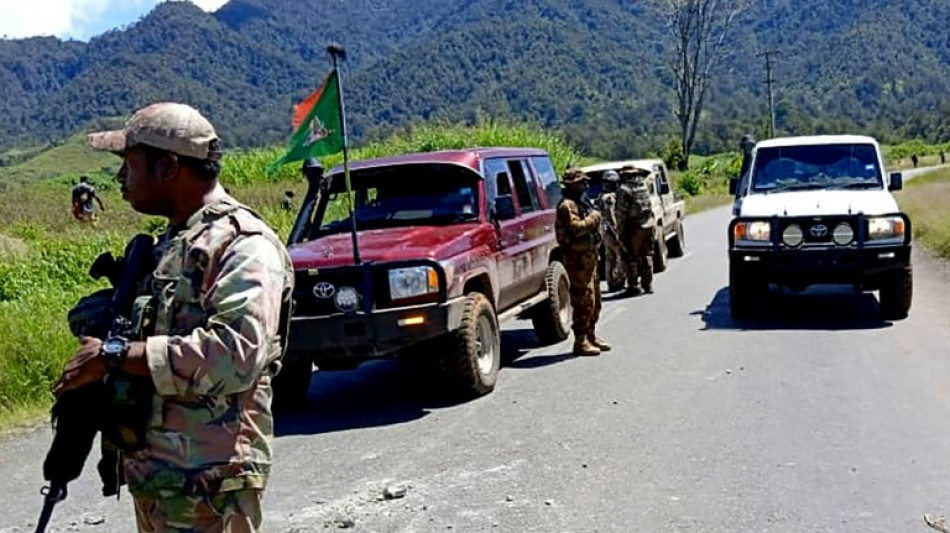
Dozens dead in Papua New Guinea tribal violence / Photo: Handout - ROYAL PAPAU NEW GUINEA CONSTABULARY/AFP

 The "Everlasting Battery" Inside Your Joints:UConn Professor's Self-Powered Healing Material just Got Acquired

 Visionary or conman? Elon Musk enigmatic star of Venice documentary

 Trial opens in France over deadliest Channel migrant crossing disaster

 England skipper Root says it's wrong to accuse Pakistan of lacking fight
 Owen Wilson leaves tough action work to Alan Ritchson in 'Runner'
 France's BIC sees high potential in US pot smokers

 WHO says needs 5,000 more healthworkers to tackle Ebola in DRC
 Napoli's McTominay has successful heart procedure

 Two Renoir paintings missing after break-in at France museum

 Oil prices jump, stocks drop as Mideast war flares

 South Lebanon town buries its dead after Israeli strike
 Singapore to bump cabinet wages, already world's highest

 Saudi vows response as Houthis hit oil sites in worst attack in years
 Thieves steal Renoir paintings from France museum
 Nicaragua accuses Germany of multiple violations of law in Gaza genocide case

 Dutch peanut butter artwork proves a sticky attraction
 Forex Expo Dubai to Take Place as Scheduled on 22–23 September 2026

 Russia pounds Kyiv, ending three-day halt for US talks
 Flights resume gradually in Indonesia after volcanic eruption
 French AI firm Mistral valued at 21 bn euros after latest funding

 Sweden heads to the polls in close election race
 Australia's Big Bash T20 teams face sale to private investors

 Russia resumes strikes on Kyiv after three-day halt

 Canada's counter-tariffs take effect on various US goods

 China's trade booms as focus turns to expected Trump-Xi summit

Dozens of bloodied bodies have been found along a remote stretch of road in Papua New Guinea's highlands, police said Monday, a gruesome escalation of long-running violence between warring clans.
Police said as many as 64 tribal fighters had been killed in an ambush by a rival group in the early hours of Sunday, although officials later said the number was still unclear.
The incident occurred near the village of Wapenamanda, about 600 kilometres (370 miles) northwest of the capital Port Moresby.
The rugged and lawless area has been the scene of tit-for-tat mass killings between rival Sikin, Ambulin, Kaekin and other tribesmen for years -- with each retaliatory attack fuelling a fresh round of atrocities.
Graphic police images from the scene showed dozens of stripped and bloodied bodies lying by the side of the road and piled up on the back of a flatbed truck.
Some men had limbs hacked and were left naked by the road with beer bottles or cans placed on their chests.
Police reported gunfights were ongoing in nearby valleys and bodies were still being recovered, leading to confusion about the number of people killed.
Senior police and cabinet officials said the toll was between 49 and 64 tribesmen.
"The total number of dead and injured is still being assessed as police recover further remains from dense scrubland," Police Commissioner David Manning said late Monday.
Describing the incident as a "disgraceful act of barbarity", Manning said additional security personnel had been deployed to the area to restore order.
"These personnel have clear instructions that are to use any level of force required to prevent further violence and payback," he said.
"This includes the use of up to deadly force when the lives of civilians or security personnel are threatened."
- Mass killings -
Clans have fought each other in Papua New Guinea's highlands for centuries, but an influx of mercenaries and automatic weapons has made clashes more deadly and escalated the cycle of violence.
Police said the gunmen had used a veritable armoury, including SLR, AK-47, M4, AR15 and M16 rifles, as well as pump-action shotguns and home-made firearms.
The province's acting police commander Patrick Peka said many of the dead were believed to be mercenaries -- men who roam the countryside offering to help tribes settle scores with their rivals.
"The police and government cannot do much when leaders and educated elites supply arms, ammunitions and engage the services of gunmen from other parts of the province," Peka said.
Papua New Guinea's government has for years tried suppression, mediation, gun amnesties and a range of other strategies to control the violence, with little success.
The military had deployed to the area but their impact has been limited and the security services remain outnumbered and outgunned.
Police privately complain that they do not have the resources to do the job, with officers so badly paid that some of the weapons that end up in the hands of the attackers have come from the police force.
- 'Very disturbing' -
The murders are often extremely violent, with victims hacked with machetes, burned, mutilated or tortured.
Civilians, including pregnant women and children, have been targeted in the past in a cycle of retaliatory violence that has stretched over years.
Local member of parliament Miki Kaeok called for a state of emergency to be declared.
"Hundreds of lives have been lost. Properties worth millions... have been ransacked and destroyed. I don't want this to continue. It must stop now," he said.
The killings come at a difficult time for Prime Minister James Marape following deadly January riots in the capital Port Moresby and the city of Lae that prompted opponents to launch a motion of no confidence in his leadership.
Papua New Guinea's population has more than doubled since 1980, placing increasing strain on land and resources and deepening tribal rivalries.
Anthony Albanese, the prime minister of neighbouring Australia, described the incident as "very disturbing" and said on Monday Canberra would "provide whatever support we can."
W.Nelson--AT