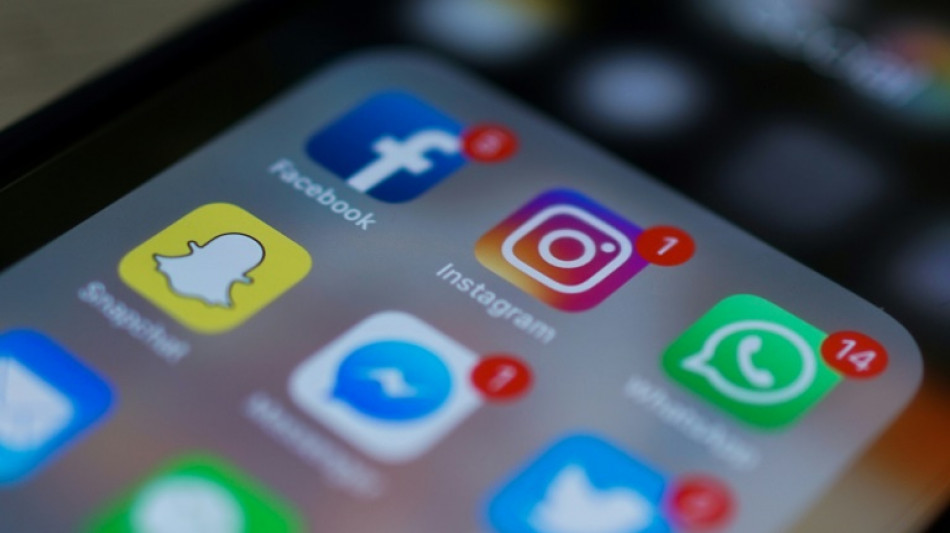
EU rules policing digital content kick in Saturday / Photo: CHANDAN KHANNA - AFP/File

 The "Everlasting Battery" Inside Your Joints:UConn Professor's Self-Powered Healing Material just Got Acquired
 Visionary or conman? Elon Musk enigmatic star of Venice documentary

 Trial opens in France over deadliest Channel migrant crossing disaster

 England skipper Root says it's wrong to accuse Pakistan of lacking fight

 Owen Wilson leaves tough action work to Alan Ritchson in 'Runner'

 France's BIC sees high potential in US pot smokers

 WHO says needs 5,000 more healthworkers to tackle Ebola in DRC

 Napoli's McTominay has successful heart procedure

 Two Renoir paintings missing after break-in at France museum

 Oil prices jump, stocks drop as Mideast war flares

 South Lebanon town buries its dead after Israeli strike

 Singapore to bump cabinet wages, already world's highest

 Saudi vows response as Houthis hit oil sites in worst attack in years

 Thieves steal Renoir paintings from France museum

 Nicaragua accuses Germany of multiple violations of law in Gaza genocide case

 Dutch peanut butter artwork proves a sticky attraction

 Forex Expo Dubai to Take Place as Scheduled on 22–23 September 2026

 Russia pounds Kyiv, ending three-day halt for US talks

 Flights resume gradually in Indonesia after volcanic eruption

 French AI firm Mistral valued at 21 bn euros after latest funding
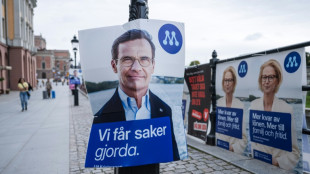 Sweden heads to the polls in close election race

 Australia's Big Bash T20 teams face sale to private investors

 Russia resumes strikes on Kyiv after three-day halt

 Canada's counter-tariffs take effect on various US goods

 China's trade booms as focus turns to expected Trump-Xi summit

Digital companies will have nowhere to hide after the EU's landmark content law enters into full force from Saturday, with the risk of heavy fines for any violations.
The new rules, known as the Digital Services Act (DSA), kicked in last year for the world's largest platforms, including Facebook and TikTok, but will now apply to all except the smallest companies.
When the European Union proposed the law in 2020, the objective was simple: to tame the wild west online, where Brussels felt companies were not doing enough to block illegal content or acting sufficiently to protect consumers.
Brussels has already bared its teeth, showing the tech titans that it means business.
There have been a wave of probes launched by the European Commission to quiz the largest platforms on how they are addressing an array of concerns from consumer protection to children's activity online.
So far, the EU has launched formal infringement proceedings against tech billionaire Elon Musk's X, formerly Twitter, over "illegal content and disinformation".
Punishment for violations of the DSA will be harsh.
Those that breach the rules could be fined up to six percent of their global annual turnover, or even banned in the EU for serious and repeated violations.
The EU will officially be able to hit companies with sanctions, including fines, for any violations from Saturday.
But beyond the prospect of fines, Alexandre de Streel of the think tank Centre on Regulation in Europe (CERRE), said the law aimed ultimately to change the culture of digital firms.
"The DSA is a gradual system, everything is not going to change in one minute and not on February 17," he said. "The goal isn't to impose fines, it's that platforms change their practices."
- Enforcement across the bloc -
Keeping an eye on firms will be a duty split between the commission, with its team of more than 120 experts, and EU states.
As an example of their new obligations, platforms that offer shopping services must act swiftly to stop the sale of counterfeit products and block repeat fraudsters.
The EU also prohibits targeted advertising for children and seeks to make it easier for users to report illegal content, complain and seek compensation for rule breaches.
The commission will supervise the largest platforms but states will need to set up "digital services coordinators" to monitor the smaller firms.
Firms with fewer than 50 staff and a turnover of less than 10 million euros ($10.8 million) will be exempted from the most burdensome rules.
- Challenges -
The law entered into force in August for "very large" platforms owned by Google's Alphabet, Amazon, Apple, TikTok parent ByteDance, Facebook owner Meta and Microsoft.
The EU believes these platforms must do more since their size and reach means they have greater responsibilities to address the higher risks to users.
The 22 platforms facing more stringent rules include booking.com, Google Search, Instagram, Snapchat and X as well as three major porn platforms.
They are obliged to be more transparent, giving access to researchers to scrutinise the platforms as well as publishing yearly risk assessments at their own cost.
The new law has already seen its share of controversy.
The DSA has faced a slew of legal challenges from Amazon and Zalando over their designations as "very large" firms, and from Meta and TikTok over a fee to pay for enforcement.
Meta paid around 11 million euros while TikTok refused to say how much it paid.
A.Taylor--AT