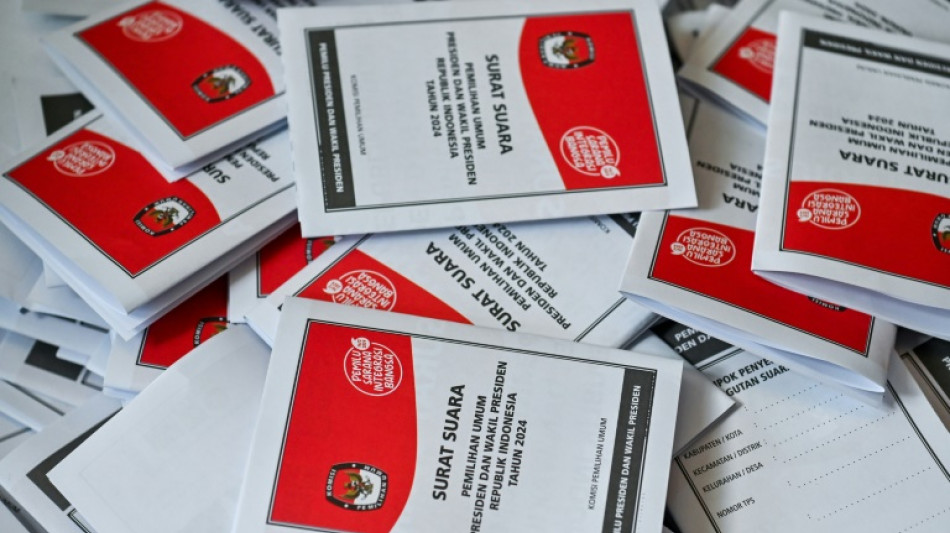
Vote-buying shadows Indonesian election / Photo: Chaideer MAHYUDDIN - AFP

 The "Everlasting Battery" Inside Your Joints:UConn Professor's Self-Powered Healing Material just Got Acquired

 Visionary or conman? Elon Musk enigmatic star of Venice documentary

 Trial opens in France over deadliest Channel migrant crossing disaster

 England skipper Root says it's wrong to accuse Pakistan of lacking fight

 Owen Wilson leaves tough action work to Alan Ritchson in 'Runner'

 France's BIC sees high potential in US pot smokers

 WHO says needs 5,000 more healthworkers to tackle Ebola in DRC
 Napoli's McTominay has successful heart procedure

 Two Renoir paintings missing after break-in at France museum
 Oil prices jump, stocks drop as Mideast war flares

 South Lebanon town buries its dead after Israeli strike

 Singapore to bump cabinet wages, already world's highest

 Saudi vows response as Houthis hit oil sites in worst attack in years
 Thieves steal Renoir paintings from France museum

 Nicaragua accuses Germany of multiple violations of law in Gaza genocide case

 Dutch peanut butter artwork proves a sticky attraction

 Forex Expo Dubai to Take Place as Scheduled on 22–23 September 2026

 Russia pounds Kyiv, ending three-day halt for US talks

 Flights resume gradually in Indonesia after volcanic eruption
 French AI firm Mistral valued at 21 bn euros after latest funding

 Sweden heads to the polls in close election race

 Australia's Big Bash T20 teams face sale to private investors

 Russia resumes strikes on Kyiv after three-day halt

 Canada's counter-tariffs take effect on various US goods

 China's trade booms as focus turns to expected Trump-Xi summit

When Indonesian housewife Suharti was returning home from a shopping trip, a gathering of political party workers handed her 100,000 rupiah ($6.3) and a T-shirt -- and asked her to vote for their candidate next week.
"They told me to vote for this certain candidate but I still don't know who I'm going to vote for," the 53-year-old told AFP.
"Once I'm inside the voting booth, I'll vote according to what my heart tells me to."
Voters, candidates and campaign volunteers have told AFP they saw free goodies and envelopes stuffed with cash being handed out ahead of the February 14 presidential, parliamentary and regional polls.
About 205 million Indonesians are registered to vote in the world's third-biggest democracy, and the country's election monitoring body, Bawaslu, has urged people to report any vote-buying.
But corruption remains a problem, and Transparency International in its 2023 report said the country's anti-graft commission had been "severely disempowered".
Parliament is widely viewed as one of Indonesia's most graft-hit institutions, and the Indonesia Corruption Watch (ICW) monitor says at least 56 candidates previously convicted of graft are running for seats in this year's legislative vote.
- Hundreds of envelopes -
One man who only gave his name as Andri told AFP he had been asked by several candidates running for a seat in parliament for help distributing money and groceries to lure voters.
He said he had been approached because of his role in a Jakarta football fan club.
He accepted the task.
"I usually started (distributing money) to people closest to me first, and then to people in my neighbourhood," the 37-year-old said.
"I distributed hundreds or even thousands of envelopes, depending on how much the candidates gave me."
Despite warnings from official bodies that bribes are illegal, the practice persists.
"It still happens because our regulations provide loopholes and law enforcement is not comprehensive enough," ICW researcher Seira Tamara told AFP.
Election frontrunner Prabowo Subianto has openly addressed the issue, urging people to take gifts but vote for their favourite candidate.
"If somebody promises you money, just accept it, that's your money, the people's money. But please vote according to your heart," he recently told supporters.
Violations start at the recruitment stage where candidates must spend to earn their candidacy, said Tamara.
One woman who ran for a seat in parliament in 2019 told AFP on condition of anonymity she spent 250 million rupiah ($15,795) to buy votes, but still lost.
"Now I am changing my method, I visit houses door-to-door and promote myself and my programmes," she said.
- 'Not effective' -
Andri of the football fan club said that out of several candidates he helped in 2019, only one won and entered parliament.
"It is not effective in my opinion, definitely not a guarantee you will win," he said.
"You don't know who they are going to vote inside the polling booth."
Regardless, vote-buying and accepting cash both perpetuate corruption regardless of who wins, with advertising and bribery costs encouraging candidates to return favours once elected.
"This is a vicious cycle," Tamara said.
"The policies they make after... will not be for the public interest, but for the interest of their investors."
"As long as there are people willing to accept the money", vote-buying will persist, she said.
Ukon Furkon Sukanda, a 39-year-old legislative candidate, is optimistic younger voters will be harder to bribe.
"People who vote in exchange for money will slowly disappear and be replaced. It will become a contest of ideas," he said.
E.Hall--AT