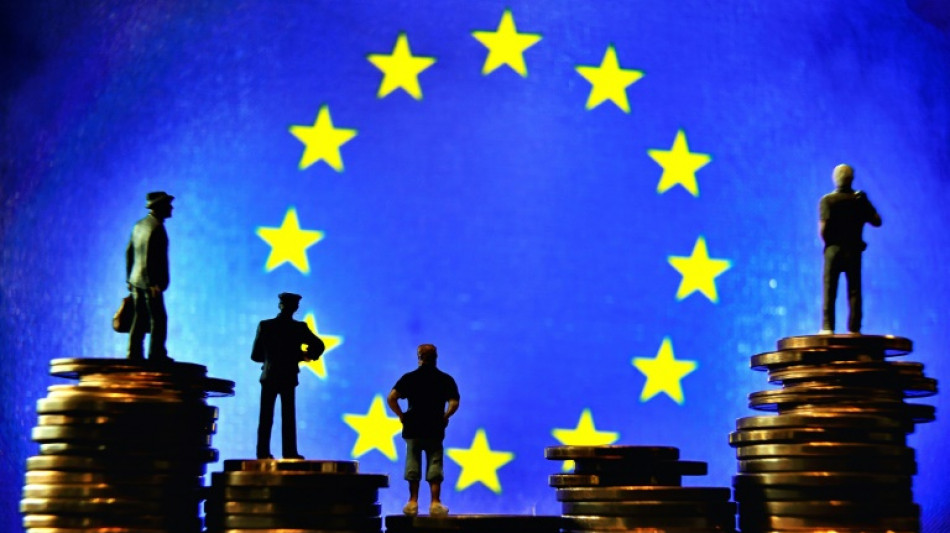
EU reaches agreement on spending rules / Photo: PHILIPPE HUGUEN - AFP/File

 The "Everlasting Battery" Inside Your Joints:UConn Professor's Self-Powered Healing Material just Got Acquired

 Visionary or conman? Elon Musk enigmatic star of Venice documentary

 Trial opens in France over deadliest Channel migrant crossing disaster

 England skipper Root says it's wrong to accuse Pakistan of lacking fight

 Owen Wilson leaves tough action work to Alan Ritchson in 'Runner'

 France's BIC sees high potential in US pot smokers

 WHO says needs 5,000 more healthworkers to tackle Ebola in DRC
 Napoli's McTominay has successful heart procedure

 Two Renoir paintings missing after break-in at France museum

 Oil prices jump, stocks drop as Mideast war flares

 South Lebanon town buries its dead after Israeli strike

 Singapore to bump cabinet wages, already world's highest

 Saudi vows response as Houthis hit oil sites in worst attack in years
 Thieves steal Renoir paintings from France museum

 Nicaragua accuses Germany of multiple violations of law in Gaza genocide case

 Dutch peanut butter artwork proves a sticky attraction

 Forex Expo Dubai to Take Place as Scheduled on 22–23 September 2026

 Russia pounds Kyiv, ending three-day halt for US talks

 Flights resume gradually in Indonesia after volcanic eruption

 French AI firm Mistral valued at 21 bn euros after latest funding
 Sweden heads to the polls in close election race

 Australia's Big Bash T20 teams face sale to private investors

 Russia resumes strikes on Kyiv after three-day halt

 Canada's counter-tariffs take effect on various US goods

 China's trade booms as focus turns to expected Trump-Xi summit

The European Parliament and member states reached an agreement early Saturday on reforms to EU budgetary rules aimed at boosting investment while keeping spending under control.
The text modernises the current rules, known as the Stability and Growth Pact, created in the late 1990s, which limit countries' debt to 60 percent of gross domestic product and public deficits to three percent.
"Deal!," the Belgian Presidency of the Council of the EU said on social media platform X after 16 hours of talks.
The European Union spent two years making an intensive effort to develop reforms supported by the more frugal member states like Germany and other countries, such as France and Italy, which seek more flexibility.
After much wrangling between Berlin and Paris, the 27 member states struck a deal in December, then began talks with negotiators from the European Parliament.
The text was criticised for its great complexity and derided by left-wing officials as a tool for imposing austerity on Europe.
The negotiators finally reached an agreement early Saturday, in time for the text to be voted on in Strasbourg this spring before the parliamentary break ahead of European elections.
The reforms will be formally adopted after agreement between lawmakers and states.
The agreement will allow member states to apply the new rules to their 2025 budgets.
"The new rules will help achieve balanced & sustainable public finances, structural reforms, foster investments, growth & jobs creation in the EU," the Belgian presidency said.
- Wiggle room -
The former budgetary framework was considered too drastic and was never really respected.
The rules had, however, been suspended since the coronavirus pandemic to give member states wiggle room to spend more during a period of great economic upheaval.
During the initial debates between countries, the battle was fierce over how much those old limits should be relaxed to give more room for investment.
With war raging in Europe and the EU making a green transition push, states led by France argued for allowing more space to finance these key areas, including, for example, supplying critical arms to Ukraine.
While confirming the previous limits on debt and budget deficits, the new agreement allows more flexibility in the event of excessive deficits.
The text provides looser fiscal rules more adapted to the particular situation of each state, allowing big spenders a slower route back to frugality.
The tailor-made approach means each country presents their own adjustment trajectory to ensure their debt's sustainability, giving them more time if they undertake reforms and investments and allowing a less painful return to fiscal health.
Monitoring would focus on expenditure trends, an economic indicator considered more relevant than deficits, which can fluctuate depending on the level of growth.
But Germany and its "frugal" allies managed to tighten this budgetary framework by imposing a quantifiable minimum effort to reduce debt and deficits for all EU countries, despite the reluctance of France and Italy.
These modifications have greatly complicated the text.
"We have a deal! A new economic governance framework was much needed," Dutch MEP Esther de Lange said on X.
"We have ensured that the new fiscal rules are sound and credible, while also allowing room for necessary investments," said de Lange, of the centre-right European People's Party Group.
The reforms are also supported by the EU's Renew liberals and a large majority of the Socialist and Democrat groupings.
The Greens and some S&D elected officials, however, reject it, as do the radical left.
These elected officials have denounced a return to austerity after three years of suspended budgetary rules due to the pandemic and war in Ukraine.
"We need investments in industry, in defence, in the ecological transition, that's the urgency today, it is not to bring economically absurd rules up to date," economist and S&D MEP Aurore Lalucq of France told AFP.
She denounced it as a "political error which will be used by populists to attack Europe".
N.Walker--AT